Industries Guide
How Low-Code No-Code Platforms Are Transforming Multi-Location Healthcare in India
This guide explains how low-code no-code platforms help Indian healthcare leaders standardise operations and improve compliance across multiple locations.
In this article 0 sections
A Smarter Way to Run Operations at Multi-Location Healthcare with Low-Code
If there’s something more complicated than running a healthcare organisation in India, it’s managing an organization with more than one clinic or hospital.
I’m talking particularly from an IT standpoint.
All sites are expected to run in fundamentally a similar way, but with every day, divergence appears in processes.
Consider data records.
You might find one branch using an old EMR system, another using paper files, and a third trying out a new cloud app.
Even the more complex IT blocks such as appointment scheduling, patient onboarding, billing, and inventory management are rarely the same everywhere.
This lack of standardisation causes day-to-day pain to everyone:
- Patients get a different experience at each location.
- Staff have to relearn forms and processes when they move between sites.
- Management cannot see live, consolidated data for admissions, revenue, or even compliance status.
- Regulatory compliance becomes much harder when each location runs on its own set of rules.
It isn’t just small multi-site clinics facing this.
Even large hospital chains in India report these same issues.
On the other hand, the government’s push for digital health and the Ayushman Bharat Digital Mission expect healthcare providers to raise their digital game and standardise operations.
It’s not easy, particularly when there’s another layer: talent shortage.
Most healthcare groups do not have big IT teams or the time and budget to build custom solutions from scratch.
This is where low code no code platforms are proving to be a real game-changer for healthcare in India.
What Low-Code No-Code Platforms Actually Do (and Why They Work)
So, what is a low code no code platform in healthcare? Why are so many Indian groups adopting them?
Simply put, these platforms let you build apps and workflows visually using drag-and-drop tools so you can create, standardise, and roll out digital processes across all locations fast.
The biggest difference between a low code no code platform for healthcare and a traditional CRM or ERP is that you don’t need to write code or hire large IT teams to get the best of these tools.
This means you can solve real problems on the ground, with the people who actually run operations.
Here’s what this looks like in practice:
With a low code no code platform, you can connect all your branches to a central electronic health record (EHR) system.
A patient’s records, test results, and history can be made instantly available at any location in your network.
This reduces repeated paperwork and duplicate testing.
Doctors at one site can see what was done at another, so the patient experience is consistent and efficient.
You can build and deploy workflows for patient onboarding, shift scheduling, and even insurance claims.
For example, every branch can follow the same five-step process for new patients, but you can also allow tweaks for local compliance (like state-specific forms).
One hospital group in India used this approach to cut nurse handover time from 90 minutes to 20, and they did it just by standardising digital workflows, which took less than a week.
With low code no code platforms for healthcare, you can bake compliance checks directly into each workflow. Every branch automatically uses the latest forms, and audit trails are recorded in real time.
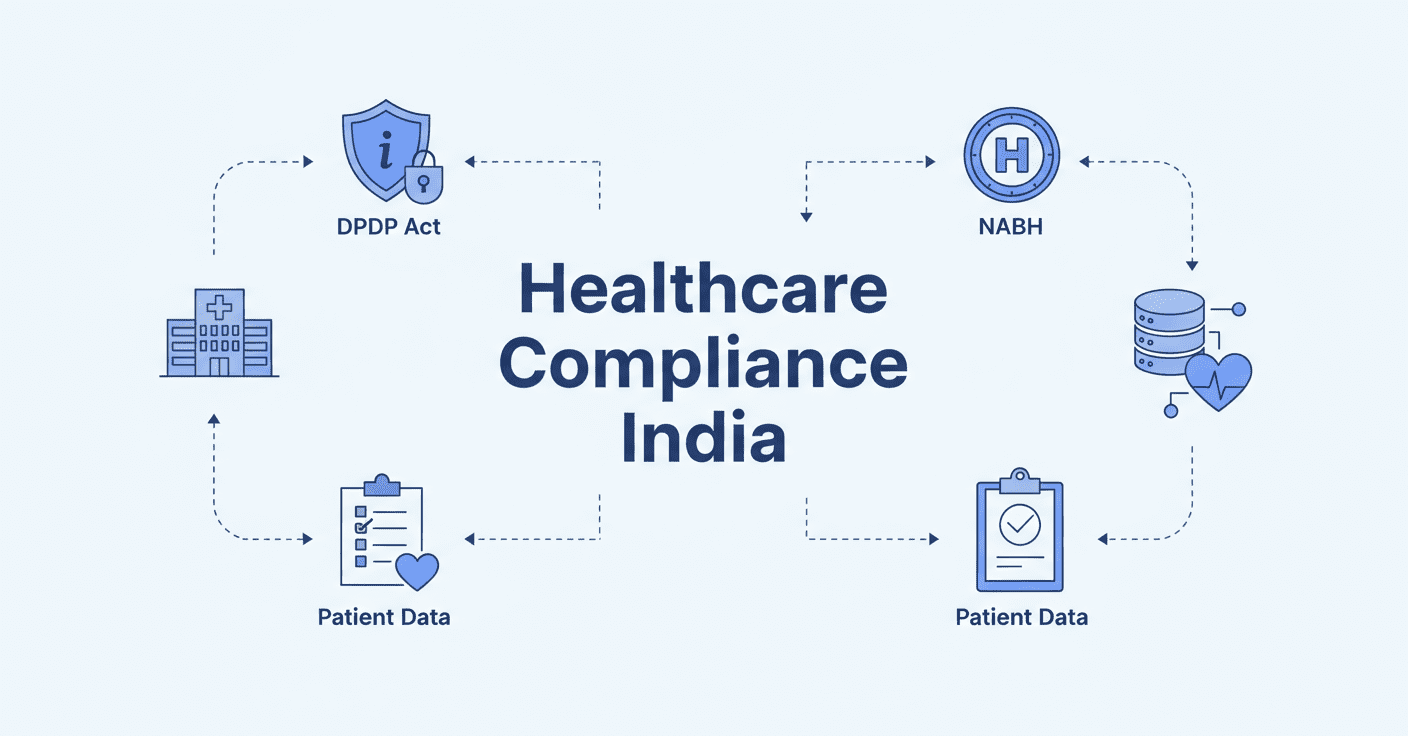
If NABH updates its guidelines, your central IT or admin team can update the template once, and the change rolls out everywhere at once.
A modern low code no code platform gives headquarters a single dashboard to monitor KPIs like bed occupancy, admissions, or compliance status, and that too across all locations, in real time.
This also means that your staff can share learnings and best practices across branches. In this way, collaboration becomes much easier.
All of this happens without months of software development or huge budgets.
You empower your team to fix operational bottlenecks, and you keep control and security at a central level.
This sets the foundation for true standardisation for Indian healthcare organisations.
Standardising with Low-Code No-Code: What Leaders Should Do First
If you want to bring real order to your healthcare network, we don’t claim that a low code no code platform for healthcare should be a big-bang IT project.
Also read: Amoga for healthcare
Instead, success comes to those who take practical, confident steps with their operations teams.
Here’s how I recommend most Indian healthcare leaders get started:
Pick two or three locations for your pilot.
Choose an area with obvious inefficiency (for most healthcare organizations it is things like appointment scheduling, patient onboarding, or compliance reporting).
Work closely with your staff on the ground to map the current process.
Then design a digital workflow together using the platform’s drag-and-drop tools.
Success depends on buy-in.
Bring in your clinicians, nurses, admin teams, even IT right from the start.
Let them help shape forms and workflows.
They’ll be the first to tell you what works in the real world and what doesn’t.
3.
Moving from paper or legacy systems is never plug-and-play.
So use the low code no code platform’s built-in data import tools to bring in old records and test that everything aligns. If your branches use different software, look for ready-made connectors or APIs. Validate data before going live, so you don’t start with errors.
Change is difficult, especially in a busy clinical environment.
So you should focus on short training sessions and create easy reference guides.
Make feedback easy, so staff can flag issues and suggest improvements as you roll out the new system.
Check that your platform supports single sign-on, strong encryption, and data residency if needed for your region.
For sites with poor internet, ask about offline or mobile-first features.
Always plan with compliance (NABH, data privacy) in mind.
Share quick wins with your teams. These could be anything from reduced wait times for patients to faster audits.
Keep improving the workflows based on feedback from different locations.
With this approach, you create a culture where digital standardisation becomes a natural part of operations.
How Amoga Helps Healthcare Leaders Take Control
At Amoga, we understand how complex it is to run healthcare across multiple locations in India.
Our low code no code platforms are built from the ground up to support healthcare organisations, no matter their size, geography, or digital maturity.
What sets Amoga apart?
We offer out-of-the-box templates for scheduling, patient intake, audit dashboards, compliance checks, and more. This means you can go live in days, not months.
You get a single cloud dashboard to manage all your locations. Update a process or workflow once, and it rolls out instantly across your network.
Amoga comes with SSO, multi-factor authentication, and AES-256 encryption as standard. We make it easy to comply with India’s privacy regulations and data residency requirements.
Whether you’re adding a new city or integrating with a local lab’s system, Amoga handles it.
Offline support and easy API integrations are available for branches with different needs.
Our dashboards consolidate KPIs from all your sites, so you always know what’s happening on the ground, right from bed occupancy to resource use.
If you’re ready to move from complexity to clarity in your healthcare operations, Amoga is here to help.
Let’s start with a conversation about your current situation, and show you how our customers are standardising healthcare across India.
See Amoga live-choose your demo time here.