Platform & governance Perspective
Evolution of Software Development: From Manual Coding to GenAI Low-Code No-Code Platforms
Explore how software development evolved from manual coding to low-code no-code with AI. Learn how GenAI low-code no-code platforms enable true citizen development.
In this article 0 sections
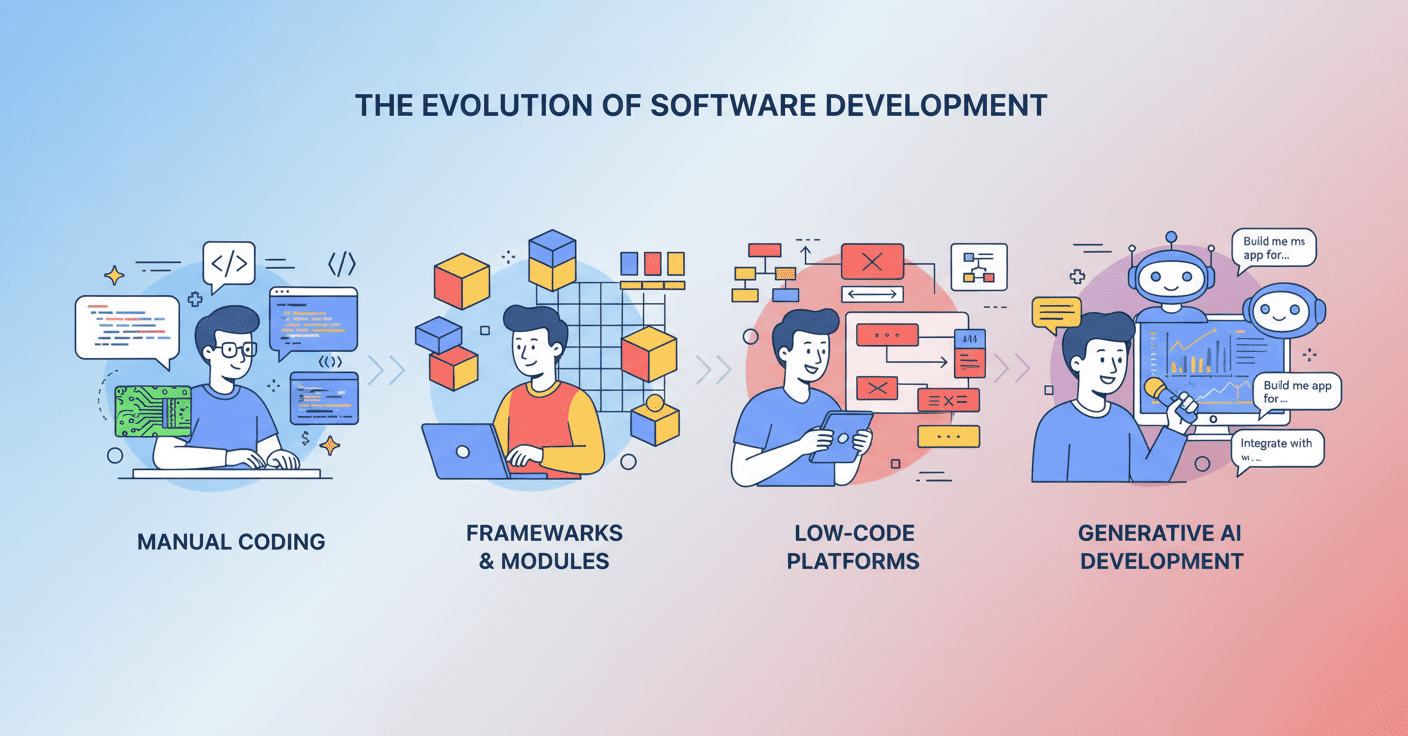
When you zoom out and look at the big picture, the evolution of software development is really the story of how we’ve tried, again and again, to make building technology simpler, faster, and more inclusive.
Every few years, we find a way to raise the “abstraction layer” in how we build.
That’s just one way of saying: we figure out how to hide more of the technical details, so that more people can create useful tools and apps.
- In the early days, software was built line-by-line, by the handful of people who could understand the syntax.
- Then came tools that let us think in modules and components, not just raw code.
- Now, we’re on the edge of something even bigger: tools that let us think in business logic, and even plain English, instead of code.
Why is it important to appreciate this sense of evolution in how code is written, or more importantly, how enterprise apps are built.
Because as businesses, we have to move fast, adapt, and involve more people in digital transformation. And if you’re a COO or CTO today, you know that moving from idea to working software is still the hardest part of digital innovation.
In this article, I’ll break down how we got here-and what’s next.
Let’s start at the very beginning.
Also read: The Intersection of Low-Code Development and Artificial Intelligence
The Traditional Way: Power, Flexibility… and Bottlenecks
When we talk about traditional software development, we’re really talking about manual coding, which was a system where software developers built every feature, integration, and screen from scratch.
Who could build software in that world? Only people with years of training in programming languages and frameworks, and people who knew how to juggle databases, APIs, server architecture, and deployment scripts.
This was hard work, but rewarding.
You could build anything you could imagine. You had ultimate control over every detail. But every new feature meant more code, more complexity, and more risk.
The downsides became clear as codebases grew:
- Projects would take months, often years.
- Maintenance and updates became nightmares.
- Even small changes could break other parts of the system.
- Teams started to “play safe,” working towards the goal of ‘not breaking things’ rather than moving fast.
There’s a stat that always sticks with me:
Low-quality codebases can have 15 times more defects than well-managed ones, and fixing them takes more than twice as long.
That’s a massive engineering problem and an even bigger business risk.
As requirements changed faster and teams struggled to keep up, something had to give.
Frameworks & Agile Improved Processes
To speed things up, we turned to frameworks and agile methodologies.
Frameworks gave us pre-built components, faster setup for common tasks, and some abstraction, but you still had to code and debug.
Agile brought new ways to organise work:
- Short sprints instead of year-long projects
- Frequent feedback and iteration
The ability to show stakeholders working prototypes in weeks, not months
These changes definitely improved delivery.
But they didn’t solve the root problem, that of too much manual coding, handled by too many humans.
Codebases still grew larger and more complex.
Collaboration challenges grew as teams scaled.
No matter how agile you were, you still needed armies of skilled developers to translate requirements into technical reality.
At the same time, as business needs changed constantly, even the most detailed requirement documents got outdated quickly.
That set the stage for the next leap: low-code no-code.
The Low-Code Shift: Thinking in Business Logic Instead of Syntax
The low-code no code movement was all about shifting how we build software. It was a move away from technical syntax and towards visual thinking.
Instead of writing hundreds of lines of code, you could:
- Drag and drop UI components
- Model workflows visually
- Use pre-built integrations
- Let the platform handle things like security and deployment
What did this mean for teams?
- You could build apps in days, not months
- Business users could finally participate in building tools, not just engineers
- Total cost of ownership dropped, with much less code to maintain, and fewer bugs to fix
- Teams could quickly prototype, iterate, and get feedback
This made low-code no-code a business breakthrough.
With low-code no-code platforms, I’ve seen companies go from idea to first release in a fraction of the time, with just a handful of people who understood the business..
This is what the industry started calling citizen development, a paradigm where operations teams, analysts, and even managers can solve their own workflow problems, safely and at speed.
But, as transformative as low-code no code was, it didn’t eliminate every friction point:
- Teams still needed to learn the platform and its logic
- Translating business ideas into structured workflows still took time
- As apps grew, governance and complexity management became necessary
- Manual modelling of requirements and iteration cycles remained
So, even after all this progress, there was still a gap between what users wanted and what platforms could deliver.
That gap is what set the stage for GenAI low-code no-code platforms.
GenAI + Low-Code: The New Abstraction Layer (Business Intent → Application)
Now, we’re seeing the biggest leap yet, that of GenAI low-code no-code platforms.
For the first time, you can go from “this is what my business needs” to “here’s a working app” with just a natural-language conversation.
Here’s how it works:
- A business team describes their process in plain English:
“We want content requests to flow from marketing, to writers, to designers, with approvals along the way and email notifications at each step.”
- The AI in software development understands, breaks it down, and starts generating:
-
- The full data model (what info to store, what’s linked to what)
- The UI screens (forms, lists, approvals)
- The workflows (who does what, when, and how notifications work)
- Even automation scripts and roles
You don’t need to waste hours in repetitive and stilted requirements meetings.
You don’t have to deal with lost-in-translation moments between users and IT.
This low-code no-code with AI model means:
- User feedback can be turned into changes within minutes
- The platform keeps structure and security intact so citizen development becomes truly safe
- Developers can now focus on higher-order logic and integration, instead of plumbing and boilerplate
I’ve seen teams go from a whiteboard idea to a working, testable MVP in less than an hour, with our Gen AI powered low-code no-code platform, Amoga.
This brings us to what all these changes actually mean for today’s enterprise.
What This Evolution Means for Modern Enterprises
For business leaders, this new era changes the math completely.
- Operations teams, analysts, even those with little tech background, can create safe, robust workflows, which frees up IT for true innovation and architecture.
- With citizen development becoming a reality, feedback loops shrink to hours, not weeks.
- Errors drop, because the platform (not the user) maintains core structure.
- GenAI low-code no-code platforms capture business logic as you explain it. The system turns intent into structured logic, so you aren’t buried in specs and PRDs.
- Because the platform manages data models, permissions, and automations, growing from a 5-user tool to a 5,000-user enterprise app doesn’t require a total rewrite.
- Teams focus on outcomes, not tickets. Experimentation becomes cheap and easy.
And that leads us to a simple but important conclusion.
Also read; Stop Adapting to AI Features, Start Adapting AI to Your Operations: The Low-Code Control Advantage
We Finally Reached the Abstraction Layer Software Needed
We started with code, moved to visual models, and now we’re at a place where GenAI low-code no-code platforms let us think in pure business intent.
That means:
- Faster builds
- Fewer bottlenecks
- More people empowered to create real value
So, it’s safe to say that the future of software development isn’t about writing code faster.
It’s about finally removing the need to write it at all.
Book your personalised demo now and see Amoga in action.