Platform & governance Perspective
AI Can Build Fast. But Can Your Business Run What It Builds?
AI builds enterprise apps in hours. Running them at scale needs governance, audit trails, and structure. See how a GenAI low-code platform closes the gap.
In this article 0 sections
Let me start with what's genuinely changed.
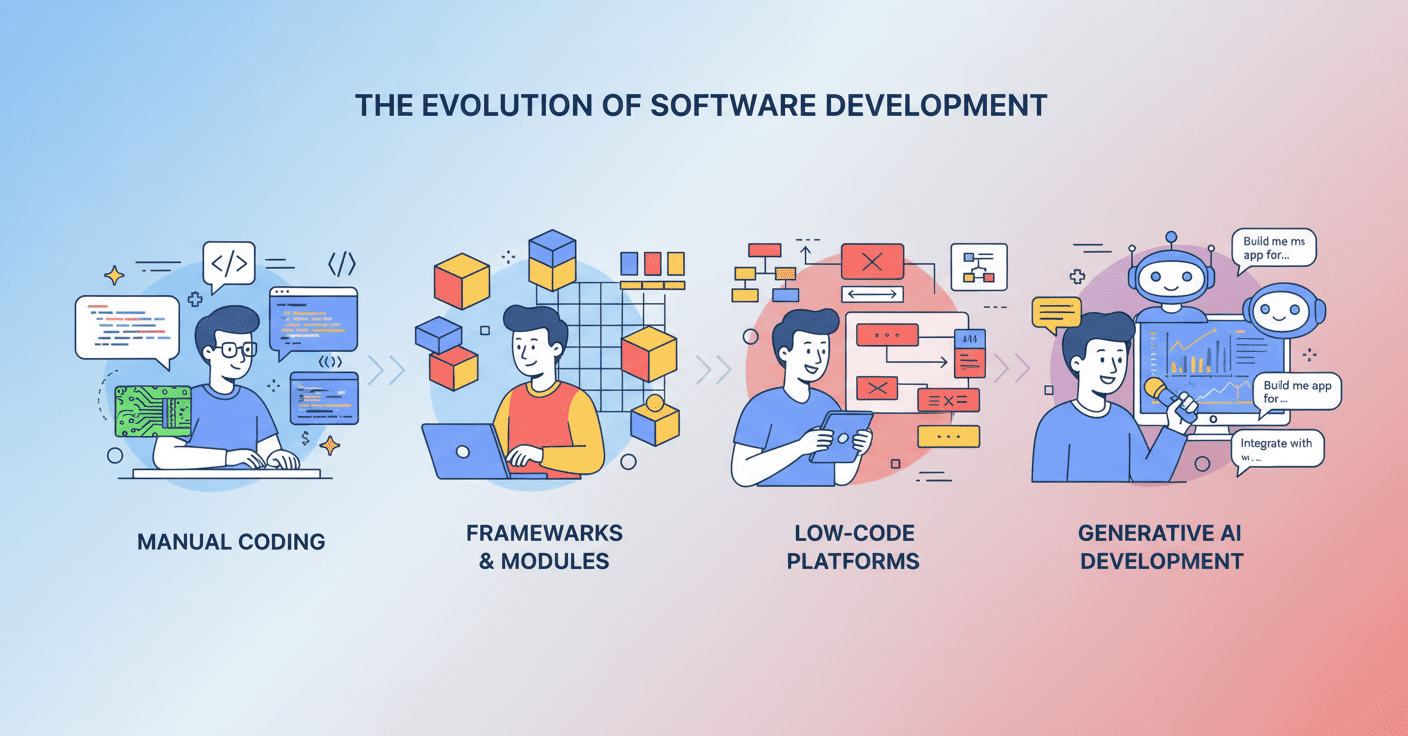
A GenAI low-code platform can compress what used to take 12-24 months of custom enterprise application development into days.
That's not an exaggeration. It's what the data says.
OpenAI's 2025 Enterprise Report found that 73% of engineers report faster code delivery with AI tools. Enterprises collectively invested $18 billion in AI infrastructure in 2025 alone.
What does this look like in practice?
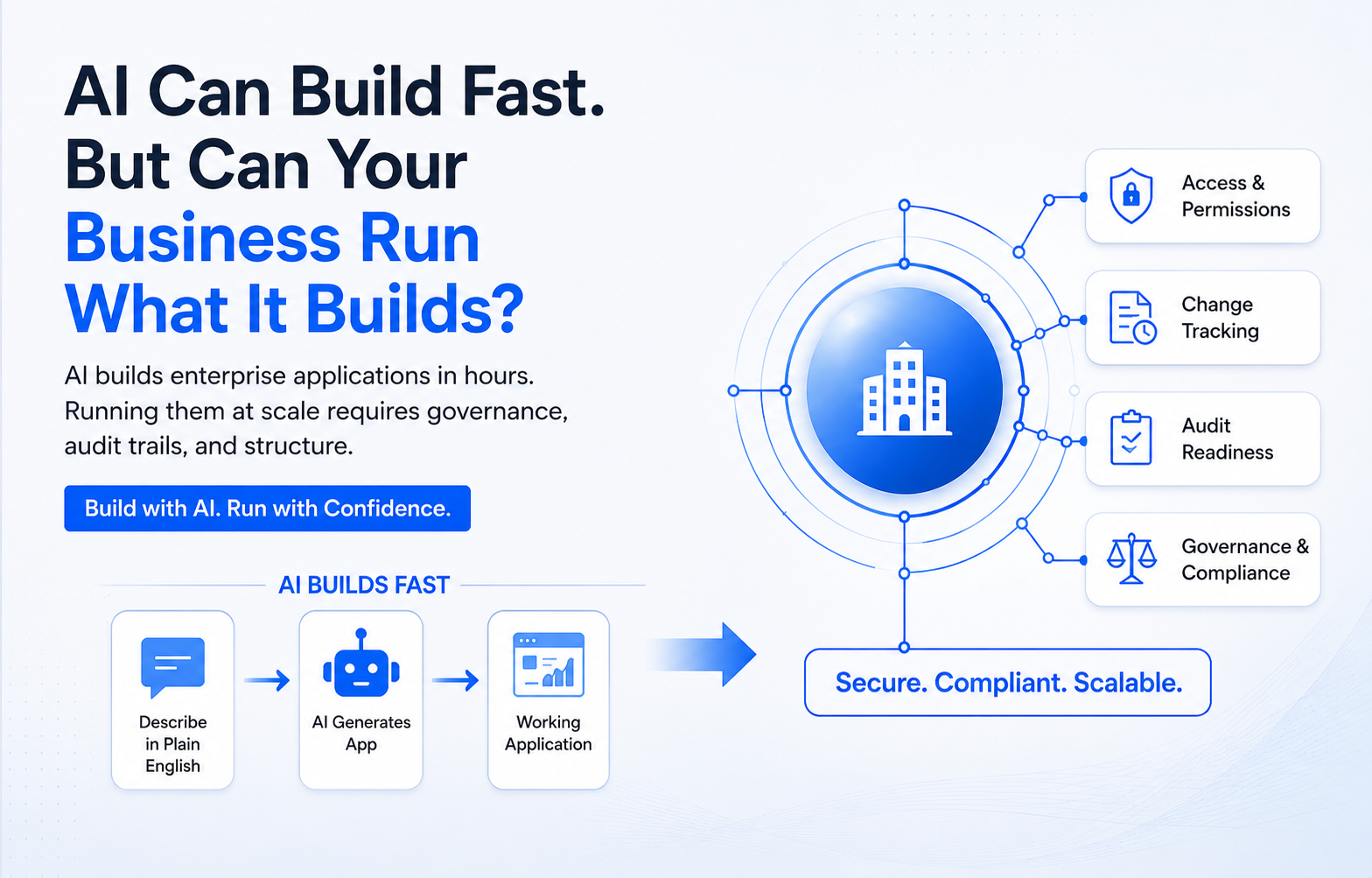
A business team describes a process, say, a procurement approval flow or an employee onboarding journey in plain English. AI generates the data model, the UI, the workflows, and the backend logic. Not a mockup. A working application.
For the first time in enterprise software, building the app is no longer the slow part.
But here's what changes when that app is actually live.
Also read: The Intersection of Low-Code Development and Artificial Intelligence
What Happens After an AI-Built App Goes Live
An internal app isn't a side project. The moment it goes live, it becomes something your business depends on every day.
Think about what a typical enterprise app actually touches:
- A procurement approval chain where three departments sign off before a PO is created.
- A loan origination flow with multi-level underwriting, document verification, and regulatory audit trails.
- An employee onboarding sequence that triggers IT provisioning, training assignments, buddy allocation, and manager check-ins.
These aren't simple forms. They're fully operational systems with real people, real data, and real compliance exposure.
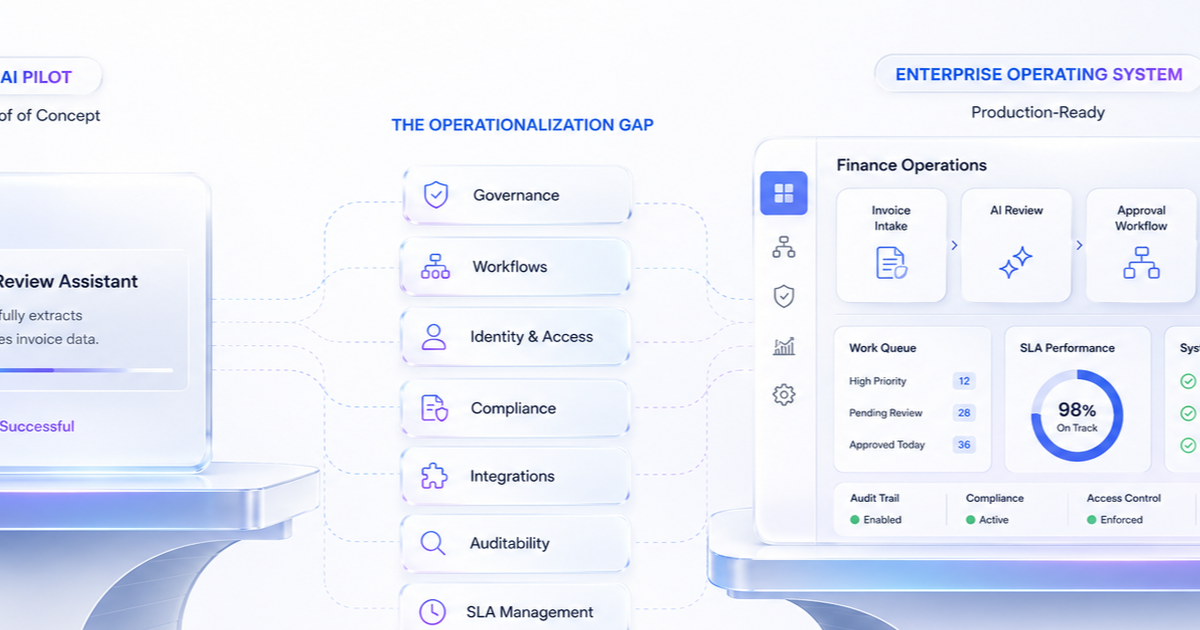
And this is where AI governance in enterprises has become a hard operational requirement.
The regulatory timeline makes this urgent, not theoretical.
The EU AI Act's high-risk system requirements take effect in August 2026, with penalties up to EUR 35 million or 7% of global turnover. Colorado's AI Act goes live the same year.
ISO 42001, the international standard for AI management systems, has moved from "interesting" to "required" in enterprise procurement conversations.
An app that's fast to build but impossible to audit isn't an asset for any enterprise. It's exposure.
So the question naturally becomes: what happens over time?
Also read: The Hype vs The Reality of AI Coding Tools
The Real Cost of Building Fast Without Structure
Building fast is valuable. But apps don't just launch; they have to live too.
Over six months, twelve months, two years, people join and leave a process. Business rules change. Compliance requirements evolve. The app that was perfect at launch starts drifting from reality.
This is where most AI-built tools fall apart.
Gartner predicts that over 40% of agentic AI projects will be canceled by the end of 2027, not because the AI didn't work, but because of escalating costs, unclear business value, or inadequate risk controls.
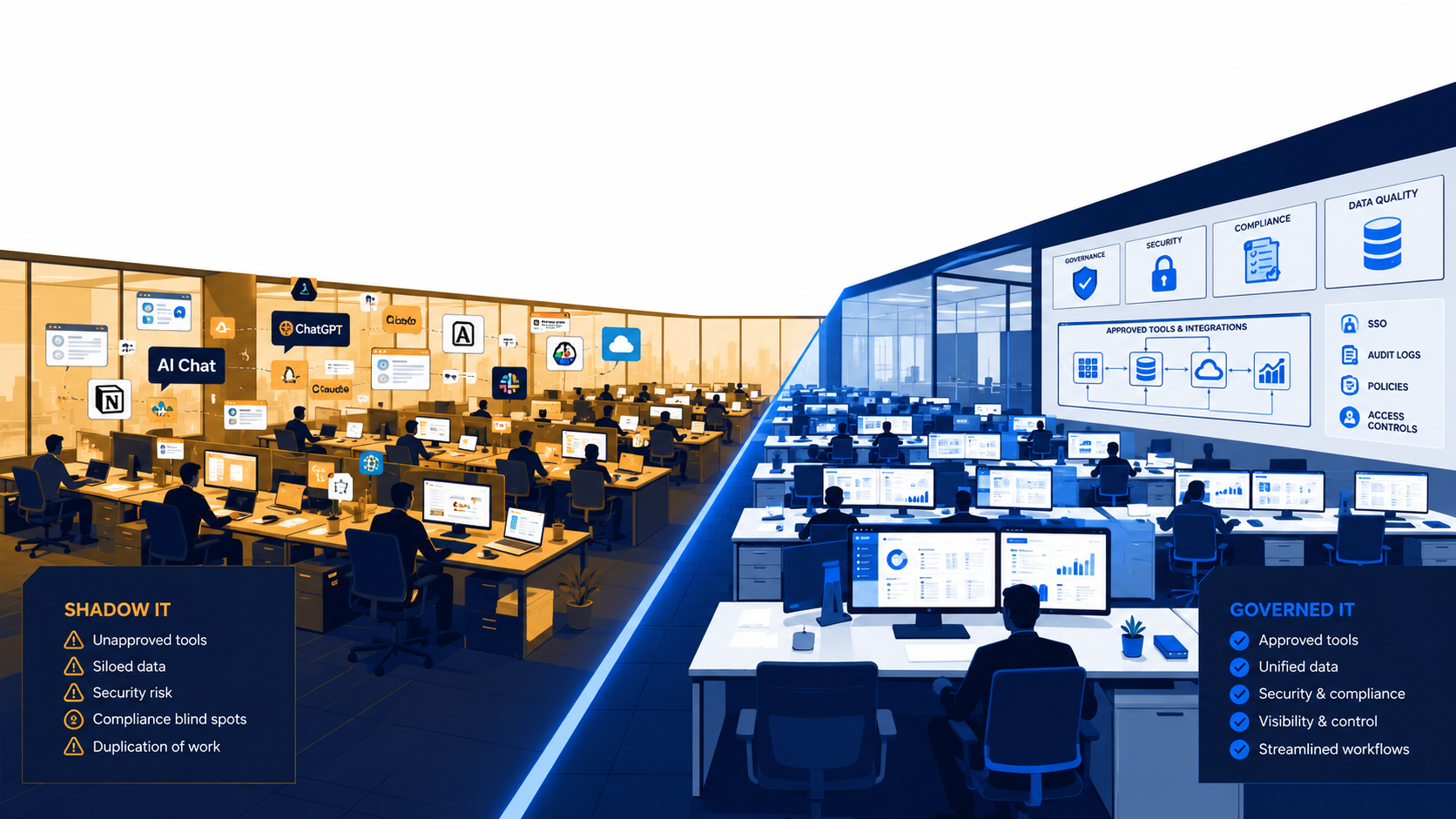
And the shadow AI problem makes this worse. When people build fast without structure, they build outside the system.
None of this means AI is the problem. It means ungoverned AI is the problem.
The value of an app isn't how fast it was built. It's how easy it is to run, change, and trust.
Also read: What Works Better for Enterprises: Low Code Platforms, or AI Coding Tools?
Three Questions Every Enterprise Leader Should Be Asking
For most of the last two years, the enterprise AI conversation has been: "Can AI build this?"
Yes. It can.
The question that matters now is different:
Can the business operate what AI builds safely, clearly, and at scale?
Three sub-questions every technology leader should be pressure-testing:
- Access and permissions: Who can see what? Is that enforced structurally from day one, or patched in after someone raises a concern?
- Change tracking: When a workflow changes, can you trace what changed, when, and by whom? Or does it just change?
- Audit readiness: If you're reviewed in six months, can you produce the evidence trail on demand? Or does your team need two weeks to assemble documentation?
These aren't edge-case concerns. 83% of AI leaders now express major or extreme concern about generative AI, which is an eightfold increase in just two years, according to Lucidworks' 2025 AI Benchmark Study. And 44% of organizations say business units are deploying AI solutions without involving IT or security teams.
But here's the important thing.
Governance isn't the thing that slows AI down.
Deloitte's 2026 State of AI report found that enterprises where senior leadership actively shapes AI governance achieve significantly greater business value than those that delegate it to technical teams alone.
Structure is what lets AI app development scale across teams, departments, and compliance requirements.
For the operating model behind this, explore Amoga security and Amoga compliance.
Why GenAI Powered Low-Code No-Code Platforms Are the Answer
The market is already converging on an answer.
Gartner forecasts that by 2026, 75% of new applications will be built using low-code no-code technologies. The global low-code market will exceed $30 billion the same year. And Gartner expects these platforms to evolve into enterprise-wide ecosystems with unified governance, reusable templates, and cross-departmental collaboration.
But not all platforms are built the same.
Here's what typically falls short:
- First-gen low-code tools created hidden configuration debt.
- AI coding tools produce impressive demos, but the output lacks governance, security posture, and architectural coherence.
- Off-the-shelf SaaS forces your business process to conform to the software's constraints.
What enterprises need from a GenAI low-code no-code platform is fundamentally different.
That is where a GenAI low-code platform earns its place: it keeps speed connected to governance instead of treating governance as cleanup work after launch.
Workflows that are defined, not ad hoc. Roles and permissions built in from the start. Audit trails that exist by default. Changes that are trackable. And an architecture that evolves with the business without rewrite cycles.
Speed without structure gives you a prototype. Speed with structure gives you an operating system.
See the underlying product approach on the Amoga platform page and the build flow in How Amoga works.
This Is What We Built Amoga To Do
Amoga is a GenAI low-code no-code platform where you describe your business process in plain language and get a complete enterprise application: data models, UI pages, workflows, automations, roles, and permissions. Generated end-to-end.
The difference is what's built in from the first minute:
- IAM, SSO, MFA: Identity and access management is native, not an afterthought.
- Audit trails and SLA enforcement: Every action is logged, every change is tracked.
- Compliance layers: Governance is architectural, not a policy document someone wrote and filed away.
Our Zero Tech Debt Architecture means your applications evolve continuously with the platform. No rewrite cycles every five years. No migration sprints. No framework decay leaving your systems stranded.
And you deploy on your terms: cloud, private cloud, on-prem, or hybrid. With a no vendor lock-in guarantee, you own your data, your application definitions, your workflow logic, and your audit logs. Always.
Enterprises across BFSI, healthcare, manufacturing, and internet-scale platforms trust Amoga, from CreditAccess Grameen to Nova IVF to River Mobility, because the platform doesn't just build fast. It runs inside a real business.
AI has solved the speed of building.
The real work is making sure what you build can actually run at the pace, scale, and accountability your enterprise demands.
That's what a low-code no-code platform with AI should actually deliver.
With Amoga, you get that.