Applications & operations Comparison
The Hype vs The Reality of AI Coding Tools
Understand the AI coding tools hype vs reality, key risks, and how GenAI low-code no-code platforms solve enterprise app development challenges with hype reality.
In this article 0 sections
If you’ve spent time exploring the new generation of AI coding assistants, you probably found the first impression almost addictive.
You type a prompt, and within seconds, the AI generates full functions, UI components, data handlers; sometimes even entire screens.
When you see this, for a moment, it feels like the future has arrived.
And honestly, it , although in a restricted sense.
I call it restricted because there is a part many teams discover only after the initial excitement:
AI can generate code, but it cannot generate an application (or at least not an enterprise grade application).
The difference between those two is the same difference between a working demo and a system that survives production.
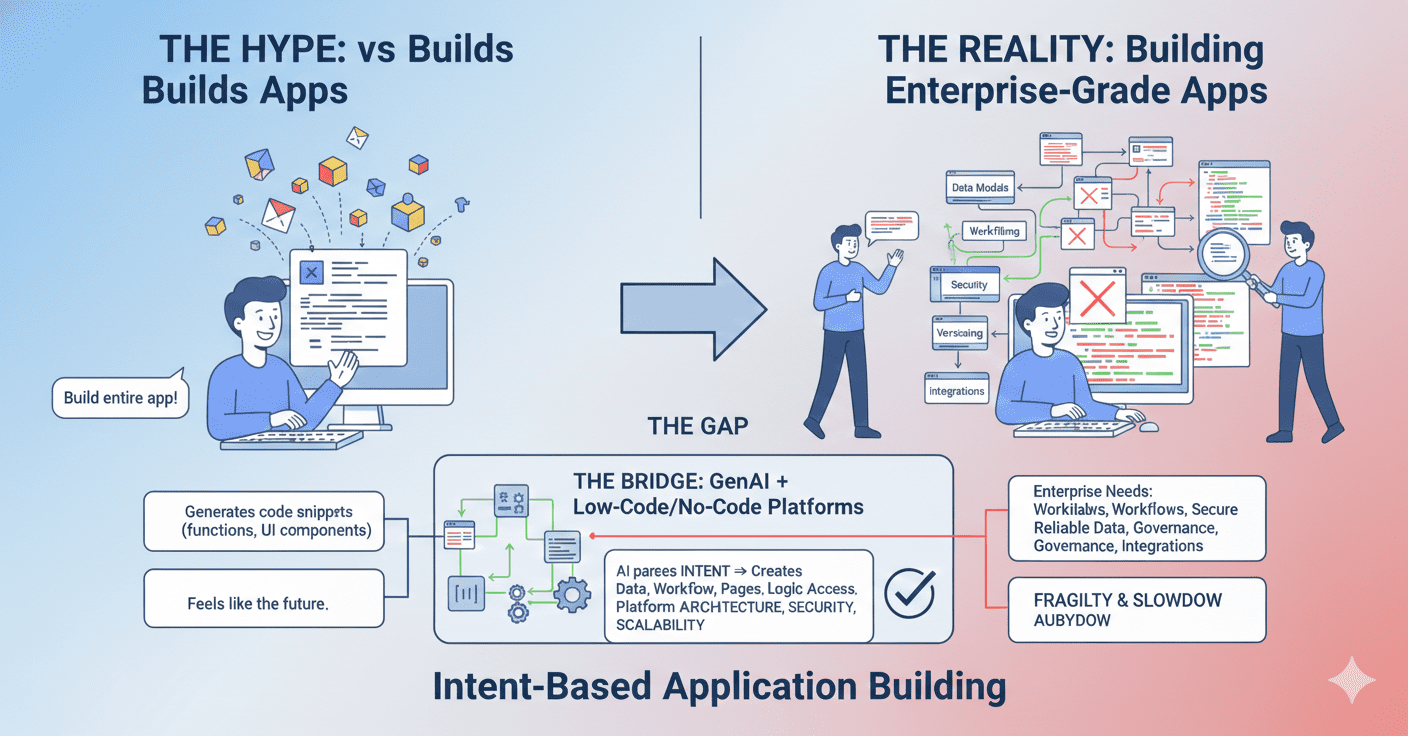
This is what I call the gap between the hype and the reality of AI coding tools.
The hype tells you that AI will “build apps in minutes.”
The reality is that enterprises don’t just need pages and APIs. They need:
- predictable business workflow
- secure role-based access
- reliable data models
- versioning and governance
- integrations that don’t collapse mid-iteration
Once we see the gap, the next question becomes obvious:
That brings us to the first underlying issue.
Also read: The Intersection of Low-Code Development and Artificial Intelligence
The Core Issue: AI Coding Tools Solve Only One Layer of Software Development
Let’s zoom out for a moment.
When we build enterprise systems, we’re not writing code for code’s sake.
We’re designing a living organism that’s a combination of:
- data contracts
- workflow transitions
- user permissions
- error conditions
- integration boundaries
- automation triggers
- compliance and audit requirements
AI tools don’t understand this organism.
They only understand patterns in text.
So when they generate code, they generate isolated components but they often miss one or multiple important aspect:
- architecture
- state management
- lifecycle rules
- dependency contracts
- workflow consistency
And without these, even the best code becomes fragile.
This is the core of AI-assisted coding risks: the code “works” in isolation, but collapses when connected to the rest of the system.
A recent industry-wide evaluation of AI-generated code found two repeating issues:
- Correctness variability - between 31% and 65% across tasks
- Security vulnerabilities - ranging from weak input sanitization to outdated libraries.
Those are structural risks.
And as we move forward, this limitation becomes even more visible when you look at how these tools behave during iterative development.
Why Iterations Break Everything: The Hidden Fragility of AI-Generated Code
If there’s one thing every CTO will agree with, it’s this:
80% of software development is iteration, not creation.
The problem is that AI coding tools shine in the first 20 minutes and then rapidly start working against you.
Here’s why:
1. AI Has No Real Memory of the System’s Past Decisions
When you ask for a new feature, AI doesn’t remember:
- why a particular data model looked the way it did
- which validations were intentional
- how different modules depended on each other
So it generates code that correct, but breaks earlier assumptions.
2. Version Control Becomes Chaotic
Developers see this every day:
- AI rewrites entire files instead of small patches
- merges become unmanageable
- diffs lose meaning because the AI changes formatting + logic simultaneously
- no one can tell which change is intentional
This is a direct blow to AI vs developer productivity, because instead of accelerating development, engineers spend more time reviewing, rewriting, reconciling, and debugging regressions.
The Mixed-Hand Problem
Once developers manually fix the AI’s inconsistencies, the AI loses context even further.
The next time you ask it to modify the same section, it may overwrite human fixes or regress the logic completely.
This is the heart of AI-assisted coding risks: AI cannot reason across iterations, and enterprise systems live or die by their ability to evolve safely.
When leaders talk about “speed,” what they actually mean is the ability to reduce the time between a business idea and a business result.
And that’s where the entire conversation starts to pivot, away from AI as a code generator and towards AI as a business enabler.
That is the next phase.
The Bridge: Why GenAI + Low-Code/No-Code Is the Actual Evolution
This is where the story gets interesting.
With GenAI low-code no-code platforms, the AI doesn’t just produce code snippets.
It works alongside a structured platform that already knows how enterprise software is supposed to be built.
Here’s the difference:
Traditional AI coding tools:
- Focus on outputting code, line by line
- Have no awareness of architecture or long-term state
- Are blind to user roles, workflow, and security
Low-code no-code with AI platforms, on the other hand:
- Start from a unified data and workflow engine
- Already enforce best practices for security, roles, and scalability
- Allow AI to operate at the level of intent, not just syntax
Let me make it concrete:
When you describe your process in plain English-
- “When a new employee joins, HR collects documents, IT sets up access, finance approves salary, and the manager gets a checklist” - the AI parses your intent and creates:
- the data objects
- the workflow steps
- the pages for each user
- the automation logic
- the audit trail
- the access controls
And because all of this is happening inside a low-code platform, the architecture is already sound.
AI is not just generating code.
It’s generating an application that can be edited, regenerated, or scaled as your needs evolve.
Every time you change your description, the platform updates all layers consistently.
No code rot, no version chaos, no lost context.
So, it’s with GenAI low-code no-code platforms that enterprises move from “faster coding” to “faster outcomes.”
The Future Is Intent-Based Application Building-Not Code Generation
The last few years have shown us what AI coding tools hype vs reality looks like.
We’ve seen the promise and the pitfalls of letting AI write code for us.
But the real breakthrough isn’t just getting code faster.
It’s getting business-ready applications, built on a platform that understands architecture, security, and the way enterprises truly operate.
GenAI low-code no-code platforms like Amoga are leading this shift.
They are turning conversations into real, scalable software, and freeing your best people to focus on what matters.
In the end, it’s not about typing faster.
It’s about making your business more responsive, more innovative, and more resilient.
That’s the future of enterprise software, and it’s closer than most people realize.
Pick a slot for a live walkthrough with our team.