Applications & operations Perspective
What Your Operations Could Look Like Very Soon With GenAI + Low-Code
GenAI low-code no-code platforms are reshaping sales, service, finance, and supply chain operations. See what's real, what's coming, and what it means for your team.
In this article 0 sections
18 months ago, the question on everyone’s lips was "should we try AI?" That question is settled. 87% of sales teams are already using it.
88% of contact centres have it in some form.
76% of supply chain officers expect AI agents to improve their process efficiency this year.
The new question is harder: "We know what AI can do. We just can't build the systems fast enough for it to actually work."
That's the real bottleneck: the infrastructure, the CRM, the workflows, the approval chains, the dashboards, the compliance layers. All of that still takes 12–18 months of custom development.
This is where GenAI low-code no-code platforms promise something that IT and operations leaders find hard to ignore.
Here's what that looks like across four operations domains, with real numbers.
Also read: The Intersection of Low-Code Development and Artificial Intelligence
Sales — Every Person on Your Team Becomes a Revenue Engine
Let's start with a number that should bother every sales leader: the average seller spends only 40% of their time actually selling. For newer reps, it's closer to 35%.
The rest goes to data entry, prospecting research, chasing approvals, updating CRMs.
One in three field sales teams still uses no AI at all. And among those that do, adoption is scattered.
But the early movers are seeing something different.
Salesforce's own team deployed AI agents to work leads that used to go untouched.
In four months: 130,000 leads contacted, 3,200 new opportunities created. They expect 10x that next year.
Meanwhile, teams using signal-based outreach are hitting 15–25% reply rates against a 3–5% industry average. Reps using AI agents are reclaiming 4–7 hours per week from research and list-building.
Now picture your 80-person sales team. Right now, maybe 40 of them are actively selling at any given time. The rest are doing operational work. What if you could flip that, with 70 of them selling, the system handling the rest?
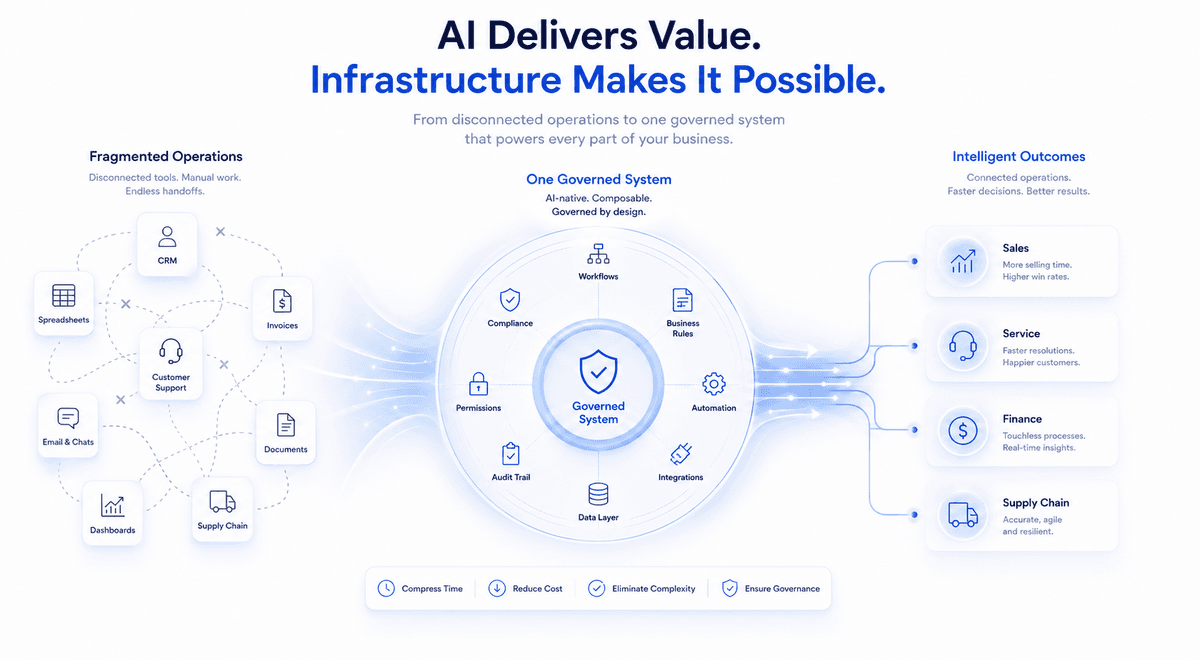
But this doesn't work with 10 disconnected tools. It works when you have one integrated system: pipeline management, lead scoring, approval workflows, mobile field access, reporting — all wired together.
That's the kind of system you can build in weeks with a low-code no-code with AI platform.
Also read: The Hype vs The Reality of AI Coding Tools
Service — From Ticket Queue to Resolution Machine
The same pattern shows up in service operations, just with different numbers.
88% of contact centres say they use AI. But only 25% have actually integrated it into daily workflows.
Most are stuck in pilot mode. Meanwhile, traditional self-service still only resolves 14% of customer issues.
The AI is there, but the system around it isn't.
Compare that with what's already working at scale:
- Klarna's AI cut average resolution time from 11 minutes to 2 minutes. Within a month, it handled two-thirds of all conversations, which is equivalent to 700 full-time agents.
- ServiceNow's AI agents handle 80% of support inquiries autonomously, reducing complex case resolution time by 52%.
- AI-native service platforms now resolve issues at $1–3 per contact, compared to $13.50 for agent-assisted interactions.
The maths is just too compelling to ignore. If AI handles 70–80% of routine tickets at a fraction of the cost, your service team can transform. Your people stop being ticket processors and start being relationship managers.
CSAT goes up because customers get instant answers on the easy stuff and skilled humans on the hard stuff.
But you can't just plug a chatbot into a broken process. You need case management, SLA tracking, escalation workflows, a customer portal, a knowledge base.
That surrounding system is what normally takes 6–12 months. With GenAI low-code no-code platforms, it takes weeks. Then the AI has somewhere to live and something useful to do.
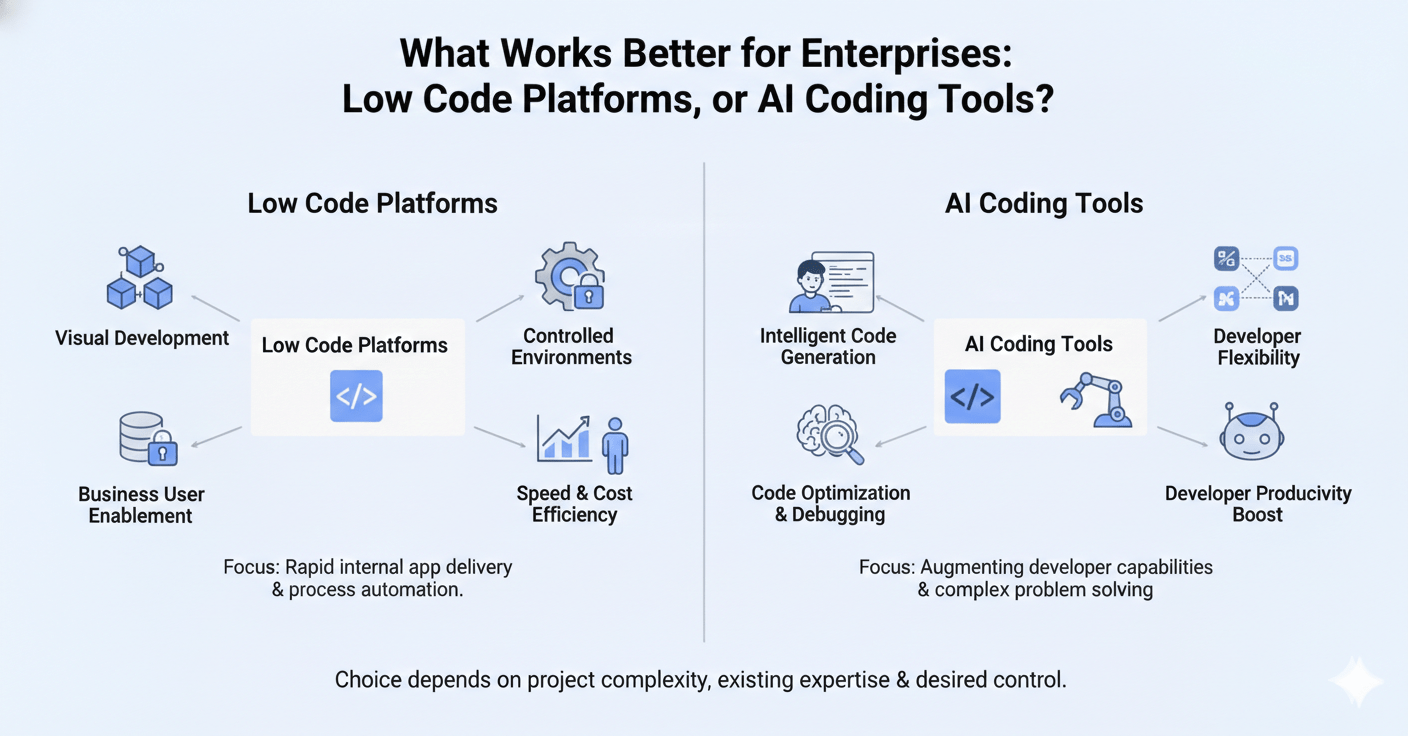
Also read: What Works Better for Enterprises: Low Code Platforms, or AI Coding Tools?
Financial Ops — From Transaction Processing to Strategic Finance
If sales and service are where AI gets the most attention, finance is where it might deliver the quietest and most significant impact.
Consider the baseline: finance teams spend over 520 hours a year on manual accounts payable tasks alone. Even with ERP-based automation, 70% of mid-market invoices are still processed by hand. Month-end close is a fire drill.
Now look at what's becoming possible.
AI-powered AP platforms now capture invoice data at 97–98% accuracy, suggest GL coding automatically, and run three-way matching in real time.
The leading edge is pushing toward fully touchless processing — the invoice arrives, gets validated, matched, approved, and paid without a human touching it unless something's off.
Deloitte research shows a 50% cost reduction on repetitive finance tasks, with 99.98% accuracy.
When document processing runs at 10x speed, you don't just save time. You create capacity for work you could never take on before:
- Real-time cash flow management instead of monthly reports.
- Continuous compliance monitoring instead of quarterly audits.
- Proactive vendor relationship management instead of reactive invoice chasing.
Your finance team goes from processing transactions to managing the business. The unlock is building systems like Invoice-to-Payment workflows or Audit & Compliance Trackers from a business requirement description, using a low-code no-code platform.
Supply Chain — From Document Chaos to End-to-End Visibility
Supply chain might be the domain with the most to gain and the most ground to cover.
A typical logistics company processes hundreds of thousands of documents daily. Bills of lading, customs forms, delivery notes, invoices are generated at every node. Businesses lose over $600 billion annually to data entry errors alone.
But the shift is underway. AI agents are now:
- Reading shipping documents and extracting structured data automatically.
- Managing dock appointments across email, portals, and phone.
- Processing claims, assembling evidence, and managing dispute resolution.
- Coordinating across carriers with real-time ETA adjustments.
Multi-agent systems are starting to orchestrate these tasks end-to-end. Some manufacturers have already used AI to cut customs clearance times significantly. Document AI platforms are achieving 99.5% extraction accuracy.
When every handoff is digital and every document is processed in seconds, you can do things you never could before. New suppliers in new geographies, real-time freight reconciliation, automated partner document exchange. The supply chain goes from opaque to transparent.
The backbone here is the same: Purchase Requisition systems, Vendor Onboarding portals, compliance trackers. Build them from requirements in weeks using an enterprise application platform powered by AI. The agents handle the documents; the system handles the governance.
The Real Question
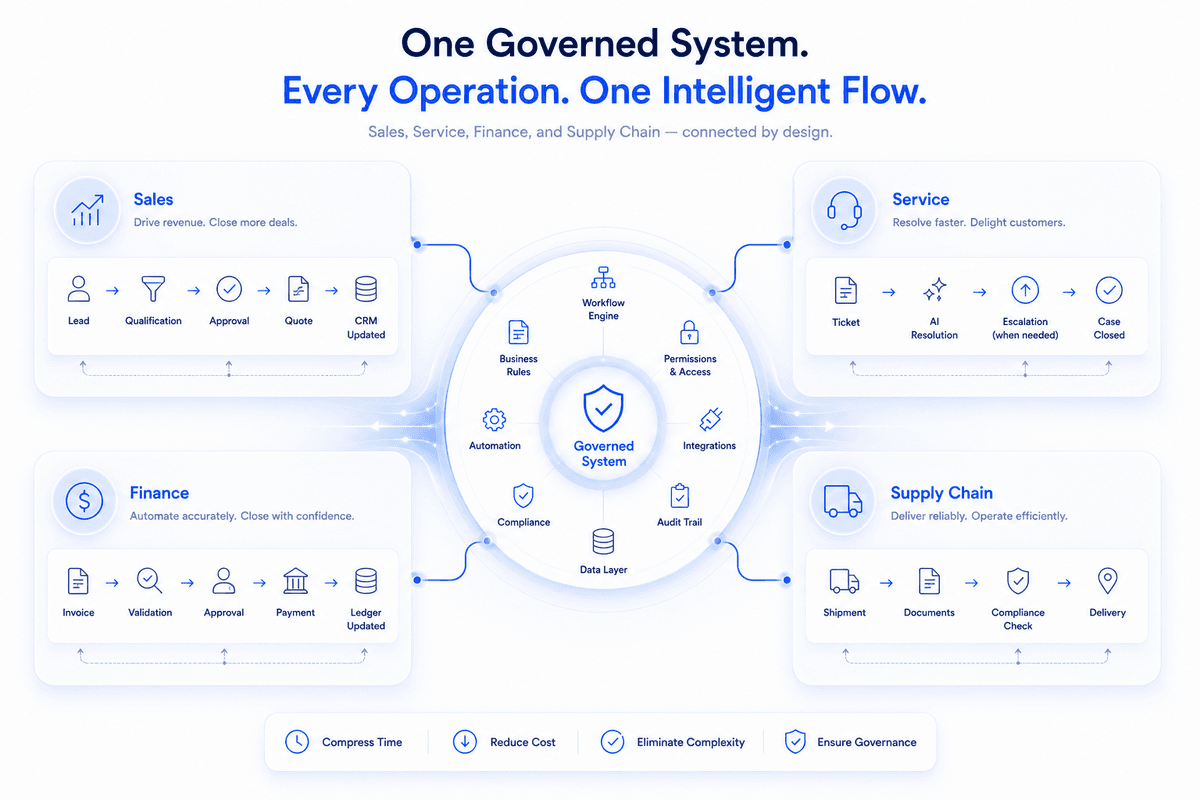
The pattern across all four domains is the same. The AI works when it has a governed, integrated system to operate inside. The bottleneck was never the intelligence. It was the infrastructure.
Low-code no-code with AI closes that gap. Not by replacing your engineering team, but by collapsing the 80% of system-building that's structural, so your engineers can focus on the 20% that's genuinely complex.
The question isn't whether AI will reshape your operations. It's whether you'll have the systems ready when it does.
That window is measured in months now, not years.
If you want to see what this looks like for your specific operations, reserve a 30-minute demo tailored to your workflows.