Applications & operations Playbook
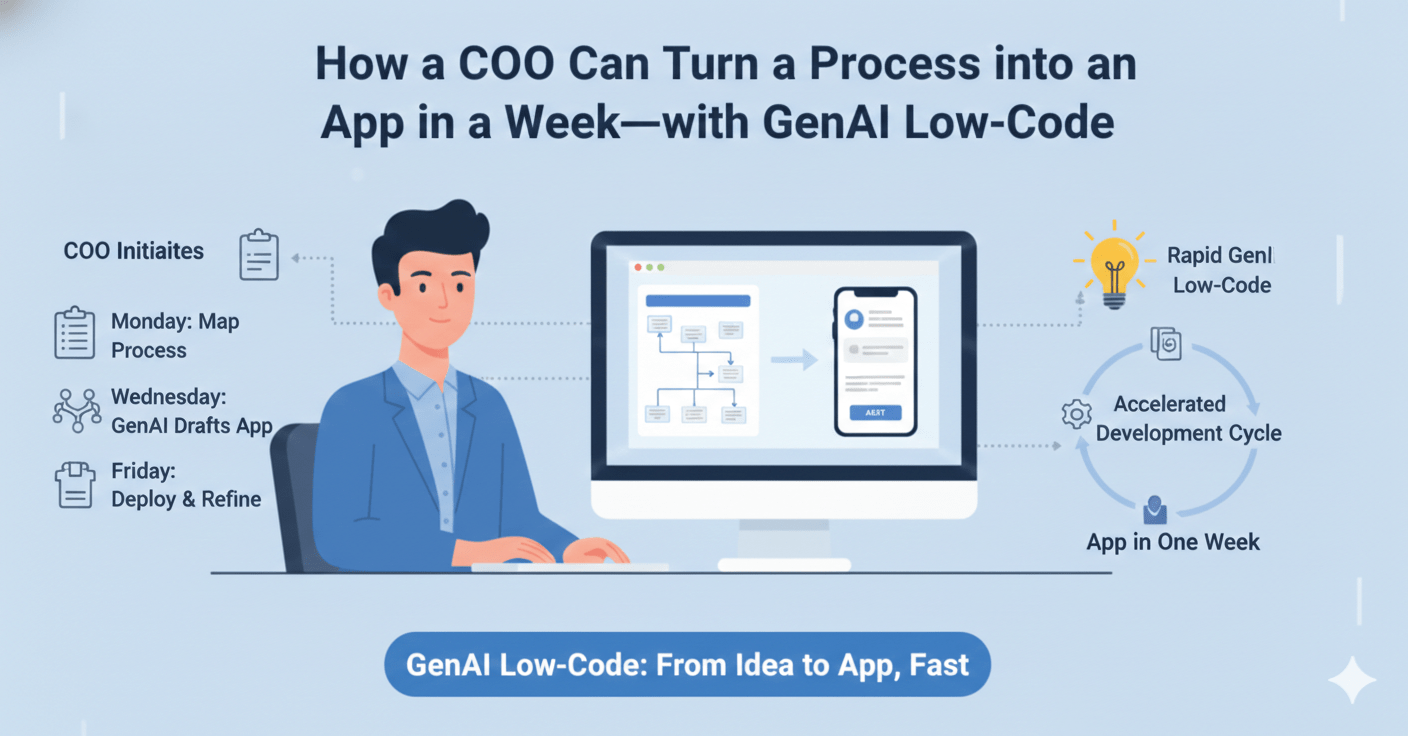
How a COO Can Turn a Process into an App in a Week, with GenAI Low-Code
Discover how GenAI low-code no-code platforms enable COOs to turn business processes into enterprise applications rapidly, reducing development time and boosting...
In this article 0 sections
Here’s a scene that every COO or CIO knows well.
Someone from operations or HR walks up and says, “If we make an app for this process,
everyone will find it easier to deliver updates, and we would be able to solve process errors. It shouldn’t take long.”
But if you’ve spent any time in enterprise IT, you know what happens next.
Suddenly, the IT team pushes back and says that there is no such thing as a “simple app”.
Soon, the need for a basic work app becomes the first link of a long chain of events:
- requirements documents
- handoffs between business and IT
- weeks spent clarifying specs
- coordination between devs, testers, ops
Most teams have simply accepted this “process tax” as the cost of doing business the traditional way.
But finally, that’s changing.
Today, thanks to GenAI powered low-code no-code platforms, you can actually go from an idea to a working app in less than a week.
In some cases, under an hour.
This may sound like a tall claim, so I’ll try to answer the two inherent questions raised by my assertion.
But how did software ever get so slow in the first place?
And why are we seeing this sudden leap where a COO should rightfully expect to ‘appify’ a business process within a week?
Also read: AI Features in Low-Code No-Code Sales CRM: Practical Guide for Indian Businesses
Why Was Software So Slow? The Unavoidable SDLC Roadblocks
Software development used to be a locked sequence where each stage needed to be finished before the next began.
Even the smallest application idea, the kind that a business user might sketch on a napkin, had to go through every step in this strict order.
Here’s how it actually unfolded, step by step:
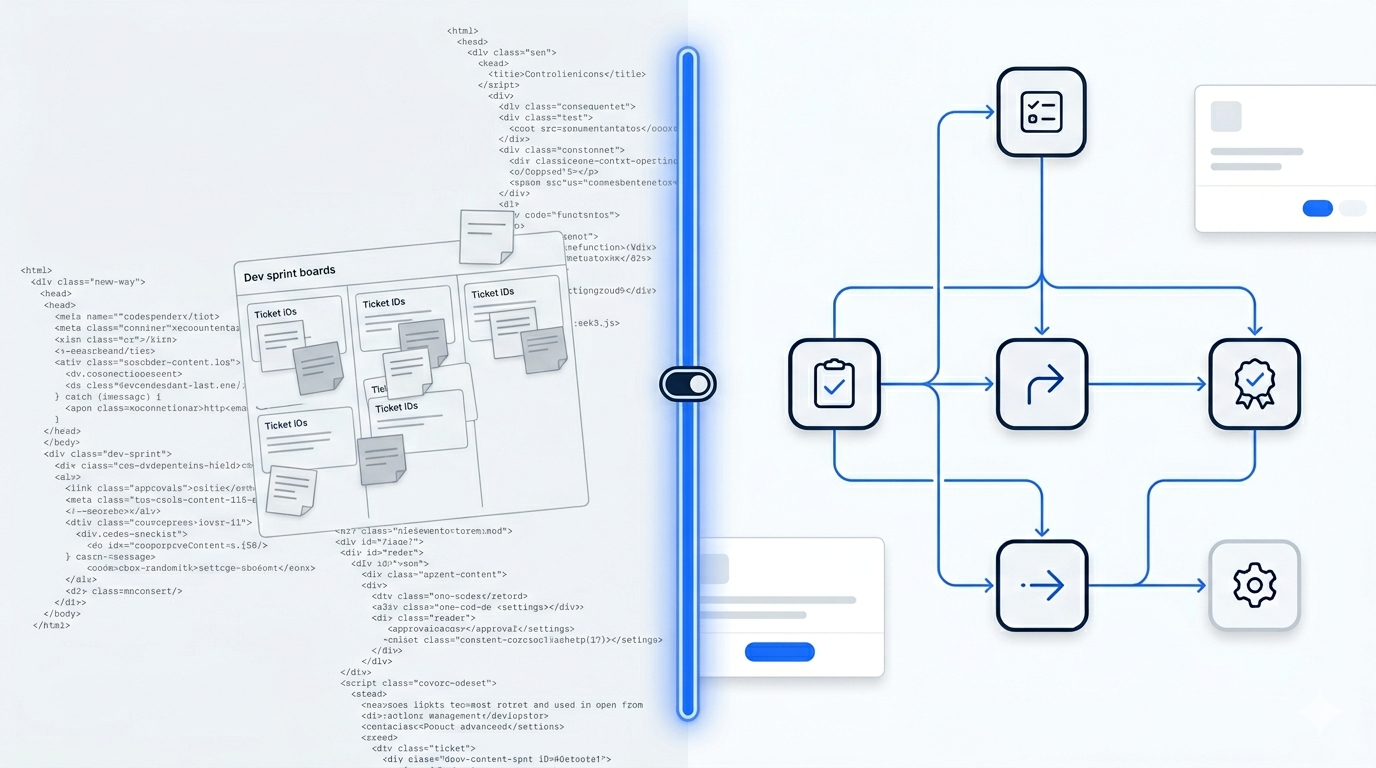
- First, you wrote long requirements documents or created JIRA tickets, and then spent weeks clarifying what was needed and why.
- Next came solution architecture: you mapped flows, designed integrations, and worried about security.
- Then, you modeled the data, defining databases and relationships, knowing that any late change could break everything downstream.
- Only after that could you get to the front-end where you would create wireframes, build screens in React or Angular, and also realize that every UI tweak risked breaking other layers.
- The backend logic came next where you would write every business rule, test edge cases, and hope for as few bugs as possible.
- Finally, you would hand everything over to QA and deployment. Testing would then take weeks. Approvals would tend to drag out.
It didn’t matter how urgent the business need was.
The process always controlled the pace.
But in a world where business processes have to change every week, an organization simply can’t keep up if IT is locked into quarterly release cycles.
This mismatch between how quickly the business wants to move, and how slowly technology actually allows it to move, is a major source of friction in modern enterprises.
The worst outcome of this friction is what we call the innovation gap.
When someone on the front line (maybe in logistics, sales, or customer support) finds a way to improve a process, the feedback takes weeks, or even months, to show up as a working change in your applications.
This is where so many MVPs (Minimum Viable Products) die:
- By the time development even starts on a new ticket, the business need has already changed or moved on.
- Frustrated, users look for shortcuts such as spreadsheets, WhatsApp groups, shadow IT, or third-party apps to fill the gap.
What’s left is a chasm:
- On one side: a real business need, urgent and clear.
- On the other: a working solution, somewhere down the line.
- In between: a huge gap of time, cost, and lost opportunity.
This is the innovation gap.
But the good news is that low-code no-code with AI is finally closing that gap.
Also read: The Intersection of Low-Code Development and Artificial Intelligence
The Breakthrough: GenAI Low-Code-Building at the Level of Intent
Let’s talk about what’s fundamentally changed because of GenAI low code no code platforms like Amoga.
With these platforms, you don’t have to translate your business needs into “tech-speak” or hope a developer interprets every nuance correctly.
Now, you can describe your process in the language you already use every day.
Say you tell the platform:
“When marketing creates a campaign brief,
it should go to creative for review,
then legal for approval,
and once it’s cleared,
publish the assets and update analytics.”
That’s it.
Here’s what happens next:
- The AI reads your instructions.
- It figures out the people involved, the sequence of steps, who needs to approve what, and what happens next.
- The work of several specialists gets done automatically, such as:
Mapping out the actors and their roles (which would need a business analyst)
Designing the workflow and how data moves (the architect’s job)
Building out the forms, pages, dashboards, and setting up the data model (what developers and database admins would spend weeks on)
Testing and packaging the whole thing so it actually works (the domain of QA and DevOps)
Instead of taking half a year, the platform turns your words into a living solution where:
- The complete solution design is mapped out
- Database objects and relationships are created behind the scenes
- User-ready forms, dashboards, and task screens are built instantly
- Workflows, notifications, and business logic (in Python or your stack) are generated
- Everything is connected and ready to test
Developers are still in the loop, but now, they focus on what really matters, such as edge cases, deep integrations, and fine-tuning, rather than rewriting boilerplate or translating business needs.
But the biggest shift is even more transformative:
- You can now regenerate, redeploy, and refine your app as quickly as your business learns
- No more waiting for quarterly releases or watching MVPs gather dust in a backlog
You build at the level of intent, not at the level of code.
The old “wait for IT” cycle is over.
Now, your business momentum drives your technology.
Are You Prepared For This New Standard of Enterprise Speed?
The shift isn’t just coming; we feel it's already here, and any team can adopt it right now.
With GenAI low-code no-code platforms, you don’t have to trade off between quality and speed any longer.
You can build and improve your enterprise tools at the actual pace of your business, not at the pace set by external vendors, overworked IT teams, or legacy systems.
A one-hour MVP isn’t some tech-world fantasy. We feel it should now be the new baseline.
So here’s my question for every COO and CIO reading this:
If your best ideas could become real, working software in days instead of quarters, what could your team accomplish this year?
Let’s not let old habits keep us from moving forward.
Let’s build at the speed of intent.
Get hands-on: request your on-demand demo.