Applications & operations Guide
What Works Better for Enterprises: Low Code Platforms, or AI Coding Tools?
Explore how GenAI low-code no-code platforms compare to AI coding tools for digital transformation in enterprises. Learn which option delivers speed, scale, and...
In this article 0 sections
Over the last few years, most enterprises have accepted the reality that software is no longer just an IT function. It is how work actually gets done.
As a result, digital transformation in enterprises has moved from long-term strategy to immediate necessity.
Recently, two approaches have gained attention for building such software faster:
- AI coding tools
- GenAI low-code no-code platforms
Both involve AI. Both claim speed.
But they solve very different problems.
To make a sound decision, leaders first need to clearly understand what each approach actually does, and what it does not do.
Let’s start with AI coding tools.
Also read: AI Features in Low-Code No-Code Sales CRM: Practical Guide for Indian Businesses
What Are AI Coding Tools, Really?
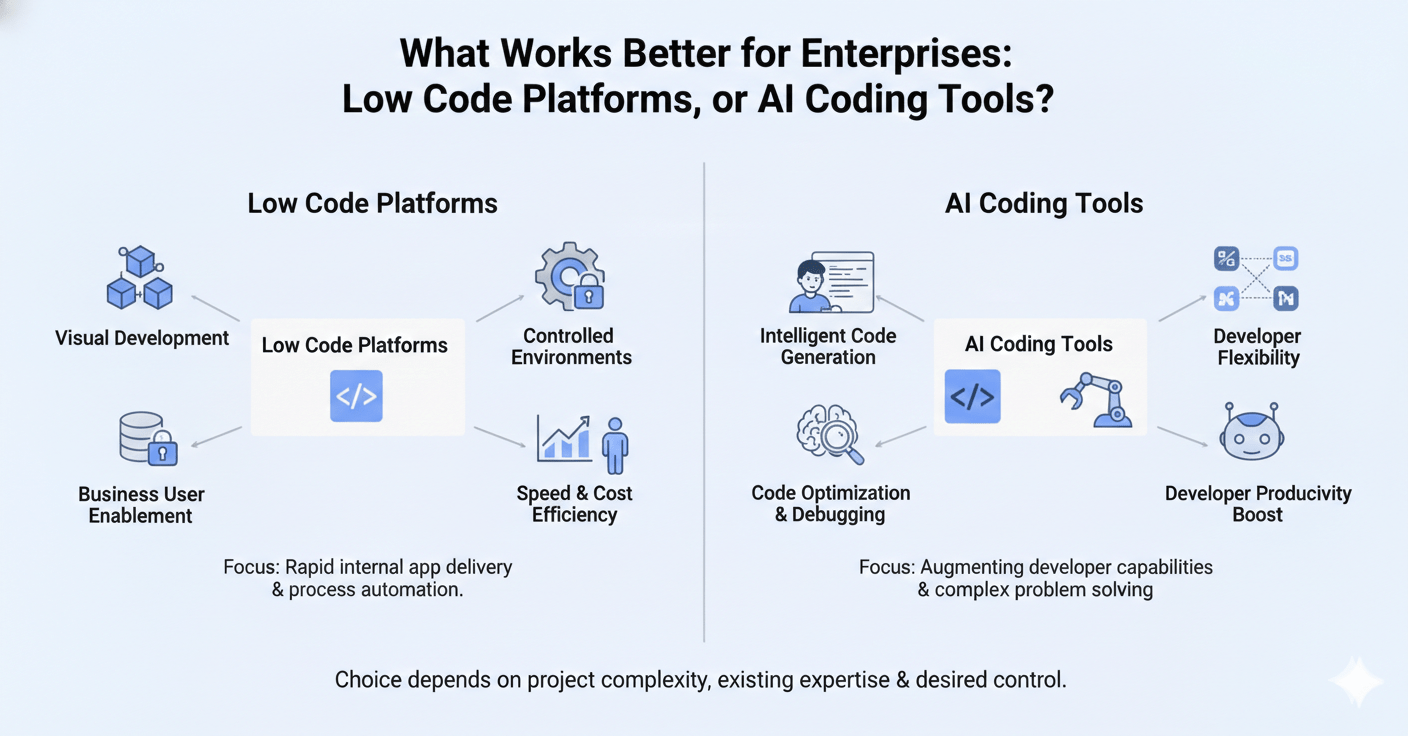
At a basic level, AI coding tools are designed to assist developers while they write code.
They do not build applications on their own.
They can generate pieces of code that developers then assemble, test, secure, and maintain.
In practice, these tools can:
- Suggest functions or logic while a developer types
- Generate boilerplate code from comments
- Help debug or refactor existing code
- Speed up repetitive programming tasks
Popular examples of such tools are GitHub Copilot, Amazon CodeWhisperer, Tabnine, and Replit Ghostwriter.
These tools are genuinely useful and almost every engineering team that I know to be using these tools has experienced meaningful productivity gains.
However, it is important to be clear here that these tools are meant to be sidekicks for:
- Software developers
- Engineers who understand programming languages, frameworks, and architecture
They reduce effort, sure, but they do not remove the need for development expertise.
What Are GenAI Low-Code Platforms?
GenAI low-code no-code platforms take a fundamentally different approach to building applications compared to AI coding tools.
Let’s get clear about what an application actually is.
When you use an AI code assistant, what you get is just that-code.
But an actual enterprise application is a lot more than a pile of code files. It’s a combination of many moving parts working together, such as:
- The underlying data model (what information is stored and how it connects)
- The screens that users see and interact with every day
- The business logic (the rules, workflows, and permissions that drive decisions and automation)
- Background automations that handle notifications, escalations, reminders, and integrations
- Secure access, audit trails, and compliance features that are essential for large organizations
AI code tools can help generate pieces of code, but they don’t bring all of these pieces together into a real, working application.
That’s where a GenAI low-code no-code platform like Amoga stands apart.
They blend the best of two worlds:
- The raw power of AI-driven code generation (GenAI)
- The structure, governance, and completeness of modern low-code no-code app builders
The result is a system where a business user can simply describe their process in plain business language.
The platform’s AI engine then interprets that description and builds out every major element automatically:
- The data structure that stores and organizes business information
- The screens employees will use to do their work
- The end-to-end workflows that match the actual process
- All the automations that keep things moving in the background
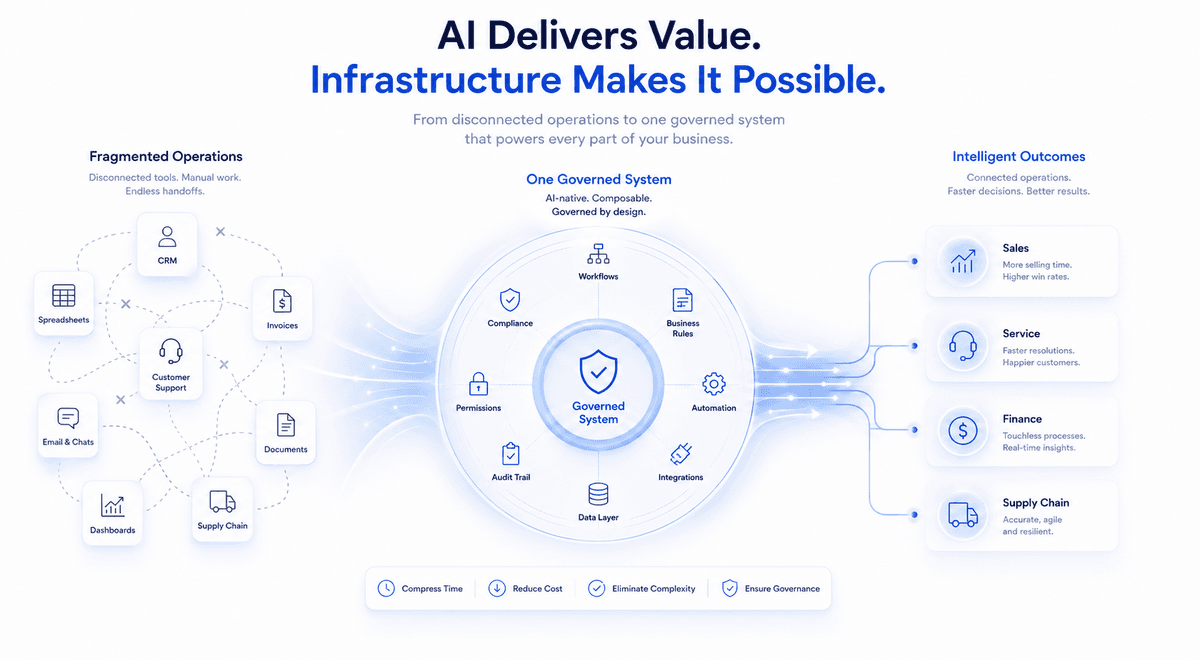
Behind the scenes, instead of producing only code, these platforms generate something called a “meta-configuration.”
You can think of this as a digital blueprint or a single source of truth that tells the platform how everything should behave, in a language that is almost human readable (and hence, easy to understand and work with, for developers who may not have been involved in the original application’s development).
So, with low-code no-code with AI, business teams finally have the power to build what they need, while IT still stays firmly in control of data, security, and compliance.
Why GenAI Low-Code Platforms Are More Practical for Enterprises
- They drastically reduce the amount of custom code needed. GenAI low code no code platforms assemble applications from clear building blocks such as data, screens, rules, automations, so there’s much less that needs to be rewritten when something changes.
- With a GenAI low code platform, you spend less time fixing bugs, chasing framework updates, or worrying about security vulnerabilities hidden in custom scripts. For IT, the maintenance burden drops sharply.
- This model also empowers business users in a way that’s safe. IT can set guardrails, control access, and keep oversight of the whole environment. There’s less risk of shadow IT or unapproved tools, since everything is happening inside the platform with clear governance.
- These platforms are built for the scale and needs of large organizations. Everything (apps, data, roles, logs, and compliance features) lives in one place and is managed under a consistent set of policies.
For most organizations, these aren’t just nice-to-haves; they’re the only way to keep up.
Of course, every business is different.
The right path depends on your needs and the kind of challenges you face. Here’s a simple framework to help make that call.
How Enterprises Should Decide: A Simple Framework
Choosing between AI coding tools and GenAI low-code no-code platforms does not need to be complicated.
- You have a strong engineering team
- Your apps require deep customization or unique logic
- You are modernizing or integrating with legacy systems
- Your use cases are highly technical, such as algorithm design or specialized infrastructure
- You want business teams to build apps directly, with oversight from IT
- Your priority is to launch many apps quickly and keep them easy to maintain
- You want to minimize technical debt and avoid frequent code rewrites
- You need strong governance, auditability, and consistency across the board
Most large enterprises today are moving toward a mixed model:
They use AI coding tools for specialist engineering work and low-code platforms for most business process apps.
If your backlog is filled with workflows, approval tools, dashboards, and compliance tracking, the practical answer is usually low-code.
Conclusion: Choosing Speed That Matters for Business
In the end, it’s not about chasing trends but about what works for your business.
AI coding tools help engineers write software faster.
But for most organizations, that is only part of the story.
GenAI low-code no-code platforms help the entire enterprise deliver solutions faster, with less risk and lower cost.
They take care of the heavy lifting so teams can focus on outcomes, not on code.
The real test of digital transformation in enterprises is whether your technology lets you respond to change without missing a beat.
That’s what these platforms are built for, and why more leaders are making the shift.
Book your personalised demo now and see Amoga in action.