Platform & governance Perspective
Your AI-Enthusiasm Is Epic. Why Is the ROI Still Boring?
95% of AI pilots deliver zero ROI. See how GenAI low-code no-code platforms close the broken path from pilot to production with speed and governance.
In this article 0 sections
Your team ran a sharp AI pilot last quarter. The demo impressed leadership. Someone said "this could change how we operate." Everyone nodded.
Six months later, it is still a demo.
If this sounds familiar, you are in a very large company. MIT's Project NANDA studied over 300 enterprise AI deployments in 2025, interviewed 150 executives, and surveyed 350 employees. The finding was blunt: 95% of GenAI pilots delivered zero measurable impact on the P&L. Not low impact. Zero.
Meanwhile, Kyndryl reports that 62% of organizations have not moved AI projects past the pilot stage. S&P Global found the average company scrapped nearly half its AI proofs-of-concept before they ever reached production.
The enthusiasm is real. The investment is real. Gartner expects enterprises to spend $2.5 trillion on AI in 2026, up 44% from the year before. But the scoreboard? The AI ROI scoreboard is, frankly, embarrassing for most organizations.
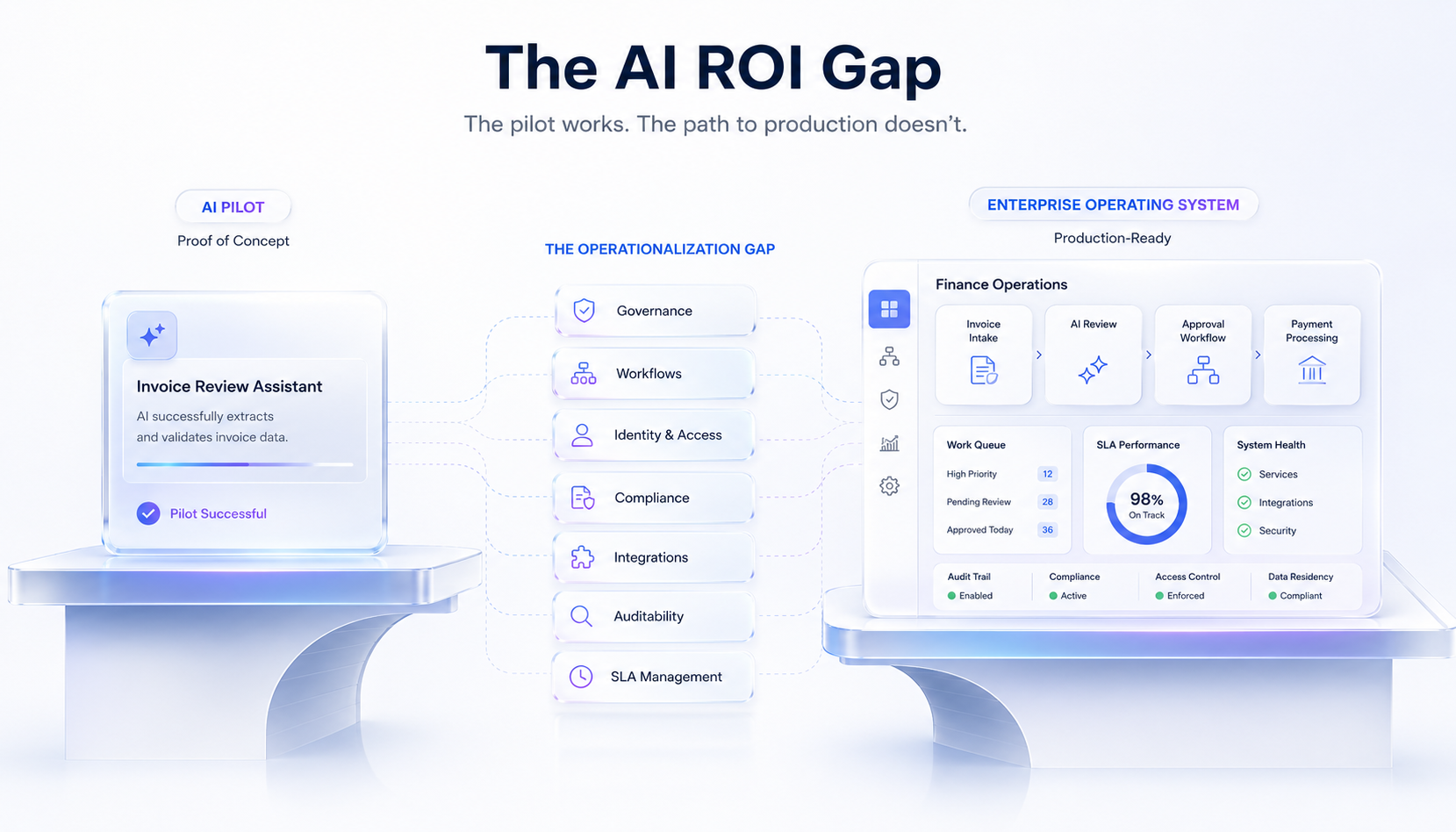
This is not because the ideas are bad. It is because almost nothing is making it from pilot to production.
So what is actually going wrong?
Also read: How a COO Can Turn a Process into an App in a Week with GenAI Low-Code
The Bottleneck Nobody Wants to Talk About
Here is what it is not.
It is not the models. GPT, Claude, Gemini. The underlying AI technology works. It is not the ideas either. Every operations team has a list of ten processes they know AI could improve. And it is not the budget. The money is flowing.
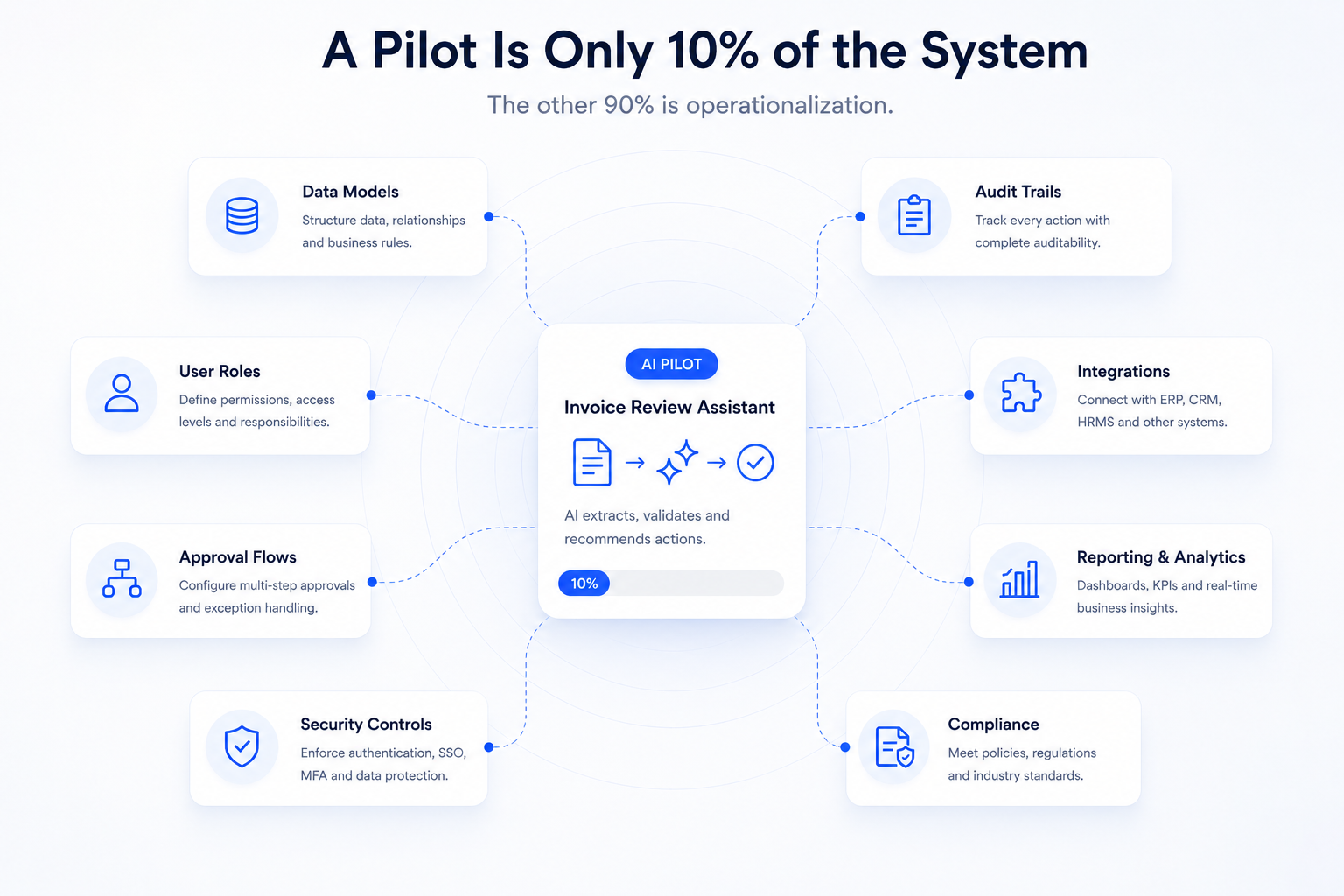
The real bottleneck is the distance between an AI pilot and a production-grade enterprise application. That distance is still measured in months, hundreds of thousands of dollars, and organizational fatigue.
Consider what it takes to turn a successful pilot into a real system. You need a data model. You need UI pages. You need role-based access, approval workflows, SLA enforcement, audit trails, ERP integrations. You need it tested, secured, and deployed in an environment your compliance team will sign off on.
That is not a weekend project. That is traditional enterprise software development. And the numbers on that are brutal.
According to industry benchmarks, IT projects on average overrun budgets by 75% and timelines by nearly 50%. Large-scale enterprise apps cost $200,000 or more and take 12 to 24 months to ship. McKinsey estimates that annual maintenance alone runs about 20% of the original build cost, every single year.
By the time your custom-built system is ready, the business context has shifted. The executive sponsor has moved to a different priority. The budget has been reallocated. The pilot that once excited everyone has quietly become a line item nobody wants to defend.
The pilot did not fail. The path from pilot to production did. And that path was designed for a world that moved much slower than this one.
Which raises an obvious question. If the old path is too slow, why not just use AI to build faster?
Also read: How GenAI Low-Code No-Code Platforms Help Enterprises Reduce Technical Debt
Why Just Build It Faster Misses the Point
This is where the conversation usually turns to AI-assisted coding. Copilot, Cursor, vibe coding. The pitch is appealing: let AI write the code and collapse the timeline.
But here is what the data actually shows.
MIT's research found that purchasing from specialized platform vendors succeeds about 67% of the time. Internal builds, including AI-assisted ones, succeed only a third as often.
The reason is not speed. It is completeness. AI coding tools produce code. They do not produce production systems. There is a significant difference.
A production enterprise system needs:
- Identity and access management
- Audit trails and compliance controls
- Workflow orchestration with SLA tracking
- Role-based dashboards and reporting
- Deployment across cloud, on-prem, or hybrid environments
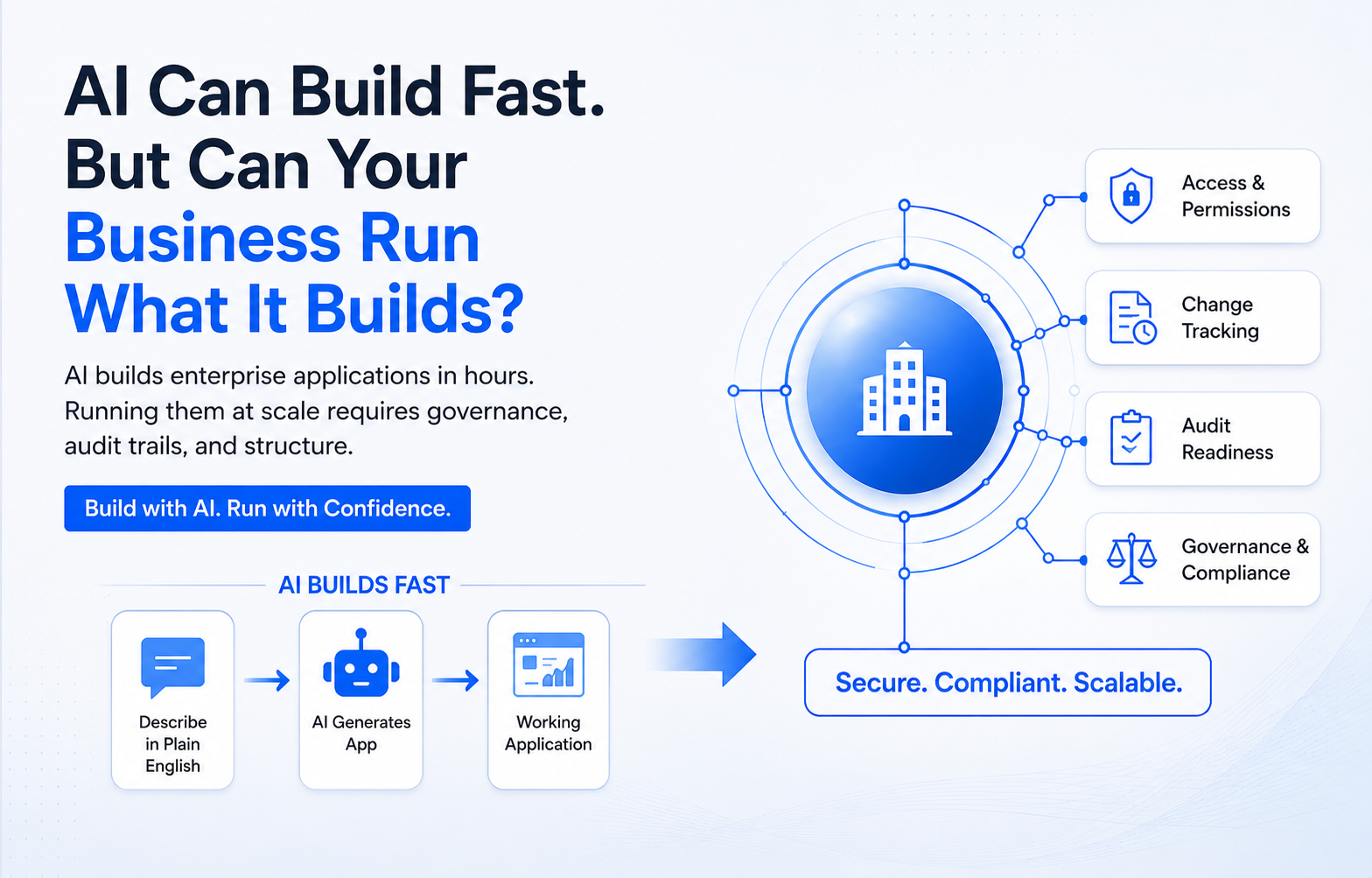
AI-generated code gives you none of that out of the box. You still need months of integration, security hardening, and governance layering before legal, compliance, or IT will let it anywhere near real operations.
Speed without enterprise AI governance is just a faster way to create technical debt. And if you have run an enterprise for any length of time, you know technical debt is not free. It compounds.
Gartner now places GenAI in the Trough of Disillusionment, and predicts that over 40% of agentic AI projects will be cancelled by the end of 2027 due to escalating costs and unclear value.
So if custom development is too slow and AI coding is too incomplete, what actually works?
Also read: How GenAI Speeds Up Low-Code Development
Three Things That Need to Be True at the Same Time
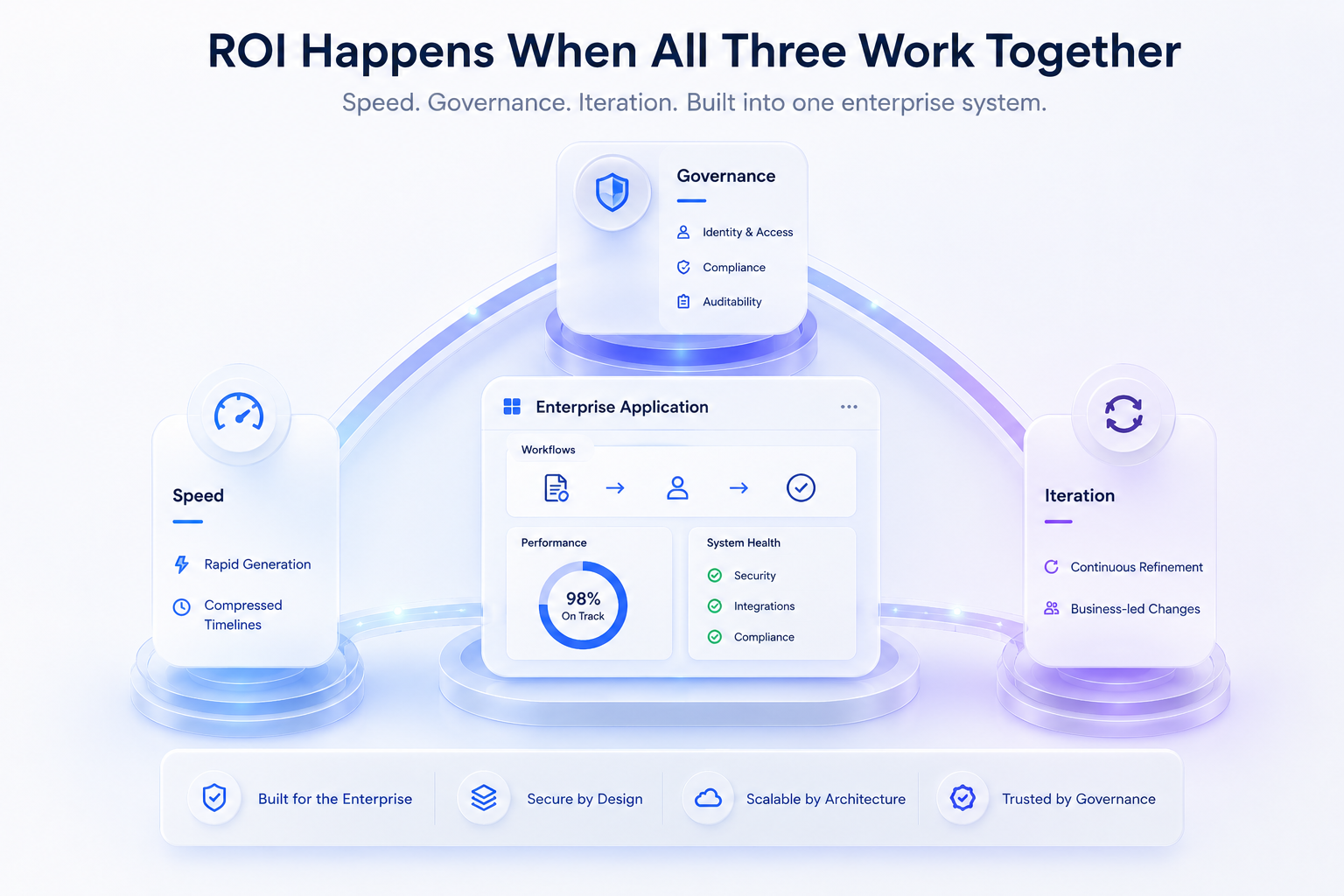
After working with enterprises across BFSI, healthcare, manufacturing, and technology, here is what I have come to believe. Three things have to be true simultaneously for AI investment to produce real ROI at the enterprise level.
First, speed that preserves relevance.
If turning a pilot into a running system takes 12 months, you are not solving today's problem. You are building for a context that no longer exists. The iteration cycle has to compress from quarters to days. As one insight from the CIO Playbook 2026 put it well: high-performance systems are not perfected in staging. They are refined through disciplined cycles of live deployment and real-world iteration.
Second, governance from day one.
This is the single biggest anxiety in every CIO and CTO conversation I am part of right now. Boards are no longer asking "are you using AI?" They are asking "how are you governing it?"
Multiple CIO surveys from 2025 and 2026 converge on the same insight: governance is the most underestimated trend in enterprise AI. One technology leader summarized it perfectly. Everyone wants models that think like humans, but nobody wants to manage them like humans.
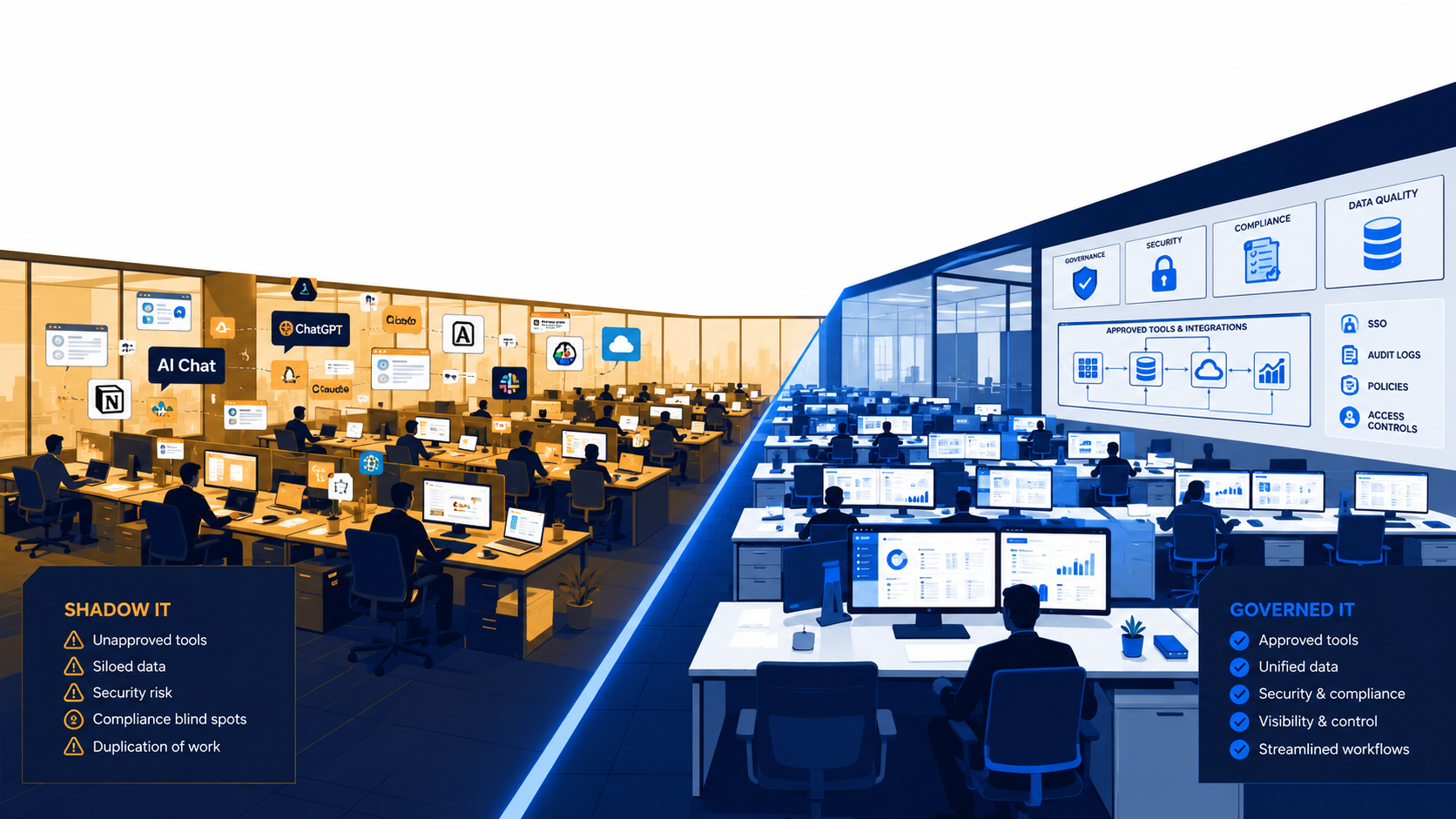
The organizations that are winning have compliance wired into the architecture itself. IAM, SSO, MFA, audit trails, SLA enforcement. Not added after launch. Present from the first deployment.
Third, iteration that does not cost a fortune.
The first version of any system is wrong. That is not failure. That is learning. The real question is how expensive and painful it is to correct the course.
If every adjustment requires a dev sprint, a QA cycle, and a deployment window, you have recreated the waterfall model and just put a GenAI label on it. What you need is a platform where the business team can adjust workflows, data models, and UI directly, without filing a ticket and waiting three weeks.
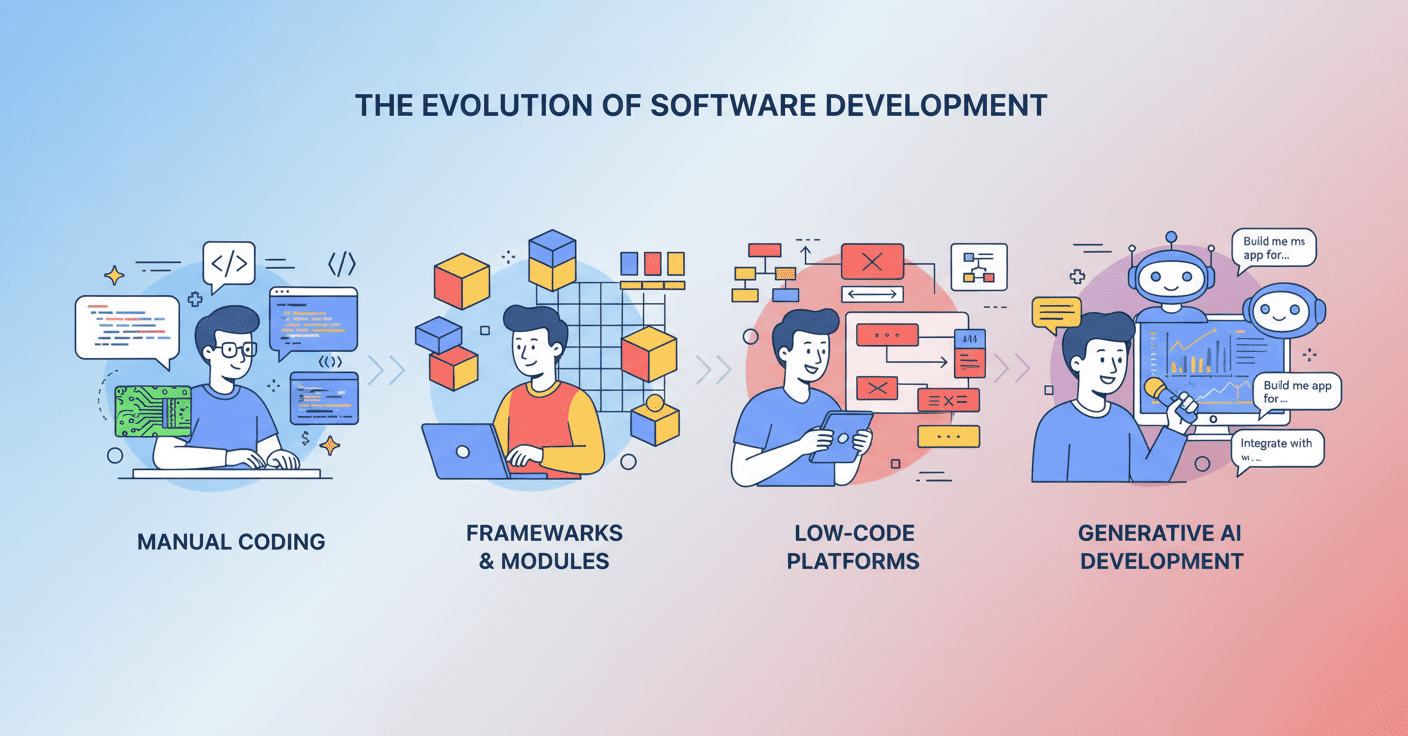
This is exactly the combination that low-code no-code with AI was supposed to deliver. But most first-generation platforms created their own problems: configuration debt, limited scalability, and governance that was bolted on as an afterthought.
Which brings me to what we built.
This Is What We Built Amoga For
Amoga is a GenAI low-code no-code platform built specifically for this gap.
You describe your business process in plain language. Amoga's AI generates the complete application: data models, UI pages, workflows, automations, user roles, and governance layers. Not a prototype. A production-ready enterprise system. In hours, not months.
Here is how it maps to the three criteria:
| What is needed | How Amoga delivers it |
|---|---|
| Speed that preserves relevance | Full-stack app generated from a natural language business requirement. Production-ready in hours. |
| Governance from day one | IAM, audit trails, compliance controls, and SLA enforcement built into every generated application. Not added later. |
| Low-cost iteration | Business teams adjust workflows, data models, and pages directly. No dev sprints. Zero Tech Debt Architecture means apps evolve with the platform, no rewrites, no migrations. |
Deployment is flexible: cloud, private cloud, on-prem, or hybrid. For regulated industries like banking, insurance, and healthcare, this is not a nice-to-have. It is a requirement.
And there is no lock-in. You own your data, your metadata, your workflow definitions, your integration mappings. If you ever choose to leave, you take everything with you. I believe vendor relationships should be earned by ongoing value, not enforced by switching costs.
This is what a low-code no-code enterprise platform looks like when it is designed for the reality of 2026, not the assumptions of 2018.
For the operating layer behind this, explore the Amoga platform, Amoga security, and Amoga compliance.
The Real Question for 2026
The question this year is not whether your team has good AI ideas. They do. Every team does.
The question is whether your operationalization pipeline, the path from idea to governed, running system, can keep up with the speed those ideas deserve. Without sacrificing the governance your board demands.
Today, roughly 5 to 6% of enterprises are extracting real, measurable value from AI. The other 94% are not failing at intelligence. They are failing at the last mile. Turning that intelligence into systems that actually run, with the controls that let them run safely.
That is why GenAI low-code no-code platforms matter now: they connect AI speed to the operational structure enterprises need before ROI can show up.
That is the gap we spend every day working to close. If it is the gap you are looking at too, I would welcome the conversation.