Applications & operations Guide
How GenAI Speeds Up Low-Code Development
Explore how GenAI low-code no-code platforms compare to pure AI coding tools. Understand real-world benefits, limits, and impacts for business and IT leaders.
In this article 0 sections
Everyone’s seen viral demos where tech influencers show you a hot new AI tool where they type a prompt, and in seconds, the AI-coder generates a ‘working’ app.
But, in enterprise tech, there’s a world of difference between and .
GenAI coding has shown already that it has huge potential for simple use cases.
But if you want to transform how your entire company works, the answer isn’t just “more AI.”
It’s about how AI and low-code no-code can come together and work .
So let’s break down what pure GenAI coding can really do on its own, and why that’s only the start.
What You Can Realistically Build Today With Pure GenAI Coding
The honest answer is that GenAI coding works beautifully for very small, basic apps.
Think about:
- A holiday expense tracker you might use for a week.
- A “contact us” form that sends one email.
- A to-do list for a three-person team.
This is what we call the “toy app” zone.
Until your app idea is simple enough, pretty much any of the top 5 AI coders today can build it.
By ‘simple enough’ I mean:
- The logic is straightforward, which usually means just (CRUD).
- There’s no complicated logic, branching, or approvals.
- The stakes are low: If something breaks, nothing mission-critical is at risk.
- Usually, just one or two people are expected to use the app.
McKinsey reports that AI coding tools can double productivity for simple development tasks.
But that productivity leap only happens when the project is small, the rules are simple, and there’s no need for deep customisation.
But the moment your requirements grow (for instance, you want an app that will have more users, integrations, compliance, complexity) the limits of pure GenAI coding show up.
Of course, for even a basic enterprise or even an SMB app, there’s the need for:
- Setting granular permissions (Who can see what?)
- Complex data modelling (How do you link users, teams, and roles?)
- Business logic that changes often (Pricing rules, approval flows, regulatory checks)
- Integrating with legacy systems (ERP, CRM, payment gateways)
- Managing security, testing, versioning-none of which GenAI can automate end-to-end
To build and scale such apps that run your business, you need something much stronger.
This is where GenAI low-code no-code platforms truly come into their own.
Also read: Stop Adapting to AI Features, Start Adapting AI to Your Operations: The Low-Code Control Advantage
The Power of GenAI + Low-Code: A New Level of Abstraction
Let’s look at how GenAI fused with low-code no-code with AI changes the entire equation.
Imagine you could build applications not by writing code or even thinking in tech terms but by simply describing your business process.
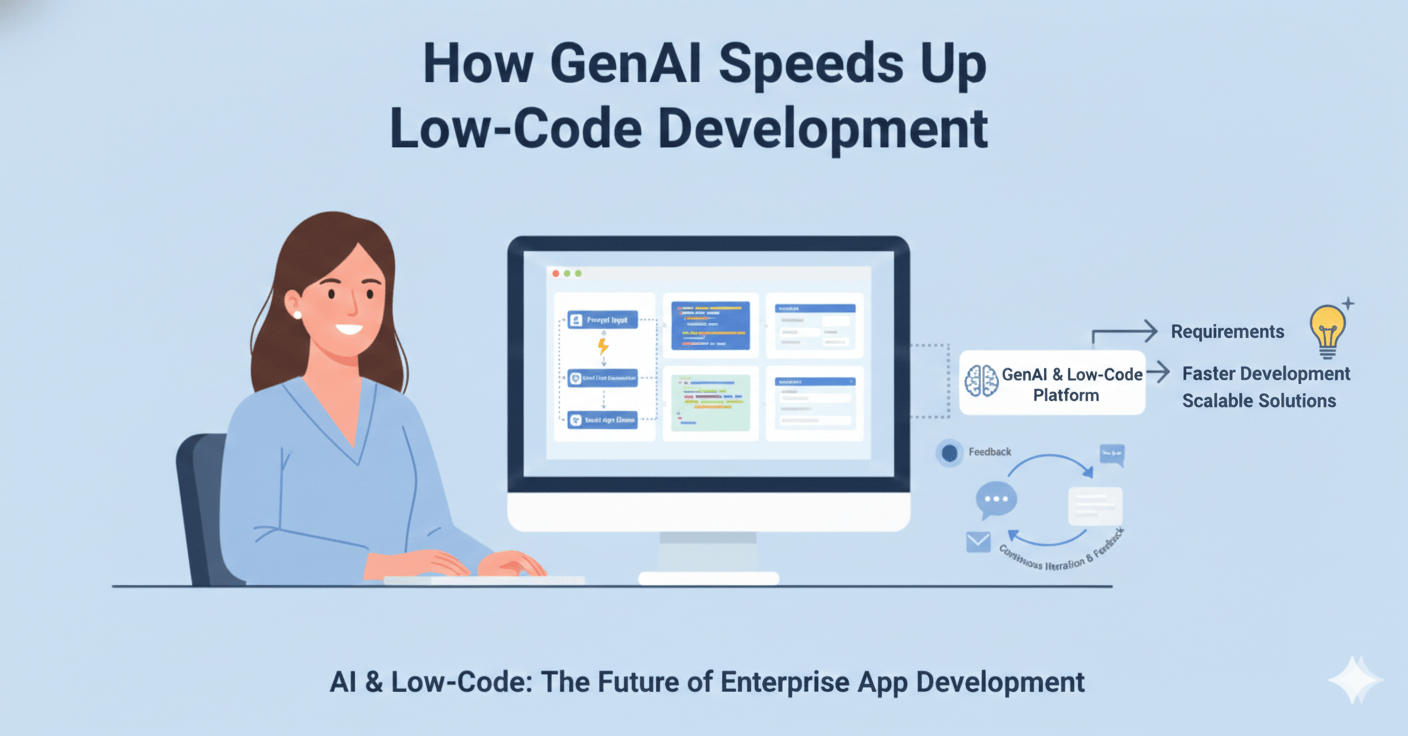
That’s what happens when you combine AI-coding with low-code no-code platforms.
Here’s how this combination works:
The low-code no-code platform handles:
- Infrastructure and hosting
- User management
- Data storage
- UI components
- Pre-built integrations
Now, when you describe your process, for instance, “When a delivery request comes in, assign it to the nearest driver, send a notification, update inventory, and escalate if unfulfilled in 30 minutes…”, the GenAI layer instantly translates that into:
- Data objects (requests, drivers, inventory)
- Pages and forms for each user role
- Automated workflows, notifications, and escalation logic
This is more powerful than it seems, because in this system:
- Business users don’t need to learn how to “think like a developer.”
- Iteration becomes live and interactive as stakeholders see changes as they talk.
- No more endless PRDs, back-and-forth emails, or missed requirements.
This shift is not about making old processes “just a bit faster.”
It’s about changing can build, they can build, and it is to scale.
And that’s why every business leader needs to see GenAI and low-code as allies, not alternatives.
What Does A GenAI Powered Low-Code Platform Mean for Business and IT Leaders
For COOs, it means you don’t have to wait months for a new field process or a change in warehouse tracking.
Your teams can build what they need directly on the platform without any more “IT bottleneck.”
For CIOs and CTOs, the difference is night and day.
With GenAI-powered low-code no-code, you get:
- Every app (no matter who builds it) remains visible, governed, and within your security perimeter.
- Maintenance is no longer a wildcard; the development platform handles updates and patches, so you’re not chasing fragile custom scripts.
- All your tools (whether it’s a new supply chain module or a CRM enhancement) are built and managed in a single, auditable environment.
CFOs see tangible value in the form of faster ROI, transparent costs, and the ability to link investment in GenAI low-code no-code platforms to measurable business impact.
As for business teams, they finally get to “speak in business” and build and iterate apps using their own process language, not tech jargon.
How Amoga Makes Enterprise Automation Fast and Clean
To sum it up:
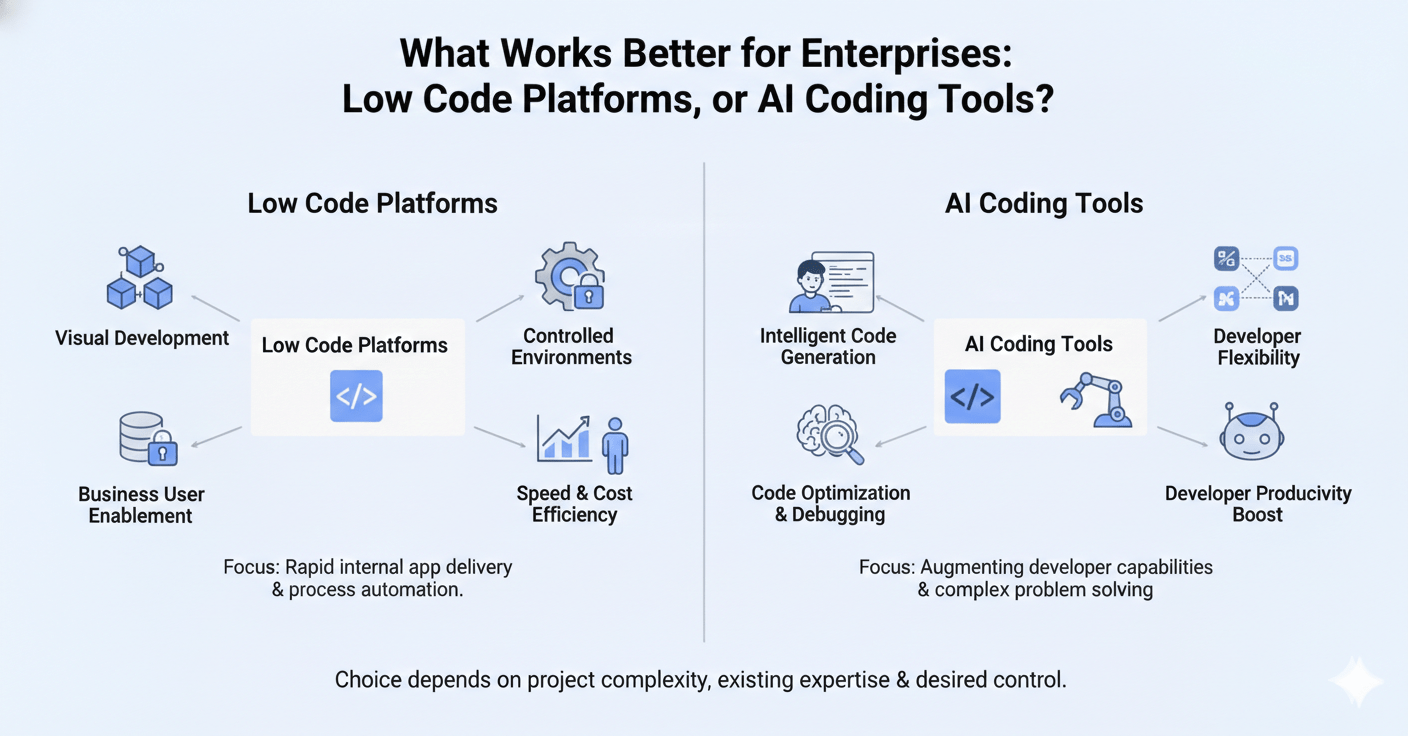
GenAI coding on its own is great for simple demos and experiments.
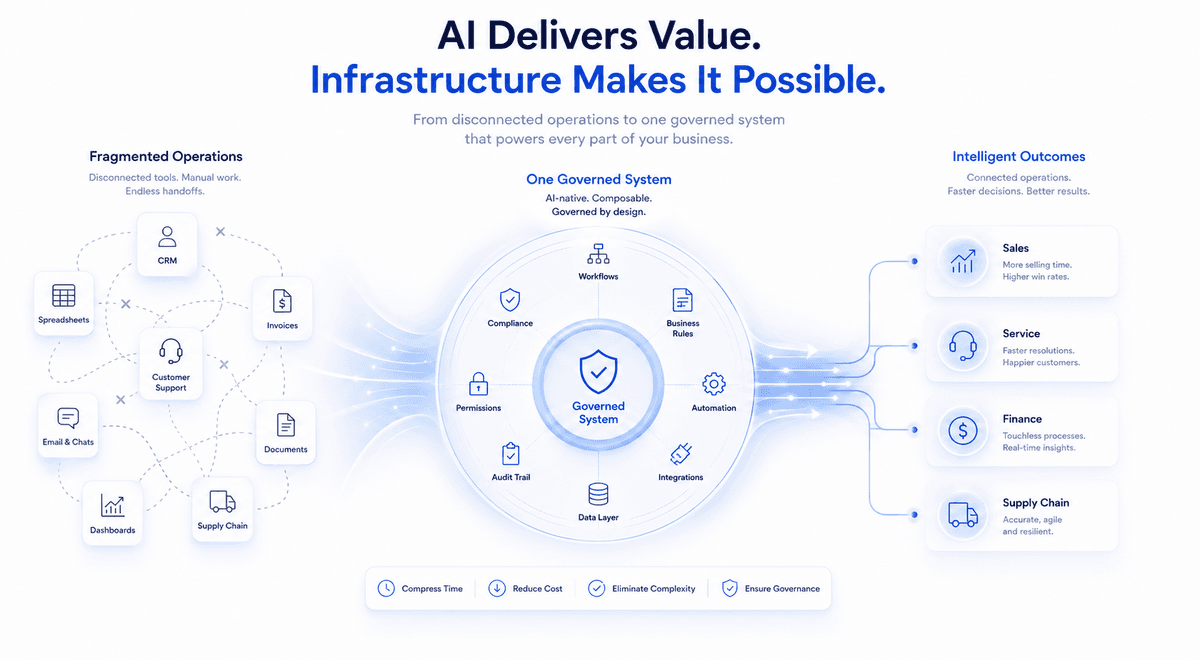
But real transformation happens when you blend that intelligence with a low-code no-code with AI platform, where business intent, not technical limits, drives every solution.
For enterprises, this is the moment-
Digitization is finally democratized, clean, and fast.
You think of the business idea; the platform builds the application.
Book your personalised demo now and see Amoga in action.