Applications & operations Guide
How GenAI Low-Code No-Code Platforms Help Enterprises Reduce Technical Debt
Find out how GenAI low-code no-code platforms like Amoga reduce technical debt, simplify app maintenance, and future-proof enterprise digital operations for CIOs...
In this article 0 sections
Gen-AI Low-Code Platforms Could Finally Solve Technical Debt
Over the last decade, every company has partly become a software company, not because they wanted to but because operations demanded it.
Every enterprise needs digital systems such as HR systems, approval workflows, vendor portals, compliance trackers, internal dashboards.
Each of these solve a real problem. But together, they created a new one: technical debt.
As a consequence, the technical debt that used to be a concern only for product companies now also affects banks, factories, hospitals, and logistics firms alike.
This is where the promise of GenAI low-code no-code platforms is so powerful: break this cycle before the debt breaks your ability to stay agile.
First, let’s see how technical debt actually forms.
How Technical Debt Actually Accumulates in Traditional App Development
The complexity of the problem of technical debt is that it rarely comes from bad engineering.
Most of the time, it comes from normal progress.
As teams build more applications, a few forces continue to act quietly but relentlessly:
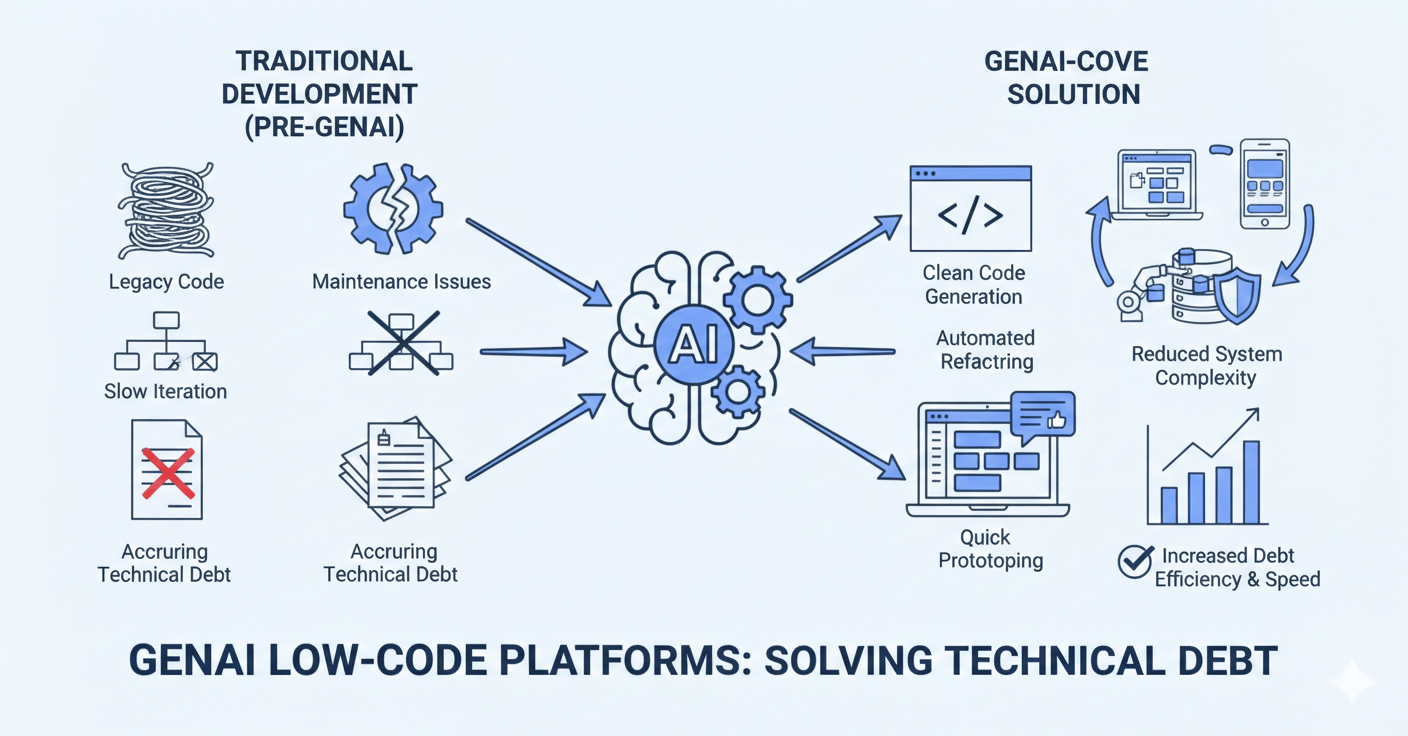
- More code means a bigger codebase to maintain
- Framework upgrades force refactoring of code, even when the business hasn’t changed
- Frequent iterations lead to patches layered on patches
- New integrations expand the surface area for failures
- Developer turnover introduces inconsistent patterns and undocumented logic
Even well-run IT teams can’t escape these forces and end up with technical debt.
Over time, this debt slows down every person on the workfloor, and soon, your capacity to innovate deteriorates.
Now imagine a different model, where the problem of technical debt is taken off your hands.
Also read: Stop Adapting to AI Features, Start Adapting AI to Your Operations: The Low-Code Control Advantage
The Low-Code Shift: From Codebases to Configurations
This is where low-code no code platforms change the conversation.
In a traditional setup, you solve problems by writing code.
In Amoga’s powered low-code no code platform, you solve problems by defining behavior.
You describe:
- The process
- The roles
- The rules
- The approvals
- The data sources
Amoga converts that definition into a structured, platform‑managed configuration in JSON or another meta‑language.
Your application does not run as bespoke code sitting in your repo.
It runs on Amoga’s runtime engine.
What this gives you, practically:
- A stable execution layer that we maintain
- Human‑readable app definitions that stay consistent over time
- No framework lock‑in at the application level
- No dependency on a specific developer’s style or decisions
In other words, we dramatically reduce the amount of code that exists in your organization in the first place.
And since technical debt grows in proportion to code volume, reducing code is the most effective way to reduce debt.
But this foundation becomes far more powerful once GenAI enters the picture.
GenAI Makes Low-Code Iterations Debt-Free
In traditional development, speed and stability are always at odds. So, tThe faster you iterate, the more technical debt you accumulate.
Low-code no-code with AI breaks this trade-off.
Here’s why.
With GenAI, changes to an app’s logic don’t mean rewriting or patching old code.
They mean updating the application definition.
When a business user says:
“Add a new approval step.”
“Change how tasks get assigned.”
“Introduce a new role and notification rule.”
The AI engine inside Amoga understands the intent and regenerates:
- The data model
- The UI screens
- The workflows
- The automation logic
There’s no leftover logic hiding in the system. No abandoned branches. No fragile patches.
Each iteration cleanly replaces the previous definition.
This makes app iterations debt‑neutral.
Consider this example: A marketing workflow expands from 3 roles to 6 as the team scales.
In a traditional setup, this means weeks of refactoring and testing.
In a GenAI-driven low-code setup, it’s a controlled update that can be done and tested in hours.
In this model, your iteration speed increases, but debt does not.
And that sets up the most important shift of all: moving technical debt ownership away from the client entirely.
The Amoga Model: We Own the Technical Debt, Not the Client
Let’s get concrete about what changes when you use an enterprise low-code platform like Amoga.
Debt That Never Gets Created
- No custom code means no code-level bugs, no risky shortcuts, and no “mystery fixes.”
- No version mismatch headaches. You’re insulated from the endless cycle of framework upgrades for React, Node, and Python because your app sits on our platform’s execution engine.
- No legacy branches or dead code paths. The only thing that matters is your latest definition. Nothing “haunts” the system from years ago.
Debt That Exists, But Lives on Amoga’s Side
- Framework and security upgrades happen entirely on the Amoga platform. When React, Node, or Python versions advance, or new security updates are released, we upgrade the platform itself for every client at once. You never have to manage or schedule these upgrades yourself.
- Performance improvements and optimizations are handled centrally. When Amoga engineers ship enhancements to speed, scalability, or efficiency, all client applications benefit at the same time. There’s no action required on your end.
- Compliance and regulatory changes are managed by us. If a new data standard or compliance requirement appears, we update the platform so your app remains current and audit-ready.
To your business, a transition to Amoga’s GenAI powered low-code no-code platform genuinely feels like moving to a system of “zero technical debt”.
This is why so many enterprises are rethinking who should really “own” technical debt in a digital-first world.
A No-Debt App Strategy Is Now Realistic
Let’s sum up the shift.
GenAI low-code no-code platforms finally make a no-debt app strategy realistic for every enterprise.
With Amoga, your team describes the business need and the platform delivers a solution that remains stable, up-to-date, and resilient.
You never get bogged down by forced upgrades, legacy modules, or unexpected technical costs.
A small risk of technical debt still exists but it’s managed, absorbed, and solved on the platform side.
With Amoga, technical debt is our challenge, not yours.
Let us show you-schedule a demo that works for you.