Agentic enterprise software Perspective
Business Process Reengineering with Low-Code
Imagine if your business could change as quickly as the world around it. What if you could cut costs, delight customers, and outpace the competition low-code.

In this article 0 sections
Imagine if your business could change as quickly as the world around it. What if you could cut costs, delight customers, and outpace the competition – all without sacrificing stability?
It’s ironic that one of the most potent management frameworks that address these challenges first came to print in the 1990s before it was more formally known as the idea of Business Process Reengineering (BPR) by the mid-1990s.
A Brief History of BPR
- BPR emerged in the 1990s as a strategy for companies to improve cost, quality, service, and speed.
- Unlike Total Quality Management (TQM), which emphasises gradual improvement, BPR advocates for deep and fundamental changes.
- This approach was highlighted in influential articles by Thomas Davenport and Michael Hammer, although the term BPR itself was coined later.
- Hammer’s view was chiefly of ‘swiftly implementing radical changes’.
- Davenport’s view was chiefly of ‘continually re-engineering business processes’.
What we know as BPR today, is how Thomas Davenport explained it in his book ‘Process Innovation’ in 1993.
The power of BPR is most evident in companies with long, established histories. Consider the massive shifts experienced by companies like Netflix in recent years.
Netflix didn’t get here by tweaking old systems; they reimagined how things could work. That’s the scale of change BPR can facilitate. It’s no different with the seismic shifts experienced by companies like Amazon or Tesla. Of course, most businesses don’t enjoy the luxury of being a Fortune 500 brand with enough appetite for adventures.
Most enterprises and SMBs operate with limitations - rightfully so. Questions arise:
- Will BPR be too disruptive?
- How much will it cost?
- When will we see a return on investment?
These concerns are valid and often prevent countless companies from experiencing the benefits of BPR. But what if there were a way to level the playing field?
shatters the barriers that once separated the biggest enterprises from everyone else. With Low-Code, the complex becomes simple, the unaffordable becomes inexpensive, and the sluggish becomes fast. Let’s understand how.
Why BPR and Low-Code are the Perfect Match
Management and technology often clash. When targets go unmet, one blames the other. However, the combination of Business Process Reengineering (BPR) and low-code platforms offers a rare and powerful solution. It’s fascinating to see how a management philosophy from the 1990s has found its ideal tech partner over 25 years later. So, why is ‘BPR and low-code’ a match made in business heaven? Let’s break it down. BPR, at its core, asks those in power to come together and answer five critical questions:
For a direct-to-consumer (D2C) e-commerce company selling speciality consumer audio equipment, the answer might be:
The answer is often a resounding “NO.” For example, if the customer value proposition is exceptional sound quality, the company’s strong suit should be processes focused on product design, audio engineering, and quality control. However, the reality might be different, highlighting a misalignment between processes and customer values.
Again, the answer tends to be “no.” Market shifts and long-term goals are constantly in flux.
Almost always, “yes.” BPR isn’t about one-time fixes; it’s a mindset of continuous evolution in how work gets done. This highlights why the technology supporting your business must be equally adaptable.
This is where the need for agility becomes clear. Businesses need collaborative, flexible systems that match their dynamic outlook. Low-code platforms fit this perfectly, while traditional technology often creates bottlenecks.
Can you see why BPR and low-code are the perfect fit?
- BPR tells you to keep thinking about how work changes, what’s important to measure, and what processes need to evolve.
- Low-Code, in turn, enables you to continuously sculpt your technology to match your changing work definitions, key performance indicators, workflows, and accountability matrices.
How Low-code Supports BPR
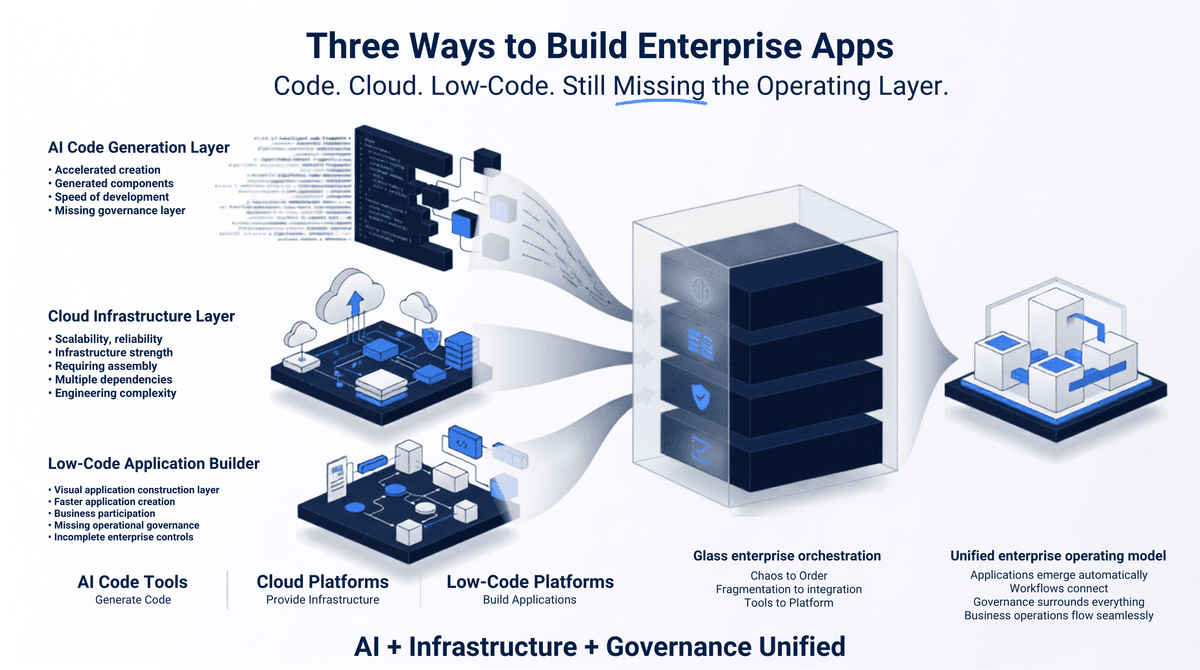
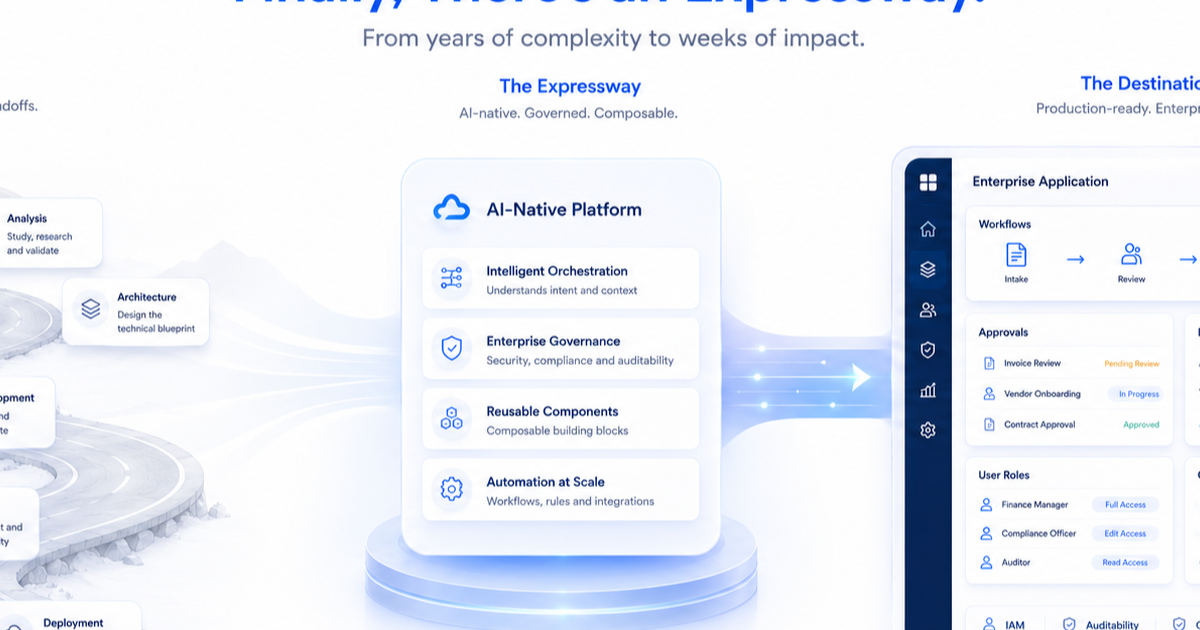
Low-code platforms change the game when it comes to BPR. On top of it, Amoga’s low-code platform is built on the same philosophy that forms the pillars of BPR. In Amoga, you get a one-stop low-code platform with every tool you need to make BPR a way of life at your business. Let’s break down the key advantages:
Few can code; everyone can draw. Now imagine being able to build complex applications without writing extensive code. Amoga’s low-code platforms offer a visual, drag-and-drop interface that allows developers and non-developers alike to create software solutions quickly.
How does Amoga bring app development from the realm of code-by-hand to build it visually? The pillars of Amoga’s low-code platform are:
- Visual, drag-and-drop interface for building applications
- Pre-built components, templates, and modules
- Visual data modeling and integration tools
The result is obvious - you can build and deliver applications in a fraction of the time required by traditional coding methods. But it’s not just about speed; Low-Code also simplifies data integration. Visual data modelling tools make it easy to connect applications with various data sources, APIs, and external systems, ensuring a seamless flow of information across your processes.
So, two exceptional outcomes are evident:
- Low code makes people think along the lines of ‘how to digitize this process and eliminate all the manual work’ rather than ‘it’s quicker to do this manually than request a development from IT’.
- Low code makes it so easy to interconnect all your existing databases that all your low-code apps will be your most reliable source of truth.
But that’s not all. Low-Code becomes the biggest enabler of BPR by placing power in the hands that are closest to real work. Let’s see how.
One of the most significant drains on productivity occurs when someone needs a digital tool for their work process, but IT is either too swamped to help or ends up delivering something that barely meets the original vision. The essence of what was needed gets lost in translation, resulting in tools that don’t quite hit the mark. Enter low-code platforms, which bring an end to this cycle of frustration.
Low-code platforms empower what we call citizen developers. These are employees who, while not professionally trained in coding, have a deep understanding of their needs. They can now take the wheel, thanks to user-friendly interfaces and intuitive tools, to quickly develop applications that truly serve their purpose.
Note: There’s no need to worry about chaos or rogue apps; built-in governance and oversight ensure everything aligns with organizational standards. This shift not only speeds up innovation but also democratizes the creation of digital tools, ensuring they’re just right.
For years, the problem has been the same: IT departments are drowning in requests, leaving only the most urgent problems to get solved. Over time, teams get used to finding workarounds instead of using technology to its full potential. Low-code platforms, like Amoga, have the power to change that.
How does it work? When software developers can focus on design and testing, rather than the nitty-gritty coding of every single feature, things move . Reusable components and visual development can lead to solutions being built ten times faster. This isn’t just a claim – it’s reality and has been proven repeatedly, from creating simple dashboards to integrating complex features like QR code scanners for field sales.
It’s no wonder Gartner predicts that by 2027, 75% of enterprise applications will be built on low-code platforms. But it’s not just about speed. Over time, as organizations build up a library of reusable parts, the cost of creating solutions plummets. Organizations can cut development costs to a quarter of what they would spend on traditional coding.
This fundamentally changes how businesses think. Managers start seeing what’s possible with automation. Analysts dream of dashboards updating themselves. CEOs focus on optimizing workflows to be faster, better, and cheaper. A pro-tech mindset takes over, and that’s where the true magic of low-code lies. The one core tenet of BRP - continual evaluation and engineering - becomes realizable because technology can now support the goal with speed and cost-effectiveness.
In a stable system, speed doesn’t come at the cost of security. Security is non-negotiable. Low-code platforms understand this. Features like role-based access (who can see and do what), data encryption, and compliance with major security standards are often baked right in. IT teams get centralized control to make sure everything stays safe and sound. Automated testing processes help catch potential security holes before those apps go live.
Imagine a healthcare organization undergoing a digital transformation to streamline patient data management. To do this on a Low-Code platform, everyone needs to have the confidence that the system is compliant with industry standards like GDPR and HIPAA. With low-code’s robust security features, they can confidently develop and deploy applications.
Ready for BPR + Low-code?
BPR isn’t an incremental improvement. We’re not talking about small wins here. Imagine your D2C e-commerce brand, focused on consumer audio, revamping operations so completely that you become an industry leader for the next half-century. That’s the potential of true BPR.
Today’s Fortune 500 companies didn’t reach the top by accident. They understand the power of agility and continuous process reengineering. While they might be giants, they have the speed and flexibility to adapt quickly. The ability to re-engineer processes gives them the agility of a startup with the strength of a century-old company.
Low-code makes this practical. We’d love to show how so many enterprises and SMBs are enjoying the liberation that only a true low-code platform can bring about. Let’s chat.
Next Steps
Request an enterprise demo to accelerate your process-to-app delivery.