Agentic enterprise software Perspective
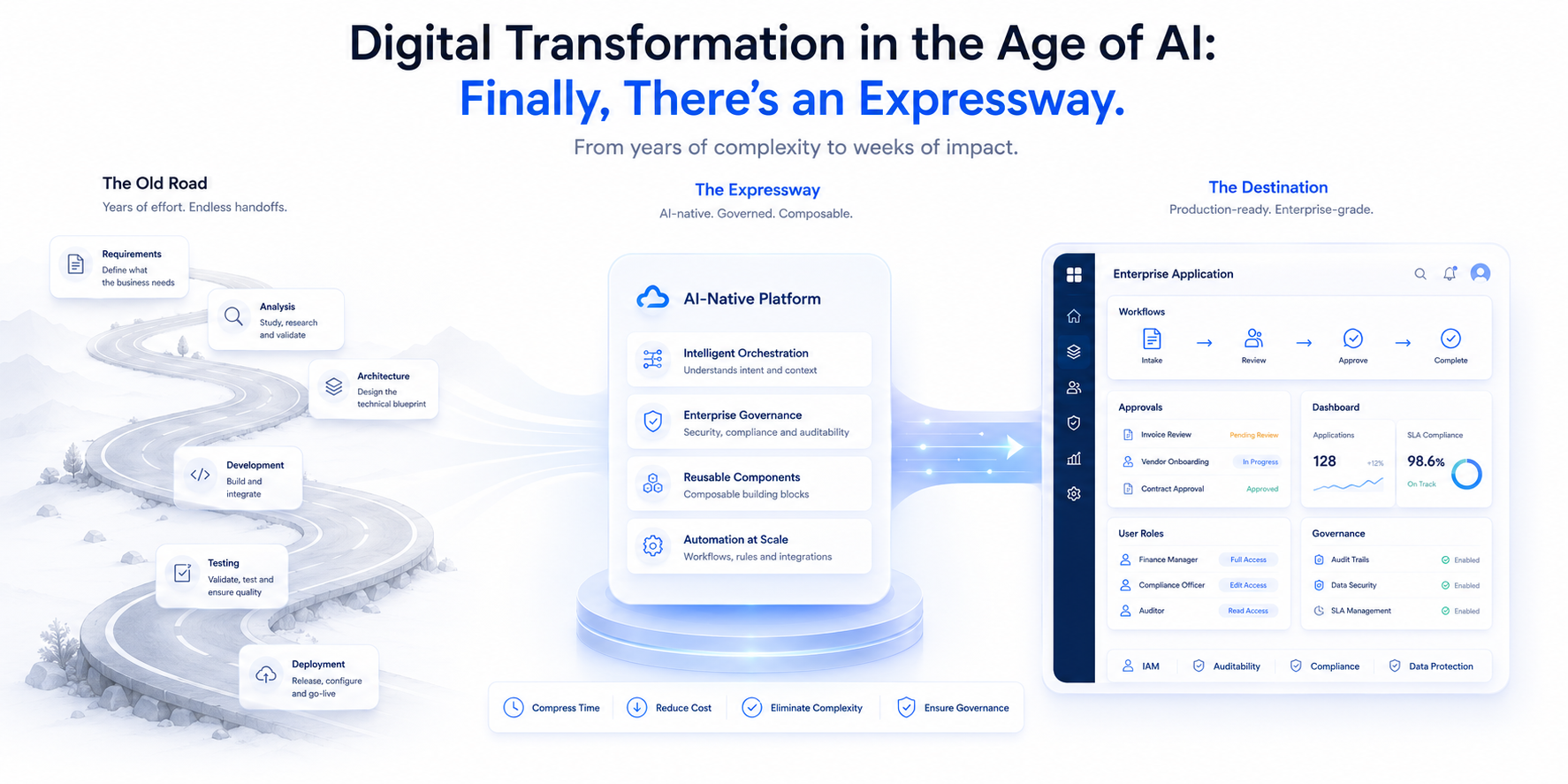
Digital Transformation in the Age of AI: Finally, There's an Expressway
How GenAI low-code no-code platforms compress years of enterprise digital transformation into weeks with governance, flexibility, and zero tech debt built in.
In this article 0 sections
If you have led an enterprise digital transformation program, or been part of one, you know the pattern.
Eighteen months of planning.
Six months of vendor evaluation.
Another year of implementation.
And somewhere around month thirty, a system that is already two versions behind what the business actually needed then.
I have had this conversation with dozens of CTOs and COOs over the past few years, and the frustration is remarkably consistent.
The frustration is not with the technology itself. It is with how long it takes to go from a clear business need to a working system.
The numbers confirm what most of us already feel.
- McKinsey puts the failure rate for digital transformation initiatives between 70% and 90%.
- Globally, failed efforts cost organizations an estimated $2.3 trillion per year.
- The average project runs about $10.9 million, and more than a third fail outright.
More than technology failures, they are coordination failures.
The real bottlenecks are all too familiar:
- The translation gap between what business teams describe and what IT eventually builds.
- 12-24 month custom development cycles that outlast the problem they were solving.
- A global developer shortage.
- Technical debt that compounds with every release, making each subsequent change slower and riskier.
First-generation low-code no-code tools promised to help. They reduced the coding burden and made basic app building accessible. But they did not fundamentally solve the structural problem.
You still needed significant technical orchestration.
Governance was an afterthought.
And the configuration debt they created was just a different flavor of the same old mess.
So for a long time, digital maturity has felt like a slow, expensive slog. But finally something has genuinely changed.
Also read: Digital Transformation: Its Relevance After The Pandemic
How AI Is Compressing the Enterprise App Lifecycle
When most people hear "AI in software development," they think of code autocompletion tools where a developer types a function and AI suggests the next few lines. That is useful, but it is a narrow view of what is actually happening.
Generative AI is now compressing entire phases of the application lifecycle. Not just coding, but also requirements analysis, solution architecture, data modeling, workflow design, and backend automation.
The measured results are significant.
An analysis published by CIO.com found that generative AI reduced development effort by roughly 34% per engineer, saving about six hours per week.
Scale that across a hundred-person team over a year, and you are looking at nearly 29,000 reclaimed engineering hours.
But the more important shift is upstream from code.
- Deloitte's 2026 State of AI report found that 66% of organizations now report measurable productivity and efficiency gains from enterprise AI.
- Worker access to AI rose 50% in just one year, and twice as many leaders reported transformative impact compared to the previous year.
- Meanwhile, 77% of businesses have already revised their digital transformation strategies specifically because of AI.
But what does this mean in practice?
The sequential process of gathering requirements, writing specs, designing architecture, building, testing, and deploying, all of which used to take quarters, can now collapse into a single governed workflow.
A business user describes a process. AI-powered app development handles the rest, including data models, pages, workflows, automations, roles, and test environments.
The path to digital maturity no longer has to be linear.
Every CTO has been handed a digital maturity framework at some point, usually by a consulting firm. The model is always sequential:
- Stage 1: Digitize individual departments.
- Stage 2: Integrate across functions.
- Stage 3: Optimize and automate.
- Stage 4: Transform the operating model.
Most enterprises, after years of investment, are stuck somewhere between stages one and two.
Gartner's own research acknowledges that rising digital spending does not automatically produce rising maturity.
But here is what is interesting. We are now seeing enterprises skip stages entirely.
Chinese enterprises offer a striking example. 49% of them are bypassing legacy migration altogether and going straight to cloud-native architectures. They are not replaying every step the previous generation took. They are leapfrogging.
The same logic applies to application development. When you generate an entire application stack from a unified platform, the fragmentation that normally accumulates over years of piecemeal building simply does not happen.
71% of organizations cite fragmented data and poor observability as their biggest barriers to digital acceleration. But fragmentation is a symptom of building incrementally over a decade. It is not inevitable. More than that, it is an artifact of the old approach.
The composable, AI-native model points in a different direction: build complete systems from the start, and evolve them as the platform evolves.
This brings us to the most important unlock: what happens when business teams can describe what they need and see it built immediately.
Also read: The Role of Low-Code Platforms in Digital Transformation
Why Citizen Developers Still Need a Platform, Not Just Low-Code Tools
The citizen developer movement is no longer a fringe experiment.
By the end of 2026, 80% of low-code no-code users will sit outside formal IT departments. Nearly 60% of custom enterprise apps are already built by non-IT employees. And the demand for citizen-built applications is growing five times faster than IT can serve.
But most platforms hit a ceiling quickly. A business user can build a form or a simple workflow. But architecting a full enterprise system with data models, approval hierarchies, role-based access, audit trails, SLA enforcement, and backend automations still requires professional developers.
Which brings you right back to the bottleneck.
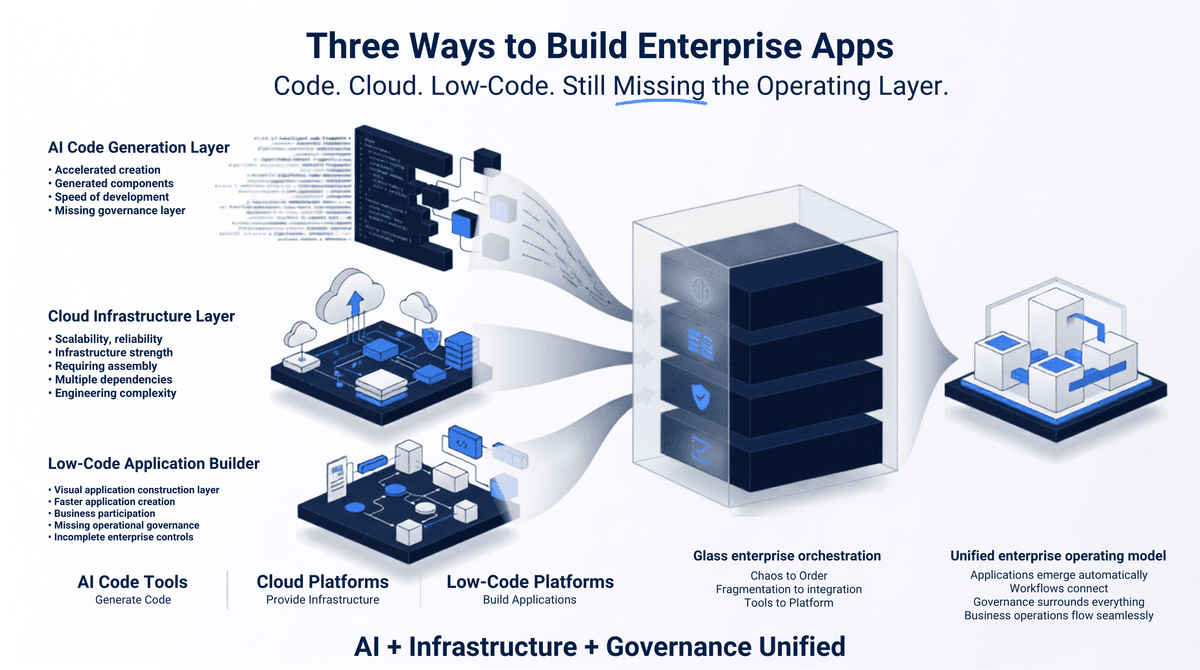
This is the gap that GenAI low-code no-code platforms close. I do not mean AI coding tools. I do not mean pure low-code no-code platforms. I mean low-code no-code platforms with generative AI embedded across the application lifecycle.
Also read: A Zero-Jargon Perspective on Digital Transformation
Why Low-Code No-Code Needs AI to Work at Enterprise Scale
When a business user can describe a process in plain language and the platform generates the complete application architecture from that description, something fundamental shifts.
The translation gap between business intent and technical execution disappears.
And given that the global developer shortage is not getting better anytime soon, this is not a nice-to-have. It is the only scalable way to close the enterprise application backlog.
At Amoga, this is the exact problem we set out to solve.
We built the platform around a single conviction: enterprises should not have to choose between speed, governance, and flexibility.
Here is how it works in practice. Amoga follows six stages:
| Stage | What happens |
|---|---|
| BRD / FRD | You describe your business requirements in plain language or structured documents. |
| Solution Prompts™ | AI converts those requirements into structured application blueprints. |
| Web and mobile apps | Full-stack applications are generated automatically, including UI, APIs, roles, and dashboards. |
| Govern | IAM, audit trails, SLA enforcement, durable execution, and compliance layers are built in from day one. |
| Deploy | Cloud, private cloud, on-premises, or hybrid: your infrastructure, your rules. |
| Zero Tech Debt | Applications evolve continuously with the platform, with no rewrite cycles and no migration sprints. |
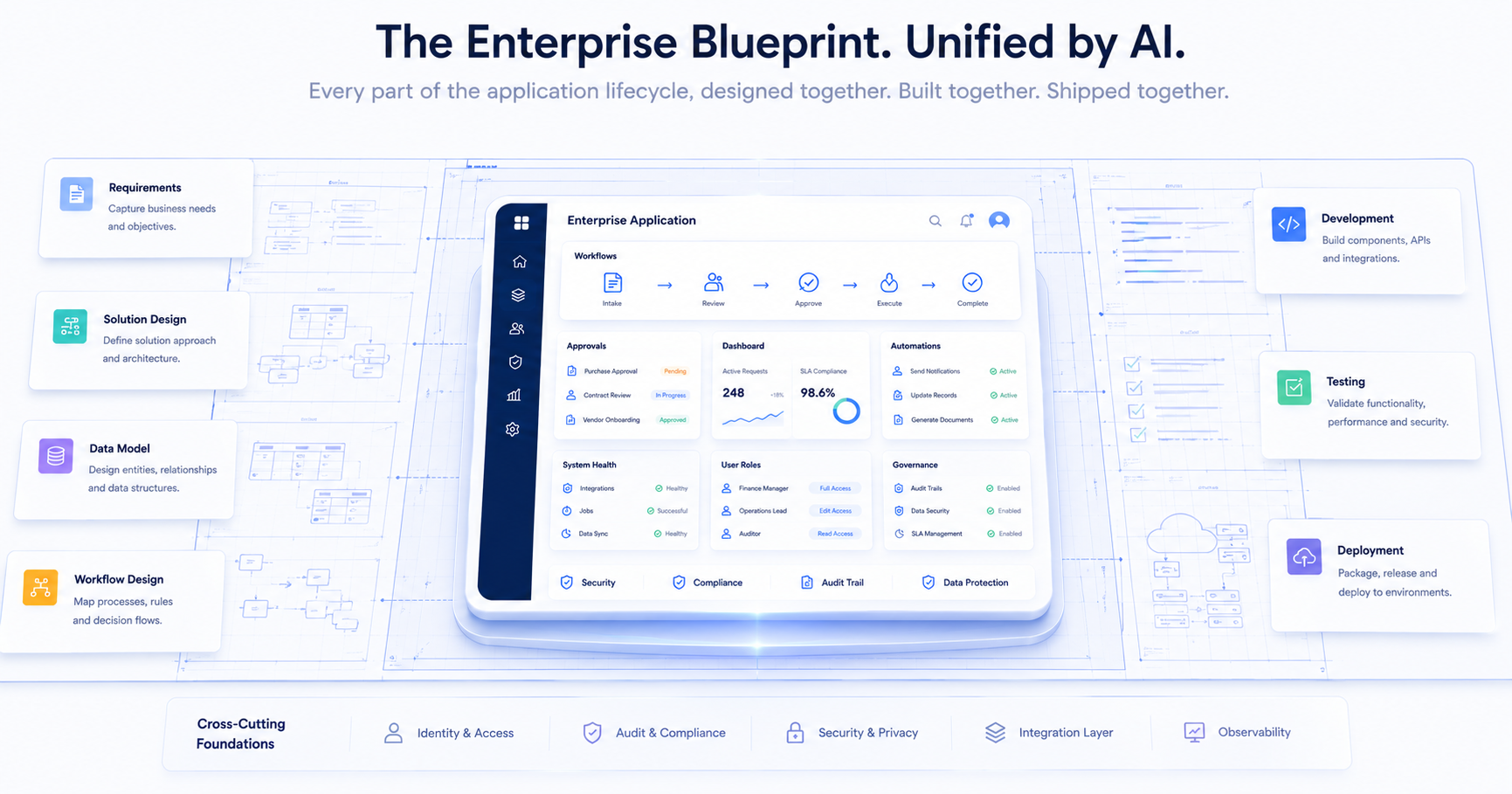
For context, here is how that compares to the alternatives:
| Custom Dev | Traditional Low-Code | SaaS | AI Coding Tools | Amoga | |
|---|---|---|---|---|---|
| Time to production | 12-24 months | 3-6 months | Weeks to configure | Days, prototype only | Weeks |
| Governance | Manual or none | Limited | Vendor-defined | None | Built in from day one |
| Tech debt over time | Accumulates rapidly | Config debt builds | Vendor dependency | Immediate and severe | Zero tech debt |
| Deployment flexibility | Complex | Cloud only | Vendor cloud only | Manual DevOps | Cloud, on-prem, hybrid |
| Vendor lock-in | Team dependency | High | Extreme | Code/model risk | None: you own everything |
That last row matters more than most people realize.
With Amoga, you own your data, your application metadata, your workflow definitions, and your integration mappings. If you ever choose to leave, you take everything with you.
Enterprises across BFSI, healthcare, manufacturing, and internet-scale platforms, including CreditAccess Grameen, Nova IVF, Motherhood Hospital, River Mobility, and Mirza International, are already running production systems on Amoga.
Explore the underlying product approach on the Amoga platform page and the build flow in How Amoga works.
What AI-Native Platforms Change for Enterprise Transformation
Gartner predicts that 40% of enterprise applications will embed task-specific AI agents by the end of 2026, up from under 5% in 2025. CIO.com frames 2026 as the year of "scale or fail."
The expressway is there for you now.
Low-code no-code with AI has made it possible to go from business requirement to production system in weeks, not years.
The only question is whether your organization takes the on-ramp now or keeps navigating the old road.
That is why GenAI low-code no-code platforms are becoming the new operating model for digital transformation: they combine speed, governance, and continuous evolution in one enterprise system.
If you want to see what this looks like for your specific operations, reserve a 30-minute demo tailored to your workflows.