Agentic enterprise software Field note
GPT-5.4 for Enterprise Apps: What It Can (and Can't) Do
GPT-5.4 can now generate APIs, workflows, and backend logic for enterprise apps. But enterprise software needs more than speed.
In this article 0 sections
On March 5, OpenAI released GPT-5.4 for Codex. And for anyone thinking about how enterprises build software, this one matters a great deal.
This is the first AI model that can realistically participate in building enterprise applications. I do not mean writing snippets of code, but working through the kind of multi-step, multi-system complexity that enterprise software demands.
Let us get to know the potential of GPT-5.4 for enterprise apps a bit better.
GPT-5.4 can now operate software the way a person would.
It sees screens, clicks buttons, fills forms, and navigates across applications autonomously.
On the OSWorld benchmark, it scored 75%, which beats the human baseline of 72.4%.
For enterprise app building, this means AI can now interact with existing systems such as your ERP, your CRM, and your approval workflows, which is much better than just generating code in isolation.
It supports up to 1 million tokens of context through the API.
In practical terms: it can hold an entire business requirements document, a legacy system's data schema, and your current workflow rules, all in one session. That is the kind of context you need when you are designing an enterprise application.
It introduced steerable reasoning.
The model shows you its plan before executing, and you can course-correct mid-way. When you are generating a multi-step workflow or a data model with dependencies, being able to say "no, the approval should route to the department head first" without starting over is a real upgrade.
And critically, GPT-5.4 can now generate working outputs with backend logic, API scaffolding, automation scripts, and even database schemas.
On OpenAI's GDPval benchmark, which tests professional-grade work across 44 occupations, it matches or exceeds industry professionals 83% of the time.
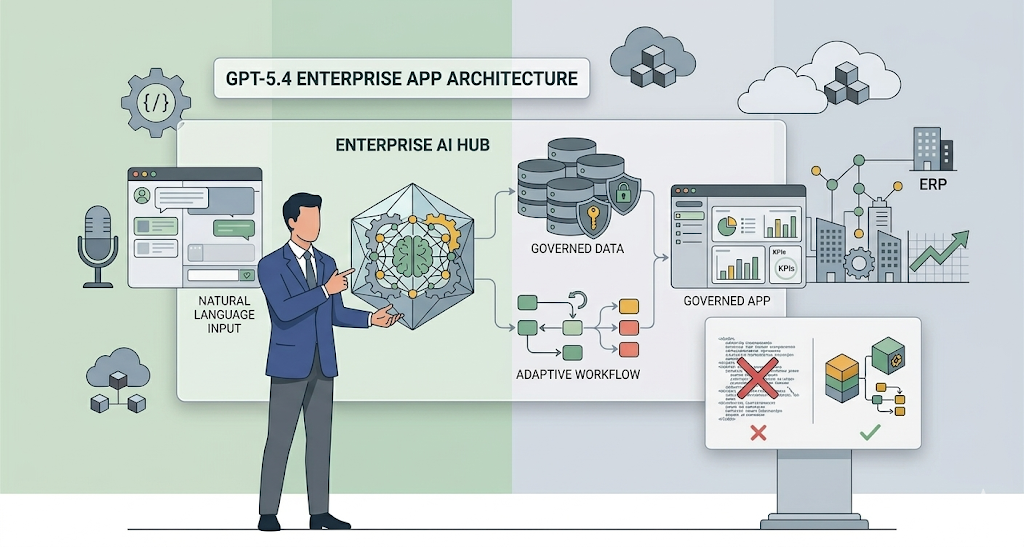
For the first time, you can describe a business process in plain English and get something that looks like the beginning of a real application.
So what does this change for how enterprises actually think about building software?
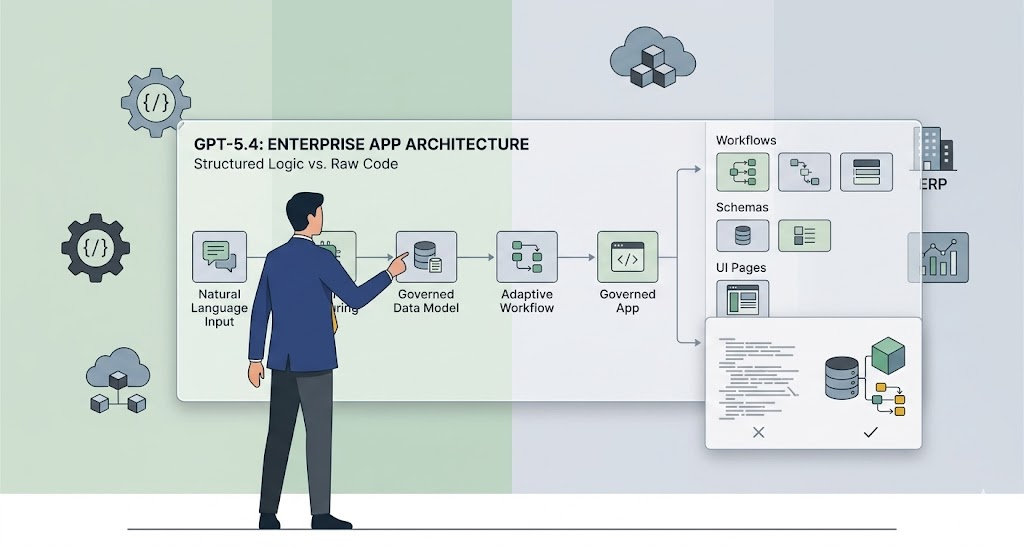
What GPT-5.4 Means for Enterprise Application Development
If you are a CTO evaluating your application development pipeline, or a COO who has been waiting months for IT to deliver an internal tool, it is clear that GPT-5.4 for enterprise use cases is highly tempting.
Think about what building an enterprise app typically requires:
- Understanding a business process end-to-end
- Designing a data model that reflects real entities and relationships
- Building workflows with approvals, conditions, and escalations
- Creating role-based screens for different user types
- Writing automation logic that connects the pieces
GPT-5.4 can now meaningfully contribute to each of these steps.
- The 1M token context means it can read your full BRD alongside your existing system schema without chunking or losing context halfway.
- GPT-5.4 computer use means it can navigate your current tools and understand what already exists before generating something new.
- Its improved code generation means the output is not pseudo-code. It is structured, functional, and closer to production-ready than anything we have seen from a general-purpose model.
So AI enterprise workflows are no longer hypothetical. GitHub Copilot already ships GPT-5.4 for agentic coding. Microsoft Foundry positions it as the model for complex, multi-step enterprise automation. OpenAI launched ChatGPT for Excel alongside this release, to explicitly target operational and financial workflows.
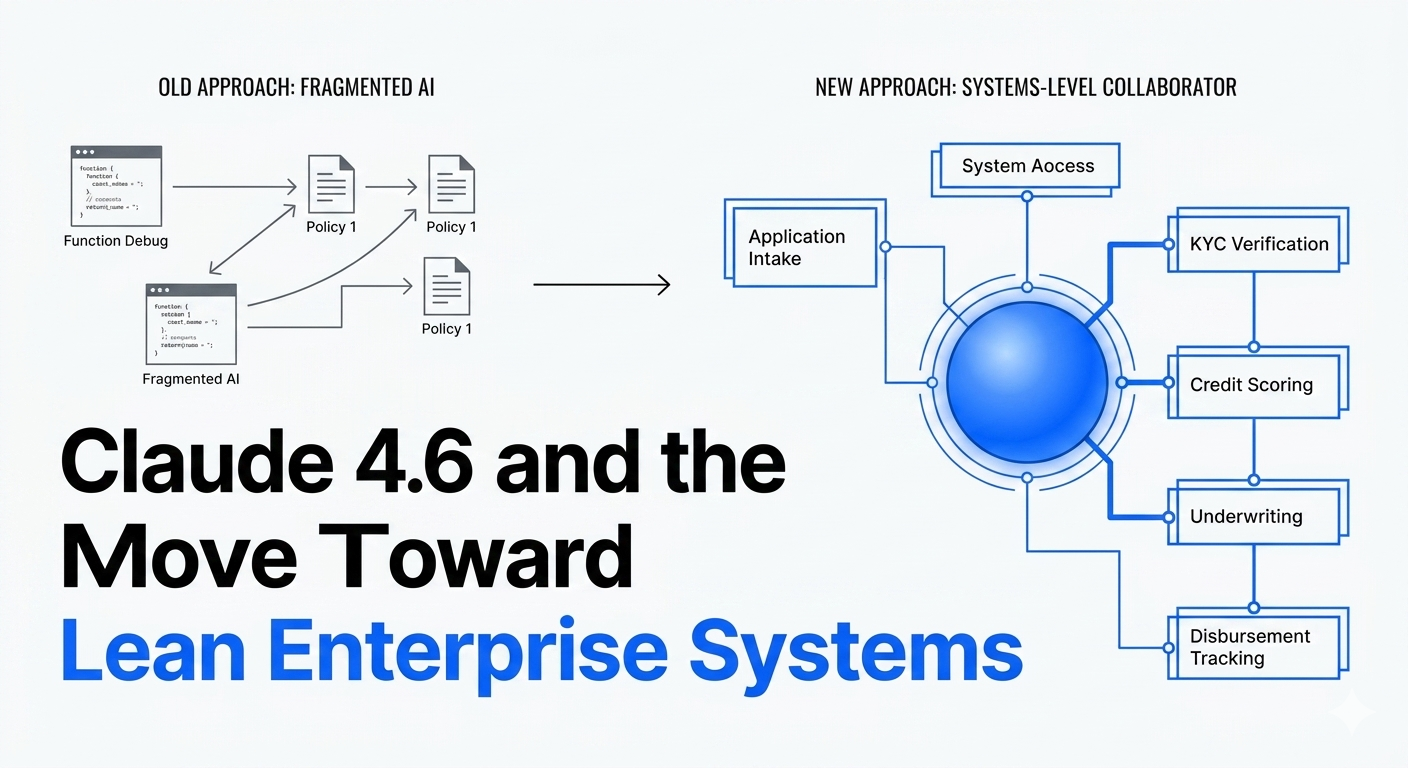
The shift is clear: earlier, AI helped developers write functions faster. Now it can help teams assemble working systems with far less hand-holding.
That is a meaningful upgrade. But it also raises a question every enterprise leader needs to sit with.
Also read: The Intersection of Low-Code Development and Artificial Intelligence
Why Speed Alone Does Not Solve the Enterprise Problem
The question is no longer can AI build apps?
It can. GPT-5.4 can generate APIs, backend logic, UI screens, and automation scripts. That is settled.
The real question is: what happens after it builds?
Enterprise applications are not demos. They change every quarter. Multiple teams depend on them. They are tied to approval hierarchies, SLAs, and compliance requirements. They need audit trails, role-based access, and version control, not just on code, but on business logic.
And this is where the pace of AI introduces a new kind of challenge.
AI coding tools now write 41% of all new commercial code in 2026. But Forrester projects that 75% of technology leaders will face moderate-to-severe technical debt by this year.
McKinsey data shows organisations routinely lose 20-40% of their IT budgets just maintaining poorly structured systems.
The issue is not that AI writes bad code. The issue is that speed without structure creates systems that are hard to change, hard to audit, and expensive to maintain over time.
Also read: The Hype vs The Reality of AI Coding Tools
The Question Every Enterprise Leader Should Be Asking
I talk to CTOs every week who are excited about what AI can generate. The question they are now asking is a different one:
"Six months from now, can my team modify this, govern it, and scale it across the organisation?"
That question changes how you think about building.
Here is the pattern I see working.
If every new workflow means fresh AI-generated code, then every change means more code, and every quarter means more weight on the system. Enterprises have seen this cycle before with custom development. AI just makes it happen faster.
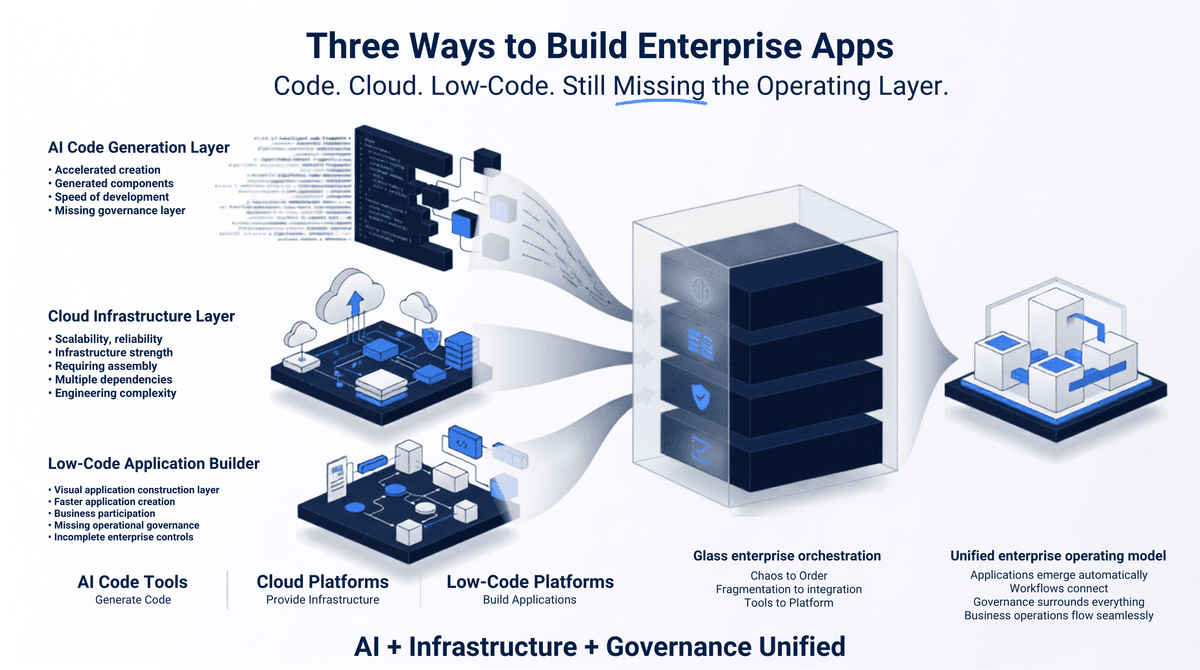
The alternative is: instead of generating raw code for every process, you generate structured components such as reusable workflows, configurable business rules, predefined roles, and governed data models. Things that can adapt without a developer rewriting logic from scratch.
This is exactly where the low-code no-code with AI market is heading.
Also read: What Works Better for Enterprises: Low Code Platforms, or AI Coding Tools?
Why Low-Code and AI Are Winning the Enterprise Market
The numbers tell the story:
| Insight | Source |
|---|---|
| 75% of new enterprise apps will use low-code no-code by end of 2026 | Gartner |
| Low-code market projected to exceed $30 billion in 2026 | Gartner |
| 85% of IT leaders say combining low-code with AI accelerates innovation significantly | Industry survey |
| 80% of mission-critical apps expected to run on low-code platforms by 2029 | Gartner |
So this is not a fringe trend. It is the direction enterprise software is moving in because structure scales, and raw code does not.
The best operations systems I have seen do not run on thousands of lines of custom code. They run on the right structure, like workflows that can adapt, roles that are predefined, and logic that is configurable without calling an engineer every time something changes.
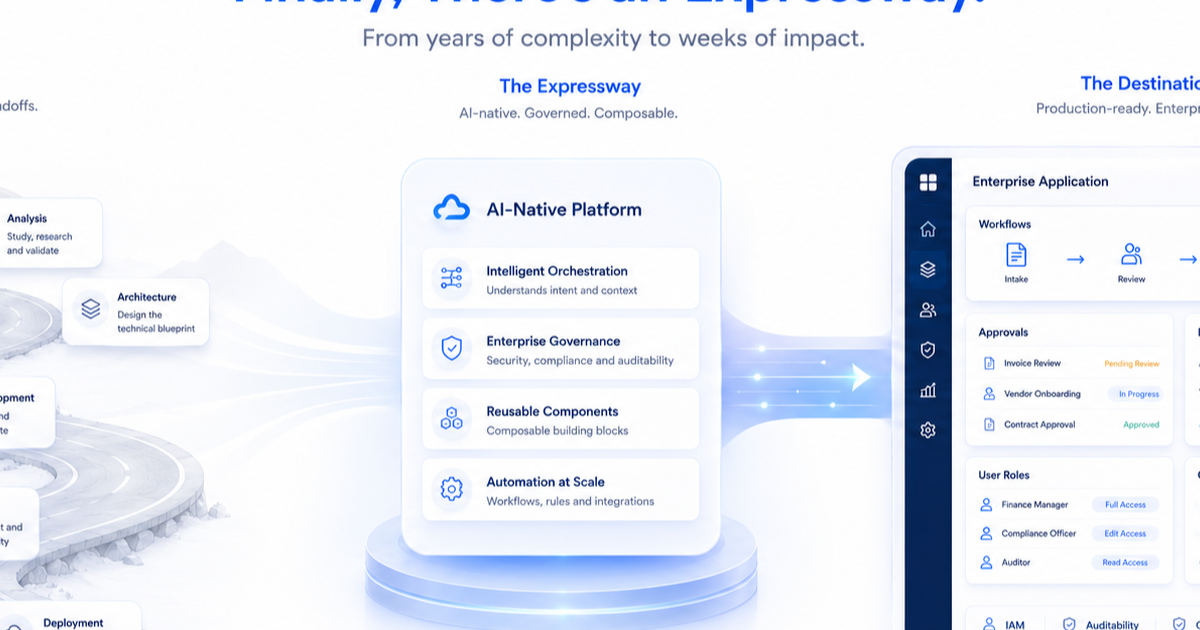
AI understands intent beautifully. What enterprises need is a layer that converts that intent into structured, governed, changeable systems instead of one-off code dumps.
Where GPT-5.4 Fits, and What Comes After the Prompt
So where does GPT-5.4's power actually peak?
It is genuinely excellent at three things:
- Understanding business intent from natural language
- Generating structured outputs
- Executing multi-step tasks across tools and environments
That is real, and that is valuable.
But the highest-value path for enterprises is not: prompt to raw code to maintenance burden.
It is: prompt to structured system to governed application.
This is exactly what we built Amoga to do.
Amoga is a GenAI low-code no-code platform that takes business requirements described in plain language and converts them into complete enterprise applications. Not code files. Not prototypes. But full systems with:
- Data models
- Workflows with approval hierarchies
- Role-based access and UI pages
- Automation logic
- Governance, audit trails, and compliance
The point is not that AI has limitations. The point is that AI's power is maximised when it flows into structure, when the output is not just fast, but governed, adaptable, and ready for production.
AI builds faster than ever. Platforms like Amoga make sure what you build actually works next quarter, next year, and across every team that depends on it.
Book your personalised demo now and see Amoga in action.
Related Resources
Explore how Amoga works for teams that need governed enterprise applications built from business intent.