Agentic enterprise software Comparison
Three Ways to Build Enterprise Apps: AI Code Tools vs Cloud Platforms vs Low-Code
A clear breakdown of GenAI low-code no-code platforms vs AI code generators and cloud platforms: what each solves and what enterprises actually need.
In this article 0 sections
If you're leading technology or operations at an enterprise today, you're not short on options for building applications.
Every month there's a new AI code generator that makes compelling headlines.
Cloud providers are launching new services faster than anyone can evaluate them.
There's genuine progress in every direction. But the core problem hasn't changed.
Your business teams need working systems that are governed, secure, and production-ready.
The question is which category of tools to pick.
The picture becomes very clear once you understand what each approach gives you and exactly where it stops.
AI code generators: fast code but incomplete systems
Let's start with AI code generators like GitHub Copilot, Cursor, Amazon CodeWhisperer, and Replit Agent.
What they do is genuinely impressive.
About 85% of developers now use AI coding tools regularly.
Boilerplate that used to take a day can be generated in minutes.
Prototyping speed has improved dramatically.
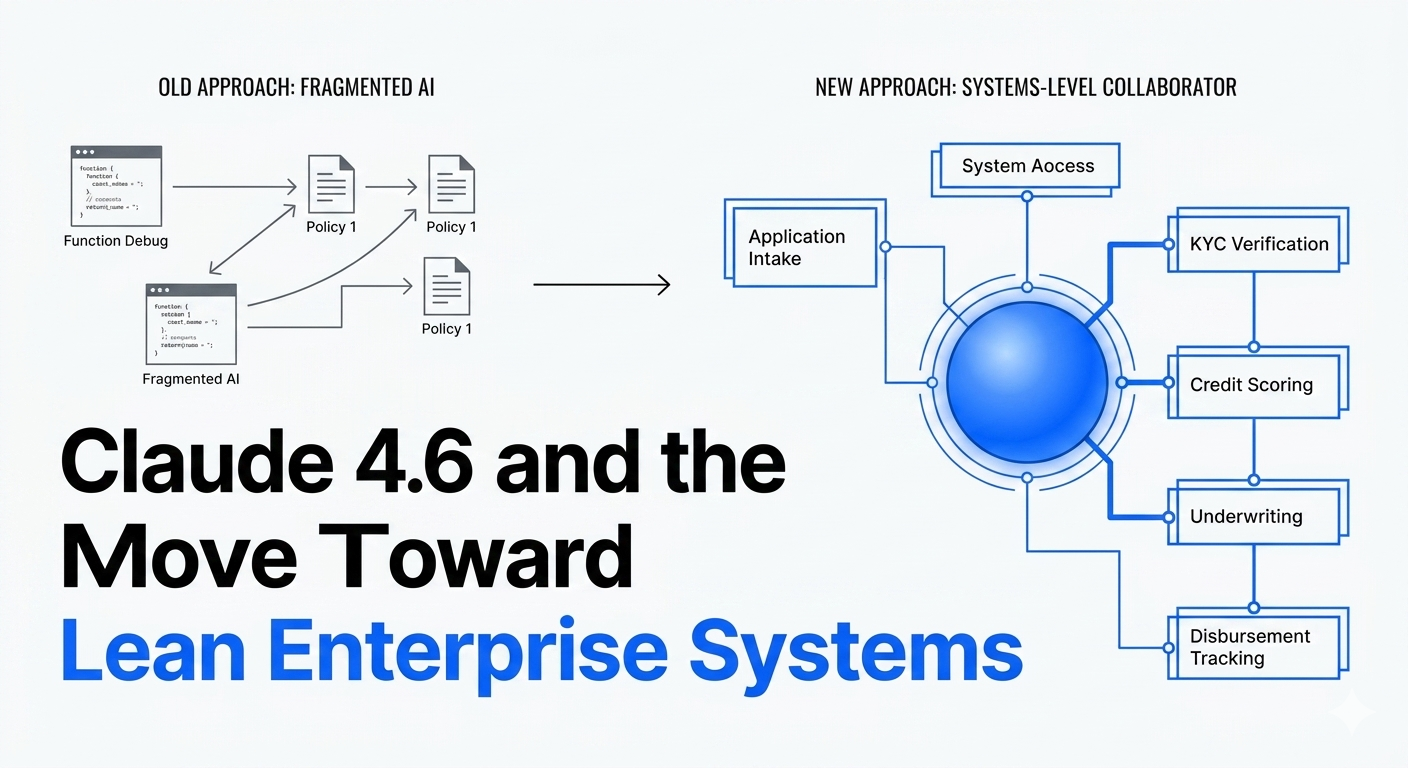
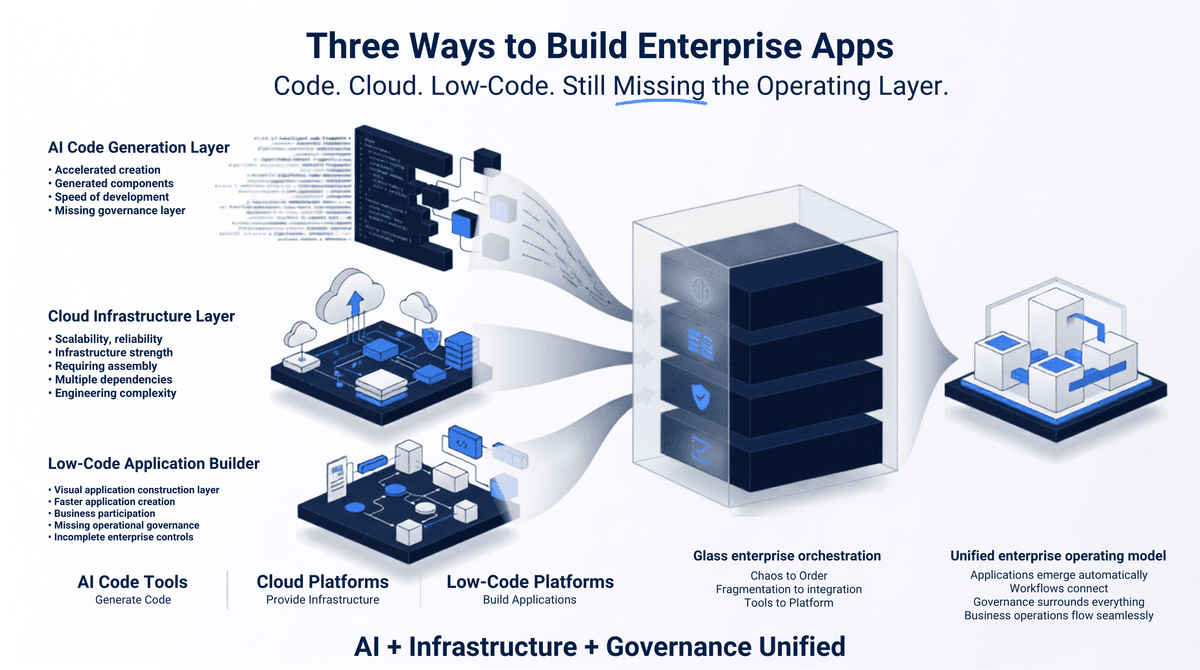
But here's what's important to understand: these tools generate code, not systems.
Enterprise software isn't a collection of independent scripts. It's hundreds of interconnected modules with data models, business rules, approval workflows, user roles, integrations, all of which need to be designed with awareness of each other.
As MIT Technology Review put it, AI has a tendency to not understand the existing conventions within a codebase and instead creates its own version of how to solve a problem.
That means you still need:
- Architects to design the overall system
- DevOps to handle deployment
- Security teams to harden it
- QA to validate it
There's no governance layer. No audit trail. No role-based access. No workflow orchestration built in.
AI code generators are brilliant at the "writing code" part. But writing code was never the whole problem.
For most enterprise application development projects, it's maybe 20% of the work.
So where does the other 80% come from? A lot of it starts with infrastructure.
Also read: How a COO Can Turn a Process into an App in a Week—with GenAI Low-Code
Cloud platforms: strong foundation, some heavy lifting still on you
AWS, Microsoft Azure, and Google Cloud have solved infrastructure at scale, including compute, storage, networking, identity management (IAM, SSO, MFA), and encryption.
But cloud platforms give you building blocks, not buildings.
To give you a real sense of what this means: a standard enterprise application deployed on Azure requires you to configure App Service Environments, virtual networks, Application Gateway, Key Vault, managed identities, RBAC policies, private endpoints, DNS, and firewall rules. That’s all before you've written a single line of business logic.
And every application you build requires you to re-implement:
- Authentication and authorization flows
- Error handling and logging
- Audit trails and compliance controls
- Change management and versioning
- Deployment pipelines and environment management
That's the boilerplate tax. You pay it on every single application.
These platforms are designed for engineers.
A Head of Operations cannot describe a procurement approval workflow to AWS and get a working system. What they get is an infrastructure bill.
Cloud platforms are necessary. I'd never argue otherwise. But the gap between having infrastructure and having a working, governed enterprise application… that gap is enormous.
This is exactly the gap that low-code no code platforms set out to close.
Also read: How GenAI Low-Code No-Code Platforms Help Enterprises Reduce Technical Debt
Traditional low-code/no-code: faster building, but still a lot of stitching
Low-code no code platforms brought application development closer to business users.
Drag-and-drop interfaces, pre-built components, visual workflow builders. Gartner projects that 75% of new enterprise apps will be built using low-code by 2026.
That's a structural market shift.
And the speed gains are real. Organizations report up to 90% reduction in build time for certain use cases.
But here's where it gets complicated.
Most traditional low-code no code platforms give you the app builder, but the infrastructure is still on you. You design the app in your LCNC platform, then deploy it on AWS or Azure, and you're still responsible for compute management, security posture, data governance, and compliance.
That creates a juggling problem. You're managing two stacks simultaneously (the low-code tool and the cloud platform) trying to keep security, environments, and CI/CD in sync across both.
And governance gaps tend to surface mid-project:
| Common gap | What it means in practice |
|---|---|
| Limited RBAC | Can't enforce granular access control across roles |
| Weak audit trails | Hard to prove compliance in regulated industries |
| Missing environment management | No clean separation of dev, staging, production |
| Platform lock-in | Proprietary formats make migration painful and expensive |
Power Apps, for instance, has documented limitations around compliance and governance that often require additional tooling and licensing to address.
For enterprises in BFSI, healthcare, or manufacturing (where regulations are strict and audit requirements are non-negotiable) these aren't minor gaps. They're deal-breakers.
Low-code no code platforms genuinely moved the industry forward. But most of them solve the "building" part while leaving the "running, securing, and governing" parts to you. And that stitching is exactly where speed dies.
So if code generators handle code, cloud platforms handle infrastructure, and low-code handles the builder, what happens when you need all three, working together?
Also read: How GenAI Speeds Up Low-Code Development
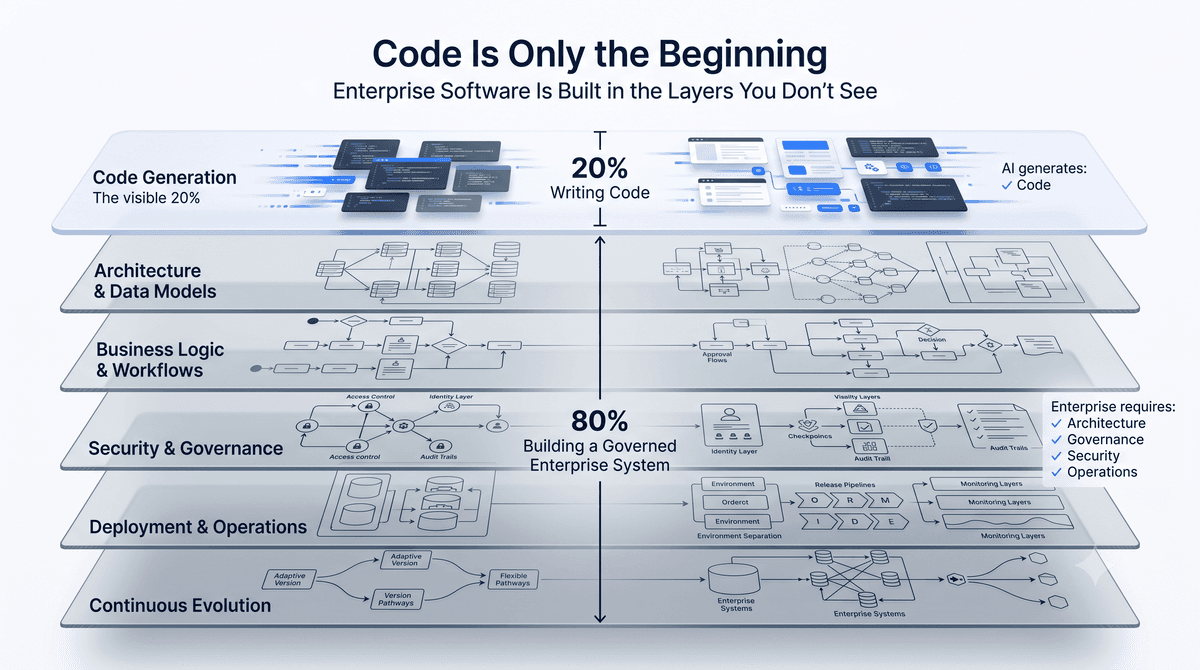
What's actually needed: one platform, not three tools
The enterprise doesn't need a better tool in any one of these categories.
What it needs is a unified no-code enterprise platform that brings together:
- The AI intelligence of code generators
- The enterprise-grade infrastructure of cloud platforms
- The accessibility of low-code builders
All on a single stack. Not three products duct-taped together.
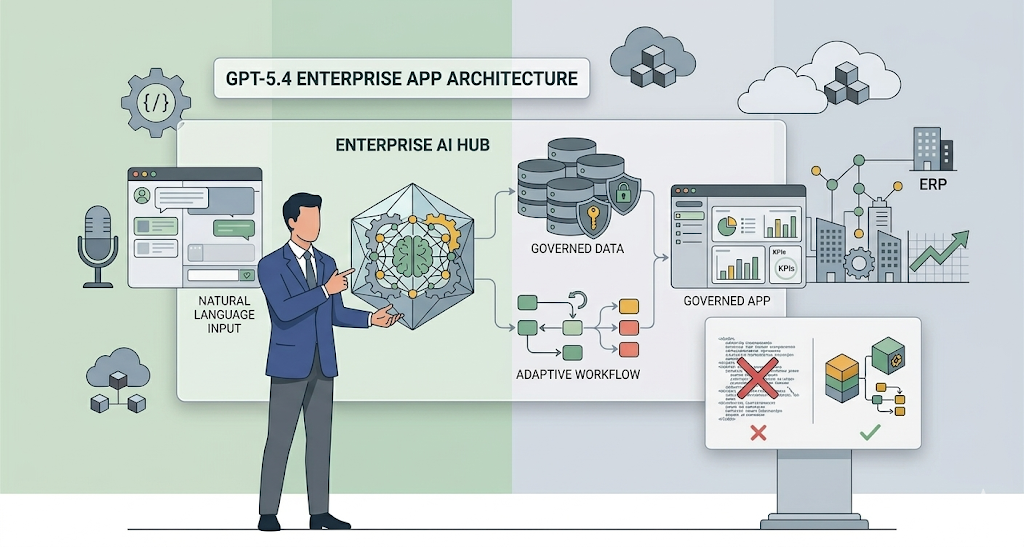
The real shift looks like this: a business operations lead should be able to describe a process and have the platform convert that into a production-grade application with governance built in. Without separately configuring infrastructure, wiring up security, or managing deployment.
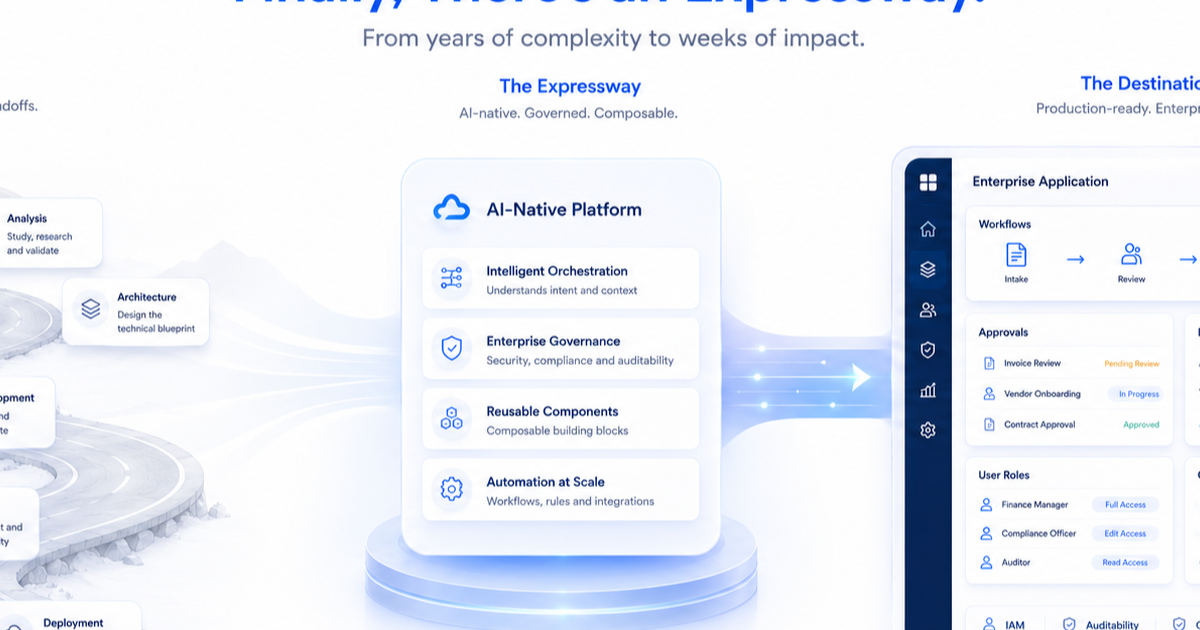
This is what GenAI low-code no-code platforms make possible. And this is exactly what we built Amoga to do.
You describe your business requirement.
The platform generates the solution design, data model, UI pages, workflows, and automation logic. You review, adjust, and deploy.
Infrastructure, governance, and security are handled under the hood as foundational layers.
Low-code no-code with AI isn't just a faster way to build. Done right, it's a fundamentally different operating model for enterprise application development.
The question isn't whether AI, cloud, or low-code wins. It's who puts them together in a way that actually respects how enterprises need to operate.
That's the problem worth solving.
If you want to see what this looks like for your specific operations, reserve a 30-minute demo tailored to your workflows.