Applications & operations Perspective
Cut Costs and Boost Profits: With A Low-Code ERP
Lets start with a simple question: Why does a business exist? Books have been written on the subject, but the answer can be summed up in one line: A low-code erp.

In this article 0 sections
Let’s start with a simple question: Why does a business exist? Books have been written on the subject, but the answer can be summed up in one line: A business exists to solve people’s problems - at a profit. Everything you do in your business responds to this goal. If you’re already profitable, the aim is to retain that profit and grow it every year.
However, how many businesses actually reach this point? The Institute of Business Value and Oxford Economics conducted a study revealing that 90% of Indian startups don’t survive past their 5th year. While it’s not fair to directly apply these numbers to established businesses, most leaders agree that growing profits is becoming more difficult each year. Even to maintain profitability, businesses need to do two things:
- Cut the cost of doing business
- Create products and services that deliver more value to customers
To achieve either of these goals at scale, businesses need robust ERP systems.
For traditional ERPs, the primary value proposition was always to enable businesses to run their processes digitally, with workflows that manage who does what and when, resulting in significant productivity gains. But has this actually happened?
Many businesses that invest in traditional ERPs struggle to see a direct impact on profits. If today’s business landscape is any indication, it’s clear that the limitations of rigid, outdated ERP systems prevent companies from scaling efficiently. That’s where a custom ERP changes the game.
With this guide, we hope to answer some of the difficult questions businesses face about ERP systems, such as:
- What is an ERP system, and why do businesses rely on it?
- Why do so many companies outgrow their traditional ERP?
- What makes a custom ERP more flexible and scalable?
- How does a custom ERP reduce costs while increasing efficiency?
- What’s the difference between a customizable ERP and a true low-code ERP?
- How can Amoga’s custom ERP solutions help businesses stay competitive?
By the end of this guide, you’ll have a clear understanding of why traditional ERPs fail to deliver on their promises and how a low-code custom ERP can transform business operations.
Also read: Standard ERP versus Low-Code Custom ERP
Why Did Traditional ERPs Fail?
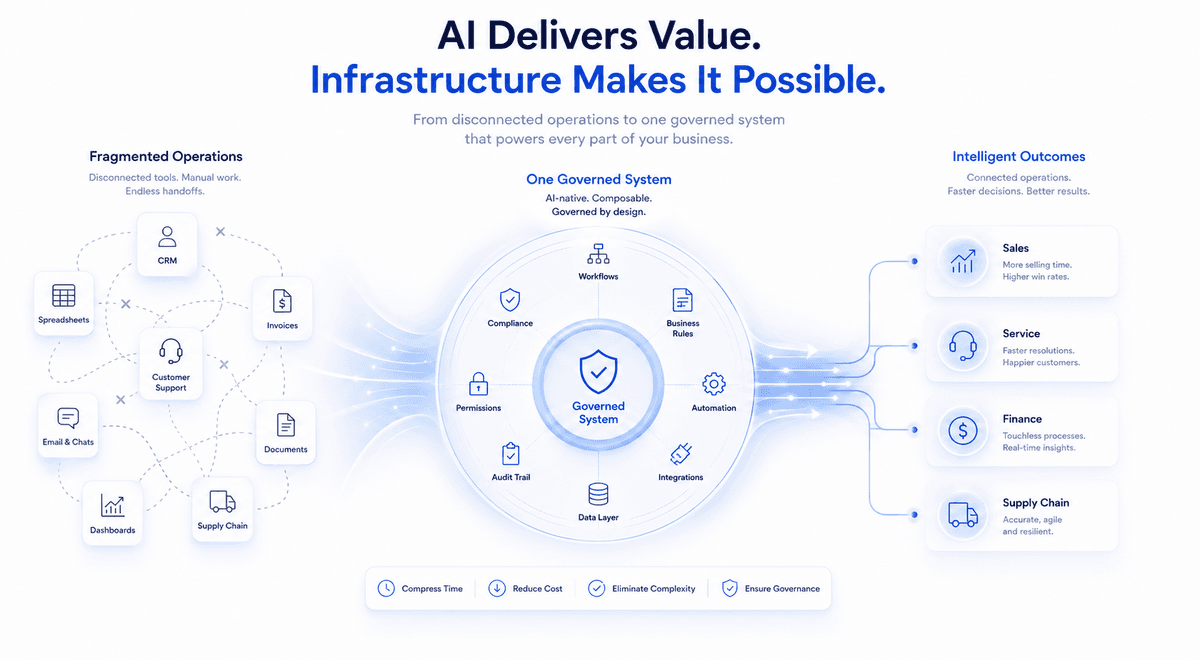
Traditional ERPs are built on the assumption that a business operates like a complex equation, with variables such as manpower, materials, time, and money. They also reflect a vendor’s idea of industry best practices. Over time, companies that invest in traditional ERPs realize the flaws in these assumptions.
First, even if you treat your business as a multivariable equation, that equation changes daily in response to market realities. Second, an ERP that mirrors industry standards may not align with your unique processes. And even if it does, your processes evolve and become more sophisticated over time. What happens when the ERP can’t keep up?
Here’s what:
- Your team spends a significant part of their day doing work that should have been automated long ago. Soon, your business is forced to seek a more flexible solution like a custom ERP.
- Employees need to remember intricate process details because the systems aren’t designed to assist them in getting things right the first time.
- Managers struggle to catch and correct errors, lose sight of the bigger picture, and get bogged down in day-to-day operations.
- The promise of “data-driven decision-making” remains unfulfilled, as a layer of shadow IT, relying on unauthorised apps and manual workarounds, arises to deal with rigid systems and processes.
The result? Your business is trying to sprint forward, but it’s shackled by outdated systems. This might sound bleak, especially considering how difficult it is to change an ERP once you’ve committed to it. But it’s not. Since the early 2020s, a revolutionary way of using technology has emerged to put the limitations of traditional enterprise applications to rest: Low-Code.
Many companies are now turning to custom ERP solutions built on Low-Code platforms, offering businesses the agility they need without the rigidity of traditional ERPs.
Also read: Enhance Organizational Efficiency with Amoga Custom ERP
What is Low-Code, and How is a Low-Code ERP Different?
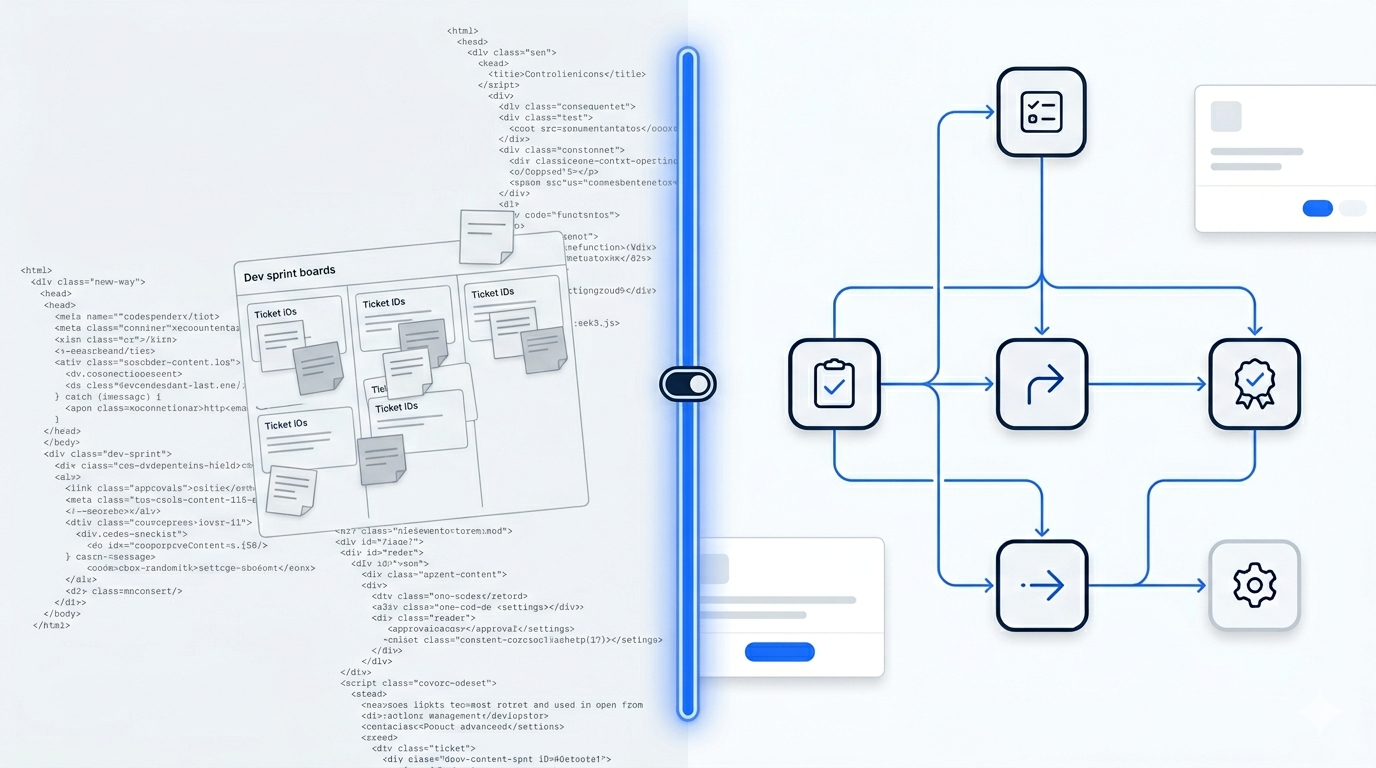
Low-Code is the antidote to everything restrictive and cumbersome about the old-school development model, where applications were coded line by line. Think about it: When you need to modify something built on tens of thousands of lines of code, you need a small army of IT experts. If you’ve ever worked with an IT team responsible for maintaining an ERP, you know how slow and challenging it is to make changes, despite all the available customizations. This is one of the major reasons businesses are now shifting toward custom ERP solutions
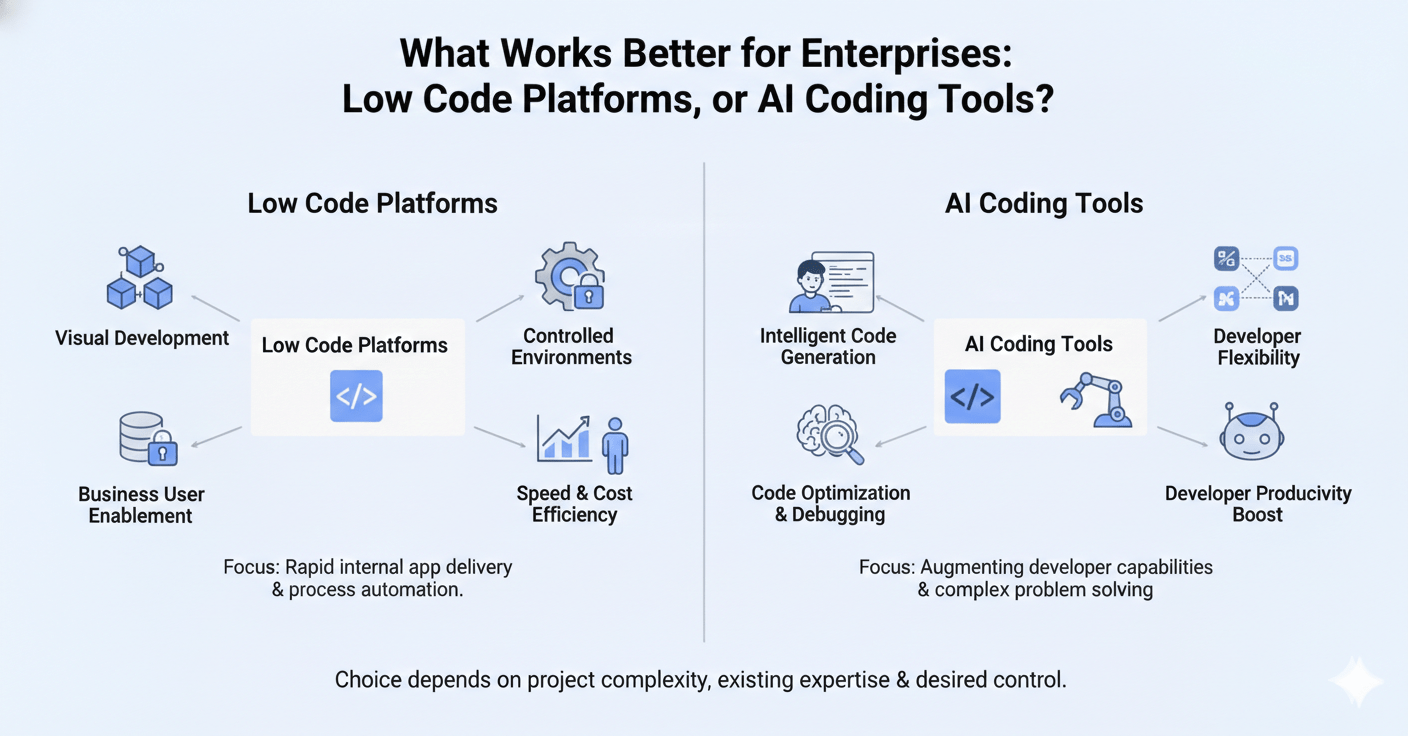
Low-Code, on the other hand, abstracts the line-by-line coding to the backend. It allows anyone to develop an application using a simple graphical user interface (GUI) that includes components such as workflow builders, UI designers, and reusable templates. This marks the most fundamental shift in application development-where the ability to build something is now within reach of anyone who does knowledge work, not just programmers. A built on Low-Code takes this a step further. It ensures that businesses can create applications that align with their unique processes
In this context, a Low-Code ERP gives users the power to shape the system in a way that lets them work faster, focus on what’s important, and do things right the first time. It enables managers to access insights when they need them, in the form they want, allowing every decision to be based on real data, not guesswork. Unlike rigid, traditional ERP systems, a custom ERP built with Low-Code make businesses agile.
For IT teams, it’s a gamechanger, enabling them to develop applications 10 times faster and at a fraction of the cost. This shift allows IT to move out of a constant firefighting mode and focus on delivering game-changing solutions that make the business more productive.
This triple benefit-developmental democracy, data-driven decision-making, and fast, inexpensive development-empowers businesses to achieve the dual goals of cutting costs and delivering more valuable products and services to customers.
Beware of the Difference: Customizable ERP vs. Low-Code ERP
However, there’s a key distinction between a highly customizable ERP and a true Low-Code ERP. This is why it’s crucial for anyone involved in IT procurement to understand the difference. Transitioning from a rigid, monolithic ERP to one with more buttons and levers doesn’t offer the revolutionary change needed to unshackle organizations from outdated ways of working. To unlock the full potential of your business, you need the true power of Low-Code. This is the core mission of Amoga.
Amoga’s approach to Low-Code is straightforward: It should give end users the power to build what they need. This philosophy is the heart and soul of Amoga’s Low-Code custom ERP software. In today’s business environment, every company must innovate and move away from standard industry practices to achieve a competitive edge. This means they need a Low-Code ERP that they can mold, rather than one that forces them to follow rigid processes.
Using an ERP to simply run things as they were before implementation is a recipe for disappointment. We believe the role of a Low-Code ERP is to free you to think in terms of the best way to do things, rather than how to encode processes into an ERP.
We’d love to tailor this conversation to your business and share relatable success stories from users of our custom ERP software. Book a demo, and let us answer your questions.
Frequently Asked Questions – Low-Code ERP
What is a low-code platform?
A low-code platform is a tool that helps people build applications with little to no coding. It offers drag-and-drop components, visual workflows, and templates that anyone with basic computer knowledge can use to build an application that they need.
What is a custom ERP, and how is it different from a traditional ERP?
A custom ERP is designed specifically for a business, instead of following a one-size-fits-all model. Traditional ERPs come with fixed processes, but custom ERP software is easy to adapt to the needs of a business. Unlike rigid systems, a custom solution can grow with your business. The key here is that the customization has to be easy, quick, and effective, and that is where low-code custom software excels.
Why do businesses prefer custom ERP software over off-the-shelf ERP?
Off-the-shelf ERPs may have many features that a business does not need. On the other hand, custom software is tailored to fit the exact business processes. If you are looking for a custom ERP, choose a low-code ERP solution because it will make customization easy, quick, and effective.