Applications & operations Perspective
Enterprises Want "Scale Without Mess" from Their Tech, and GenAI Low-Code Platforms Deliver It
This guide explains how GenAI low-code no-code platforms reduce tool sprawl, unify data, and support cleaner digital transformation at scale for modern enterprises.
In this article 0 sections
If there’s one sentence I hear most often from enterprise leaders today, it is this:
“We are scaling fast. But everything around us is becoming messier.”
And it’s true.
Growth brings new tools.
New tools bring new processes.
New processes bring exceptions.
And exceptions bring workarounds.
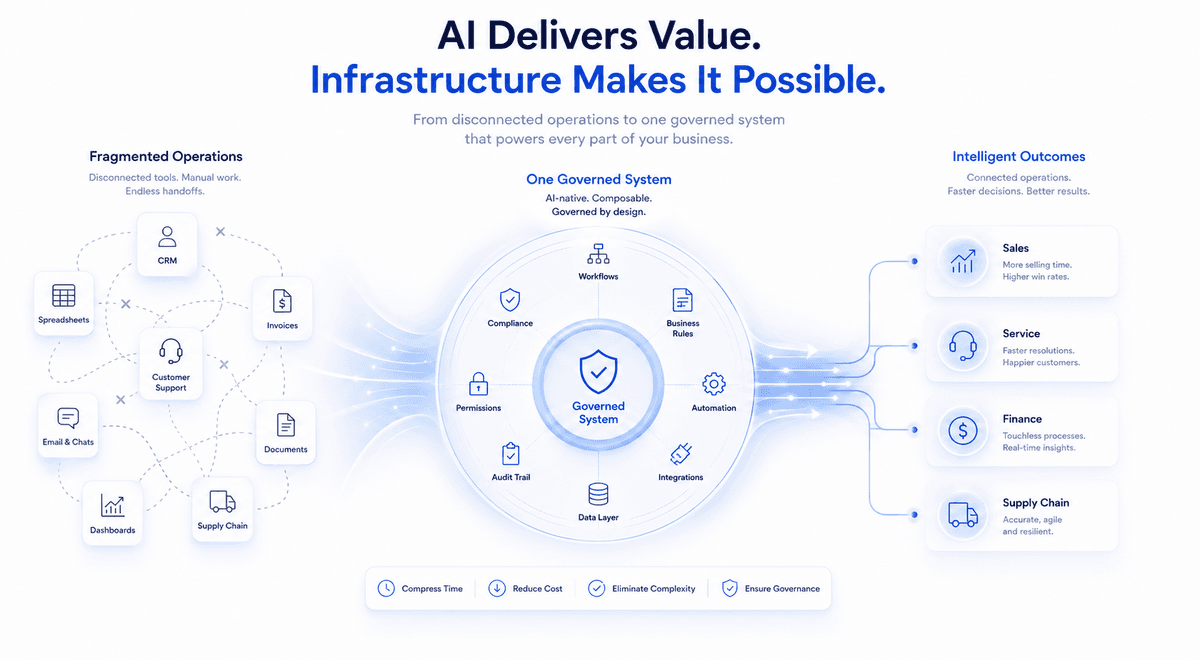
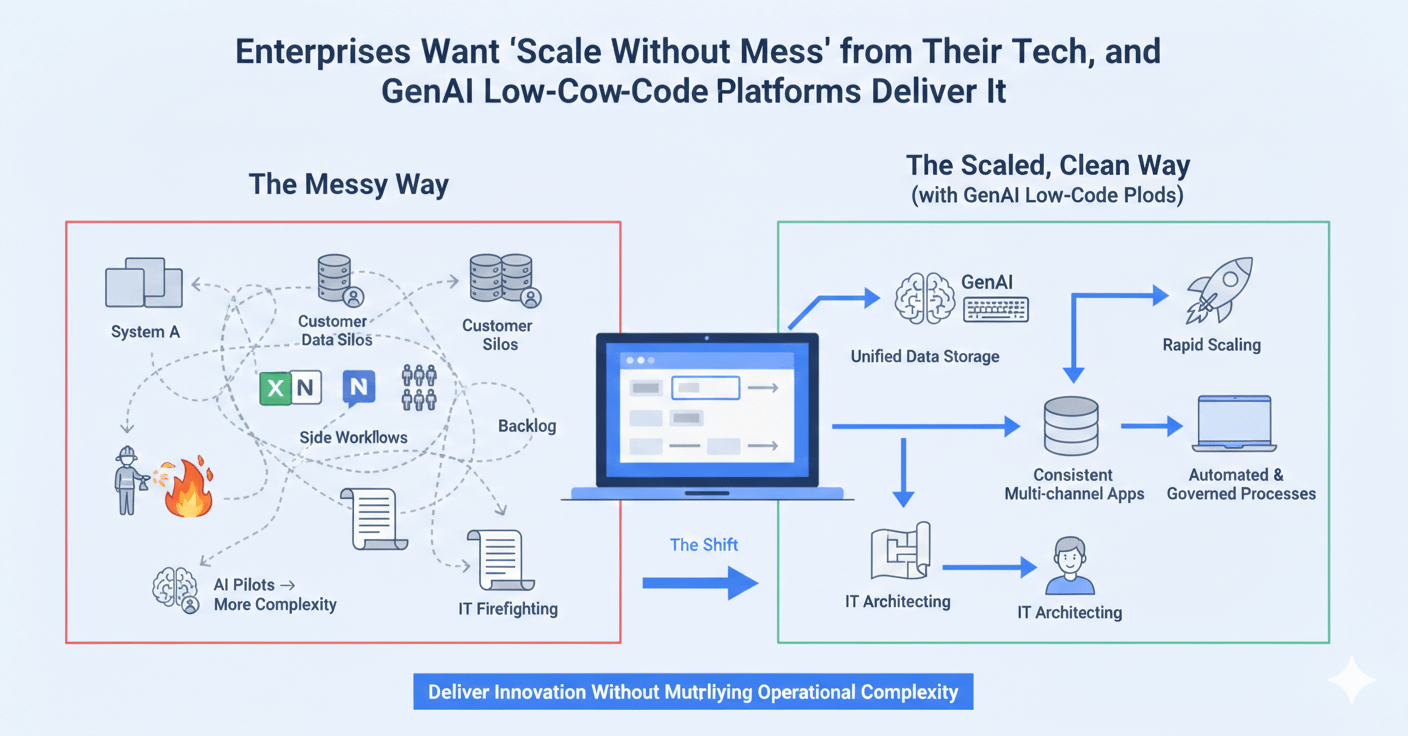
Before you know it, your organisation has:
- Three systems doing overlapping work
- Five tools storing the same customer data
- Teams running “side workflows” on Excel, Notion, and WhatsApp
- A backlog that only gets longer
- IT constantly firefighting instead of architecting
Even AI pilots eventually fall into this trap.
Most enterprises report that the real challenge is not AI itself, but without multiplying operational complexity.
And it is exactly this shift that makes low-code no-code-especially with AI-so powerful right now.
Also read: Stop Adapting to AI Features, Start Adapting AI to Your Operations: The Low-Code Control Advantage
The Shift: Why GenAI + Low-Code Changes the Scaling Equation
Something fundamentally new is happening in enterprise technology.
Until recently, speed and structure could not coexist.
If you chose speed, you lost architecture.
If you chose architecture, you lost speed.
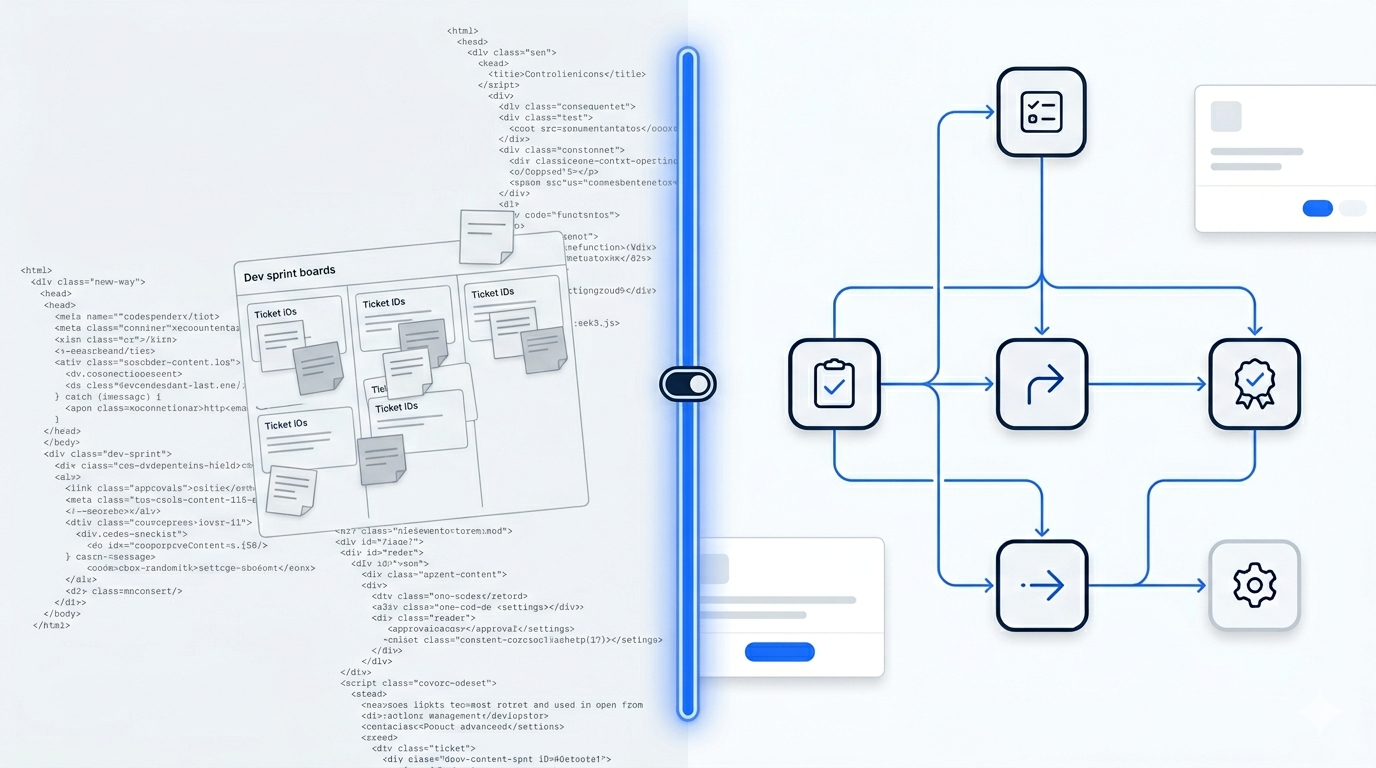
But low-code no-code with AI breaks this tradeoff.
Five Pillars of “Scale Without Mess” Enabled by GenAI Low-Code Platforms
Here are the six pillars that matter.
-
One Platform Instead of Ten Disconnected Tools
When every department builds on one low-code no-code foundation:
-
There is no tool sprawl
-
Apps follow common patterns
-
Quality remains consistent regardless of who builds 2. Data Unification Without Pain
A major source of enterprise mess is “many truths.”
GenAI low-code platforms enforce:
-
A shared data layer
-
A single definition for core entities
-
Automatic propagation of updates across apps
This eliminates brittle integrations and midnight sync failures.
3. Governance Built-In, Not Added Later
Enterprises typically bolt governance on apps proliferate.
That’s why audits become nightmares.
In enterprise low-code development, governance flows through the platform itself:
-
Uniform RBAC
-
Audit logs
-
Encryption standards
-
Version control
Every app is born compliant.
4. Clean Scalability of Apps
As business needs evolve, apps evolve too.
But on a GenAI platform, evolution doesn’t create divergence.
Updates respect original structure.
No more “v1, v2, v3_final.”
This protects long-term maintainability.
5. Iterations Don’t Create Mess Anymore
GenAI modifies apps at definition-level, not script-level.
So each change becomes:
-
An extension of the original blueprint
-
A consistent modification
-
A safe evolution you can trust
Iteration stops being expensive, and it stops breaking things.
We were convinced that if we could build a GenAI low-code no-code platform on these five pillars, we would have something enterprises could actually use at scale.
They grow like branches of the same tree, not weeds in a field.
The Amoga Approach - Build More Without Turning Your Digital Landscape Into a Jungle
Let me break down how we approach this.
Definition-Based Architecture (Not Code-Based Sprawl)
Every app in Amoga begins as a structured definition - a meta-language that captures:
- ObjectsAttributes
- Pages
- Workflows
- Automations
This means your applications don’t drift apart over time.
Unified Runtime Engine
Whether you build 5 apps or 150, each one runs on the same engine.
So you automatically get:
- Stable performance
- Predictable behaviour
- Uniform UI patterns
- Consistent security
No vendor fragmentation. No “this app behaves differently because someone else made it” problem.
GenAI App Builder for Real-World Speed
The GenAI builder handles:
- Requirement understanding
- Solution design
- Data modelling
- Page generation
- Workflow creation
- Automation logic
This removes weeks of analysis, design, and handover work.
Quick, Safe Iteration
If your users give feedback at 4 PM, you can revise the app by 4:30 PM without rewriting logic or refactoring code.
This is the essence of digital transformation at scale:
Once enterprises adopt this model, their patterns of scaling change dramatically.
Why This Matters Now - Enterprises Can’t Afford Digital Mess Anymore
The timing of this shift is not accidental.
Several macro forces are pushing enterprises toward cleaner digital ecosystems.
1. Regulatory pressure is increasing.
Data scattered across tools is a compliance nightmare.
DPDP Act, GDPR, HIPAA - they all assume you have system-level discipline.
2. Business cycles are shorter.
Teams must respond in days, not months.
But messy systems slow down iteration.
3. The cost of maintaining fragmented systems is rising.
Multiple vendors, multiple renewals, and endless integrations create compounding overhead.
4. AI must be scaled responsibly.
As Omdia and multiple industry reports highlight, scaling AI in enterprises calls for:
- unified data
- consistent governance
- secure workflows
You cannot achieve this while juggling spreadsheets, custom apps, and a dozen SaaS tools.
5. Enterprises want predictable foundations for innovation.
And that requires platforms that support AI-enabled application development while keeping architectural control intact.
In this environment, “scale without mess” is not a luxury, it’s becoming a necessary operating principle.
Conclusion - “Scale Without Mess” Is the New Enterprise Benchmark
If there’s one idea I’d like you to take away, it’s this:
Modern enterprises don’t just want to build faster. They also want to build cleaner.
That’s the real promise of genAI low-code no-code platforms.
They give you a way to:
- grow without fragmentation
- empower teams without losing control
- iterate without creating versions
- scale without drowning in integrations
This is low-code no-code with AI as an enterprise operating model.
At Amoga, we see this every day:
When technology scales cleanly, the organisation feels lighter, faster, and more confident.
Scale without mess is no longer an aspiration. It’s a platform capability. And soon, it will be the new baseline for enterprise software.
Let us show you-schedule a demo that works for you.