Agentic enterprise software Perspective
Escape the Excel Trap: How Low-Code Can Transform Your Business
Escape the Excel Trap: How Low-Code Can Transform Your Business Introduction One of the most natural things to do when managing a project is to turn to Excel to...

In this article 0 sections
Introduction
One of the most natural things to do when managing a project is to turn to Excel to organize information. Whether you are starting off as a one-person company, a team of founders, or a leader in a small to medium business, you would absolutely understand why Excel often ends up becoming your business management platform.
To some extent, there may even be merit in using a tool you are already comfortable with. You can manage business info, weave workbooks into processes, and create SOPs where people just know where to find data, how to use it, where to update it, and how to reconcile sheets. In fact, the flexibility of Excel-how it lends itself to unstructured workflows-can seem like a strength, allowing you to build any process around your data.
With this guide, we hope to answer some difficult questions about managing business processes efficiently, such as:
- Why do businesses struggle to scale when they rely on Excel for operations?
- What makes Low-Code and No-Code platforms a smarter alternative?
- How can businesses transition smoothly from Excel to a Low-Code app development approach?
- What are the real-world benefits of Low-Code No-Code platforms for teams of any size?
- Is a Low-Code software solution truly customizable for different industries?
- How does Low-Code application development improve efficiency while reducing IT workload?
By the end of this guide, you’ll have a clear picture of why moving beyond Excel is essential and how a Low-Code versus No-Code platform can help your business work smarter.
The Turning Point
However, when more data is involved and processes become tangled, you need an organization that can run efficiently. Unfortunately, the opposite happens when you rely on Excel as your business management platform. You need processes, accuracy in operations, and real-time data that managers can act on-but none of this happens with Excel.
You start feeling stuck because important processes depend on certain people who know how to navigate the Excel labyrinth that your operations pass through. Managers stop trusting Excel sheets because they don’t know whether the data they’re looking at is accurate or up to date. Many times, the data isn’t even available in the format they need, and they don’t have the time or mental bandwidth to manually go through multiple sheets to get what they want.
It becomes impossible to enforce quality standards because information drives process and process drives operations. But the information itself is scattered, hard to update, and even harder to reconcile and trust. This can literally keep your business stuck in its current state. To run efficiently, you need your team to know what to do when to do it, and how to do it right the first time.
This is exactly why businesses start exploring alternatives like a Low-Code versus No-Code platform, which offers more structured and scalable solutions. Transitioning to a No-Code Low-Code platform can help standardize processes without disrupting how your team works.
The Fork in the Road
When you reach this point, you face a choice, though both options seem equally painful. In fact, many businesses choose to stay stuck with Excel, missing the chance to accomplish much more with far less effort. They remain committed to a “toxic tech stack,” and to some degree, the complexity and cost of alternatives are to blame. Dedicated business applications may seem like the obvious solution. But anyone who runs a business knows the problems that come with this approach:
- Any business application you choose will enforce a structure on your operations, forcing you to change the way you work, which can be dangerous.
- It takes too long for these applications to become usable, and implementations can drag on, making the transition painful for the business.
- Retraining your entire workforce to use a new system can cause recurring daily operational problems.
- Over time, your business will need to change based on market dynamics, but traditional IT systems are rigid and can slow down this evolution.
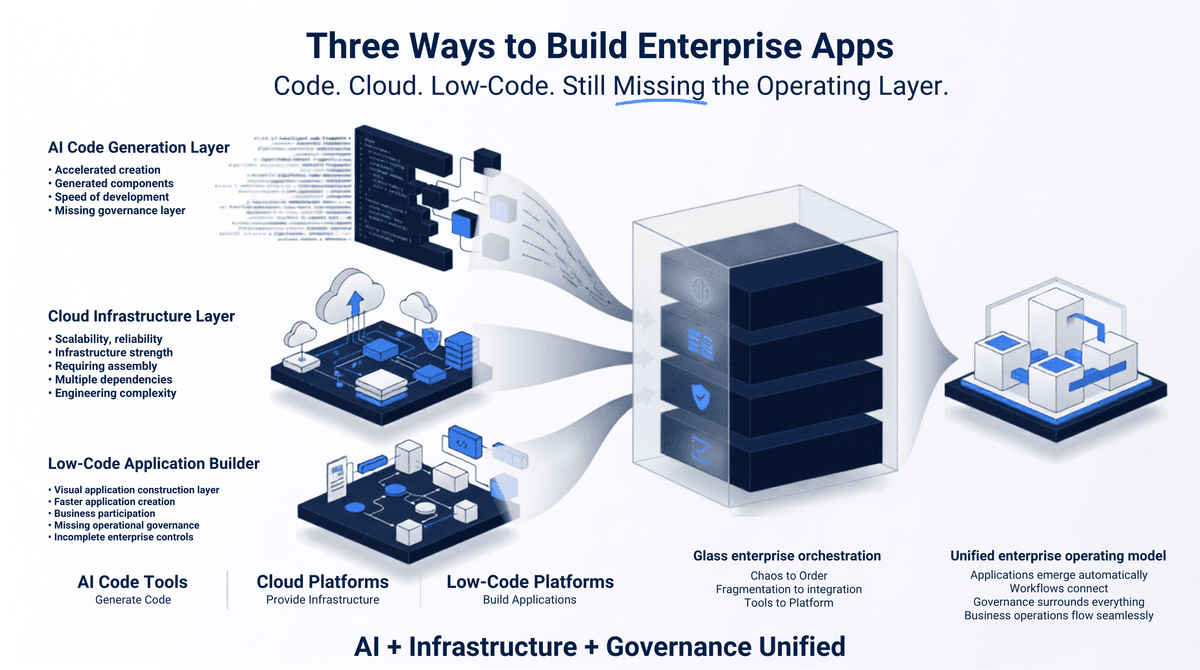
A better alternative is adopting a Low-Code application development strategy, where businesses can customize software to fit their existing workflows instead of being forced to adapt to rigid systems.
Thankfully, in the past five years, the tech landscape has seen a major shift-from high-code (where you write every line) to Low-Code app development, where coding is abstracted to the backend, letting users build applications through a GUI. This means that now anyone, even non-developers, can create applications.
What is Low-Code and Why Is It the Right Transition from Excel?
So, what exactly is Low-Code?
A Low-Code development platform includes several key components that let you develop and deploy applications with minimal hand coding. These include:
- A visual development environment with drag-and-drop interfaces to build user interfaces and workflows.
- Visual modelling tools to design data models and business logic.
- Pre-built templates and components that can be easily customized for your needs.
- Low-Code software that includes application lifecycle management tools to handle testing, debugging, version control, and collaboration.
- Pre-built connectors to common enterprise systems and databases, along with APIs and web service integrations, which ensure that your existing IT infrastructure can integrate with Low-Code No-Code platforms.
- A library of reusable components like UI elements, business logic modules, data models, and workflows, along with industry-specific templates, can drastically reduce development time.
When you choose Low-Code application development, you’re essentially choosing a philosophy that says everyone who uses an application should be able to build it. With a Low-Code platform, everyone in your team can quickly build the tools they need to work fast and accurately. Your IT team will be able to use the platform to create game-changing applications they never had time for before.
The biggest advantage of Low-Code platform development is that it allows you to transition from your current systems without feeling like you’re imposing an alien system on your workforce. Businesses looking for the best Low-Code platform find that it adapts to their workflows rather than forcing a complete overhaul. Low-Code platforms are designed to let your people continue working in the way they’re used to, while the system adapts to fit their needs, rather than the other way around.
At Amoga, we believe a platform is successful only if it delivers on certain promises:
- It should allow anyone in your team to build the tools they need to work in the best way possible.
- It should eliminate from your infrastructure.
- It should empower your IT team to work at and at .
- It should ensure and provide the right data in the right format at the right time.
We knew that nothing short of this would truly deliver on the promise of , and we’re proud to have built a platform that can fulfill that promise. If your business is at a point where continuing with Excel could harm your growth, we’d love to explain how can make the transition painless. Contact us for a demo at a time that suits you.
Frequently Asked Questions -
No, Excel isn’t a Low-Code platform-it’s a spreadsheet tool for data organization. Unlike Low-Code platforms with drag-and-drop app-building, Excel requires manual effort and lacks automation, scalability, and real-time collaboration features businesses need.
Low-Code platforms may offer limited customization and integration with existing IT systems. Security can be a concern without an enterprise-grade option. Some Low-Code development tools aren’t ideal for complex apps, and teams may face a learning curve transitioning from Excel.
Avoid Low-Code app development if you need fully custom code or strict compliance in regulated industries. Basic spreadsheet users won’t benefit, and large enterprises with IT teams may prefer traditional coding. Low-Code versus No-Code platforms vary in flexibility, so choosing the right one is critical.