Agentic enterprise software Perspective
Gamifying Work and its Importance
Gamifying Work and its Importance Introduction In 2011, a game called Foldit, an online puzzle game about protein folding, took the scientific world by storm by...
In this article 0 sections
Introduction
In 2011, a game called Foldit, an online puzzle game about protein folding, took the scientific world by storm by solving a mystery that had been unsolved for decades in three weeks. This was the first example of how this game challenge mobilized thousands of players from all over the world – who even had no expertise in this area – simply by receiving points and being part of a ranking.
This phenomenon was later transferred to the field of business, where the gamification trend was already emerging. By gamifying tasks, day-to-day tasks become a game from the employees’ point of view, which will undoubtedly influence not only their motivation and engagement but also increase productivity.
However, carrying out a gamification strategy in the company does not mean that any “game” in which there are prizes and points is valid. Instead, a game design expert should try to create one that immerses and engages employees.
Gamification is not only synonymous with fun but also with how to engage employees enough so that they not only stay with the company but are also motivated.
According to a survey by Zippia in Feb 2022, 90% of employees think gamification makes them more productive. And, on average, employees experience a 60% engagement hike with a gamified work experience.
What is Gamification in the workplace?
You may think of gamification in the workplace as simply introducing the game to reduce employee stress.
However, it is about much more.
Gamification is defined as the use of activities and external rewards to foster motivation in different contexts. It is designed to increase a person’s experience and commitment to a course, goal, or system. While gamification has been present throughout human life, what is interesting is that gaming elements have started to appear in the organization to boost productivity and drive employee engagement. With the increase in remote/hybrid models, gamifying work has become vitally important to maintain interaction and healthy competition between employees.
No doubt, badges, rewards, and points work well when it comes to motivating and encouraging students. But, as an effective alternative to points and badges using a level-up approach is an element of healthy competition in the workplace. This creates a sense of community and increases engagement in the workplace, which is fantastic for organizational success.
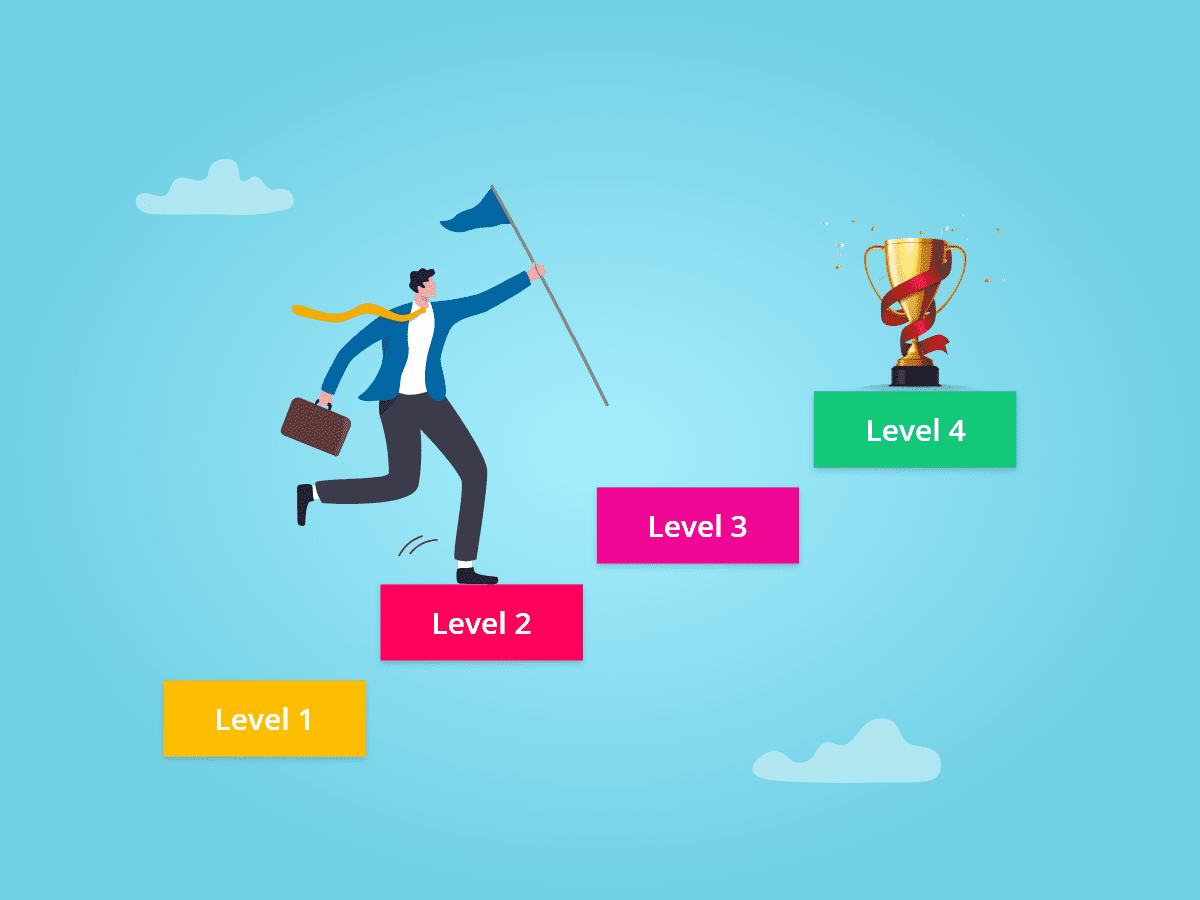
Today, game developers have pioneered in driving human behavior and the mind. They know how to keep the player engaging and motivated throughout the game by designing it on multiple levels. Players would begin from level 1 and proceed through increasingly numbered levels (of increasing difficulty) until they reach their final level.
Moreover, the game developers don’t want to spoon-feed players by making every level easy to pass through and eventually making players bored. In the same way, they also don’t want to make anything arduous that will demotivate their users. Thus, to keep the player engaging and motivating, game developers follow a level-up approach.
So, what is gamification and how Amoga helps you?
At Amoga, we gamify work by presenting growth and work progress through multiple levels. Each level is usually associated with an objective and a set of instructions for that particular level. The first level is as simple as straight walking from point A to point B. Once the employees complete the first level moves on to the next level, and so on. This way, employees feel a continuous sense of progression and foster a sense of accomplishment at each level, and eventually, they form a habit of levelling up at the workplace.
Let’s remember that progression should be designed in work to recognize the challenges already completed by the employee and offer new challenges adjusting to the employee’s current skill. This way, the employees stay motivated and are excited to play more and complete the levels, allowing them to face more complex challenges easily, usually by unlocking additional content.
With Amoga you can work in levels and scorecards which allow you to:
- Monitor every employee’s performance.
- Get unique insights about each task.
- If underperformed, coach them towards exceeding their personal goals timely.
Now that you know what gamification is and in what fields it can be applied, we will present some of its advantages of gamification in the workplace:
- Promotes employee engagementIf you understood a little about gamification, you must have thought that it might have to do with engagement, right? And this is one of its significant goals and benefits!Anyone who deals with people, management, and knowledge knows that one of the great difficulties encountered is precisely engaging people within the trails and learning journeys, right?Even more, keeping employees motivated within a learning path is a great challenge with the increase of the home office. Thus, gamifying work is an extremely positive point in this aspect. The game and its dynamics make employees leave their place of comfort, challenge themselves, think together, and overcome limits to achieve victory or the expected result.
- Strengthens knowledge managementAnother difficulty found in addition to engagement is the continuity of employees in the knowledge journey. Often, people carry out training and prepare for their activities. However, after some time, they stop accessing their knowledge bases because they think they have already absorbed as much knowledge as possible.By implementing gamification, trails, rankings, scores, rewards, and other methodology structures, the employee sees value and benefits in their learning and will certainly follow more fluidly in the knowledge management strategy.
- Provide instant feedbackA necessary feature of gamification is feedback, be it positive or negative. By embedding instant feedback into the game and even linking this feedback to the outcome, participants can monitor their progress throughout the gamification process and can even feel intrinsically motivated to complete it successfully.Leader boards offer an additional feedback mechanism, allowing participants to see how their results compare to those of their peers.
Next Steps
Request an enterprise demo to accelerate your process-to-app delivery.