Applications & operations Guide
How can Low-Code service CRM boost your CSAT scores?
How can Low-Code service CRM boost your CSAT scores? Introduction If your organization uses CRM software to measure CSAT, youre likely familiar with low-code crm.

In this article 0 sections
Introduction
If your organization uses CRM software to measure CSAT, you’re likely familiar with this puzzling situation. Your team works hard and goes the extra mile, and your regular customer interactions seem fine. There might even be a few positive comments here and there. Six months down the line, when the CSAT scores are out, the report card is far from flattering. It’s like a splash of cold water in the face.
You’re left wondering:
- Are we doing something wrong?
- What exactly are we doing wrong?
- Where should we even start to fix this?
Why does this happen? It all boils down to a mismatch between your initial assumptions and the realities of your customer service CRM software.
What This Guide Will Help You Answer
With this guide, we hope to answer some of the difficult questions businesses face when dealing with and CSAT challenges, such as:
- How can make tracking satisfaction easier?
- Why do CSAT scores sometimes not reflect actual service quality?
- How can businesses adjust their CRM strategy to improve results?
- What common CRM mistakes lead to low CSAT scores?
- How does a more flexible approach to CRM improve customer satisfaction?
By the end of this guide, you’ll have a clear understanding of why traditional CRM systems often fall short and how a more adaptable solution can transform your service operations.
Also read: Boost Your Sales Team’s Productivity with Low-Code CRM
How a traditional service CRM pulls CSAT scores down
Most companies start with reasonable assumptions when they encode the CSAT-capture process in their service CRM. Chances are you did the same. You might have started with a hazy idea of:
- What to measure
- How to measure it
- What questions to ask the customer
- Whom to ask
- How often to ask
These assumptions guided the design of your service CRM’s CSAT tracking and reporting. However, the day-to-day reality of customer service work challenges those initial assumptions. For example:
- Are you equating service-level agreement (SLA) performance with customer satisfaction? SLA performance can be a proxy for transactional customer satisfaction, but nothing more. CSAT is a more overarching number that captures what the customer thinks about your service on the whole. Even a feature-rich CRM software won’t be effective if it doesn’t allow flexible data collection.
- If you’re using a voice-of-customer (VOC) approach to CSAT, are you relying on a single questionnaire sent months after service interactions? Customers will forget the specifics of their experience and base their responses on recent interactions. To truly capture the voice of your customers, did you send them weekly reports that clearly told them that you were in control of quality most of the time? Had you done it, the CSAT scores would have been based on reality, not feelings. An adaptable CRM software for sales or customer service must enable ongoing engagement.
- Did you capture the right data? Consider a D2C eCommerce business where customers purchase several items in one order. Deliveries happen in multiple lots - say three on average. The CSAT measure is about ‘how easy the e-store ordering system’ is. But customers receive three CSAT prompts, one after each delivery. Due to these repetitive requests, customers get used to ignoring these prompts. The response rate drops to 5%. Service teams can recognize this flaw quickly, but IT says fixing it will take three weeks and a significant budget, which isn’t approved. What happens next? Trust in the CSAT system erodes; everyone feels it’s a losing battle. If your CRM lacks customization options to refine survey triggers, it can lead to poor engagement.
Can the COO even blame the service leaders for letting their teams lose motivation when their CRM refuses to budge to their needs? A rigid CRM does even more damage. It forces your service team to fight an uphill battle where scores are unfairly negative due to the way data is collected, not the quality of service. And that’s where service teams give up.
Thankfully, there is a solution that attacks the core of the problem, and does that beautifully. It’s a Low-Code service CRM. Let’s see how a Low-Code service CRM gets your service teams the flexibility and adaptability they need to make great CSAT a certainty, not a surprise.
Also read: Fix Your Broken Sales Processes with a Low-Code CRM
How Can a Low-Code Service CRM Solve This Problem?
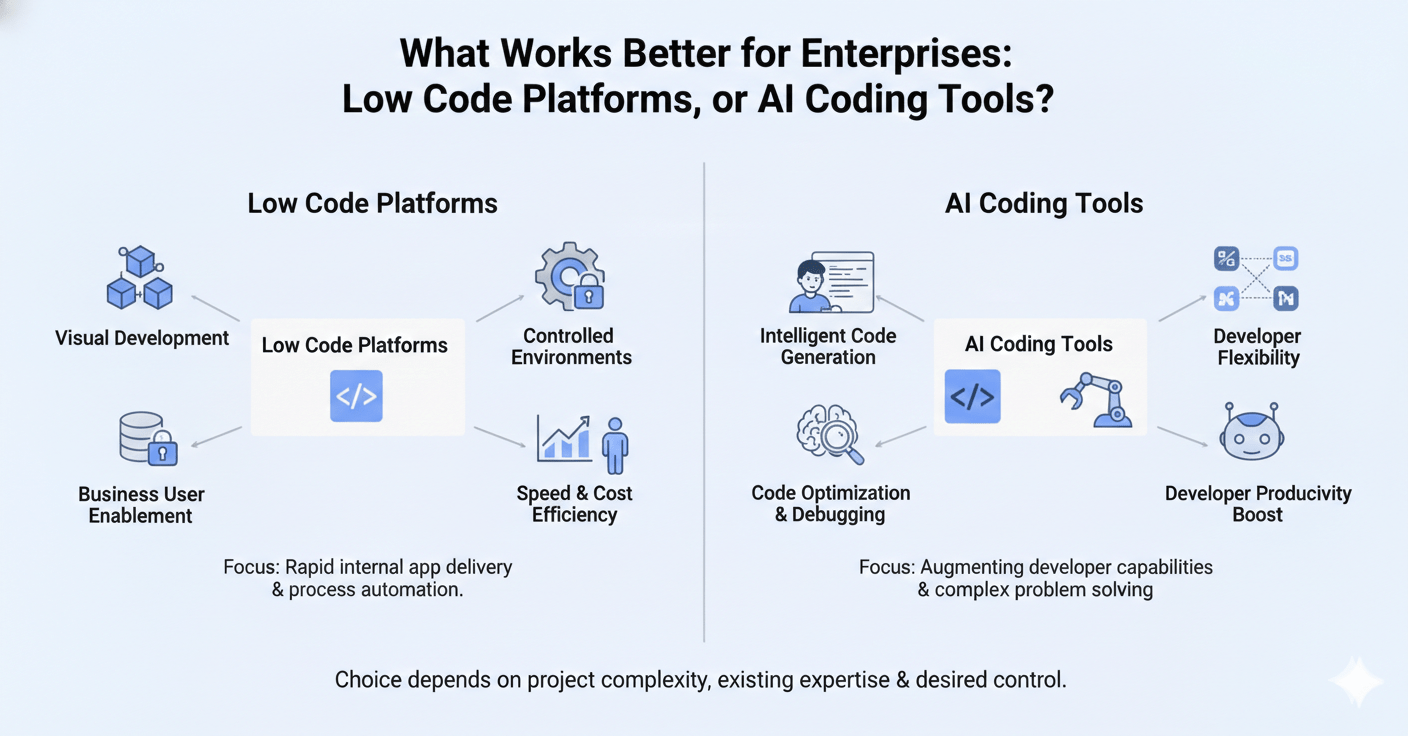
Imagine a platform where you can easily build and customize your CRM software without needing to be a coding expert. This is the power of Low-Code. A Low-Code platform offers key components that set it apart from traditional CRM tools.
- A drag-and-drop interface allows users to build and customize applications visually without being coding experts.
- Pre-built templates serve as starting points for new projects.
- Graphical workflow builders that enable users to design and automate business processes.
- Built-in connectors that integrate external systems and applications.
- Components and modules created in one project can be reused across multiple applications.
But how does a Low-Code service CRM tackle the issues we discussed earlier?
- Your team can build what they need when they need it. No more waiting on IT for every little change. They can easily adjust workflows, data capture, and reports to match the realities of their work. Unlike traditional systems, a flexible Low-Code solution can also function as a powerful customer service CRM software.
- The IT team is freed up to focus on significant developments, which they can now do in 1/10th the time and at 1/4th the cost. With the ability to build sophisticated apps quickly and easily, leaders are more likely to approve ambitious CRM enhancements.
- Low-Code service CRMs are designed for flexibility. You can capture any data you need, from any source, and create automated reports that deliver the right information to the right people. This ensures that everyone is focused on the metrics that truly matter for customer satisfaction.
In essence, with a Low-Code service CRM, your service team can:
- Focus on what truly drives customer satisfaction, not just arbitrary KPIs.
- Spend more time on activities that improve the customer experience, not on wrestling with a rigid service CRM.
- Gather the insights they need to understand your customers and their needs.
- Capture critical data points that influence CSAT and manage the expectations and opinions of those who will respond to CSAT questionnaires.
This is how a Low-Code CRM helps you create a customer-centric culture that naturally leads to higher CSAT scores. But not all Low-Code CRMs are the same.
How does Amoga’s Low-Code service CRM help?
At Amoga, we believe that customer service shouldn’t be confined to a single department; it should be the heart of your entire company. As a tech company, we live and breathe this philosophy. And we’re convinced that it holds true for any business. That’s why we built a customer service CRM software solution that empowers everyone in your organization to get the technology they need to do their work better and faster.
For us, Low-Code doesn’t just mean “highly customizable.” It means democratizing the development of features and enhancements; it means putting the power in the hands of the people closest to the work.
We believe our solution can transform your customer service and improve your CSAT scores. But claims aside, we understand that you need to see exactly how we will solve this problem for you. So, book a conversation with us. Share your experiences with CSAT measurement, your challenges, and your aspirations. We’ll show you how Amoga’s Low-Code service CRM has solved similar problems for other clients, and how it can transform your approach to customer service.
Frequently Asked Questions - Low-code CRMs
A low-code platform lets you build software without the need for advanced coding skills. It comes with drag-and-drop tools and pre-built templates that you can use to create applications quickly. A business can use it to develop applications with fewer resources and, in doing so, automate their processes and improve efficiency.
Low-code CRM software allows your business to build a customized CRM without having to depend on large IT teams. When a CRM is built on a low-code platform, it is easy to maintain and upgrade as customer-facing processes change, which is very frequent in an organization.
A low-code CRM can be instrumental in improving your lag indicators, such as CSAT scores. This is because, with a low-code CRM, you can quickly upgrade your technology to suit the business process. For example, you can build a dashboard that captures customer feedback, run analytics on it, and generate ideas and insights for managers. Then, the managers can decide on process improvements, which can be mapped into the CRM software within a matter of days. This makes it possible for service personnel to perform the right tasks at the right time without having to memorize complicated customer service processes. Eventually, this manifests in the form of better CSAT scores.