Applications & operations Perspective
Legacy ERP Holding You Hostage? Break Free with Agile Integration
Modernize legacy ERP execution with low-code integration. Learn a six-week rollout model that reduces risk and improves operational agility.
In this article 0 sections
When Legacy ERP Becomes an Operations Bottleneck
Most teams do not reject ERP systems because they dislike process discipline. They reject them because change cycles become too slow for real business demands. New pricing logic, approval rules, or data fields can take months to implement.
When the system cannot adapt quickly, teams move to spreadsheets, manual workarounds, and disconnected tools. That creates delay, inconsistent data, and higher operating risk.
Three Signals Your ERP Is Holding You Back
- Simple workflow changes require long vendor or IT cycles.
- Teams re-enter data across multiple systems to complete one transaction.
- Business teams cannot launch process improvements without custom coding.
These are not isolated issues. They are architecture symptoms.
Why Traditional Fixes Often Fail
Upgrade Programs
Version upgrades can be expensive and still leave the same rigidity in place.
Rip-and-Replace Initiatives
Full replacement projects increase execution risk and usually require multi-quarter disruption.
Point Integrations
Custom integration layers may solve one bottleneck but create long-term maintenance overhead.
A Better Approach: Low-Code Integration Layer
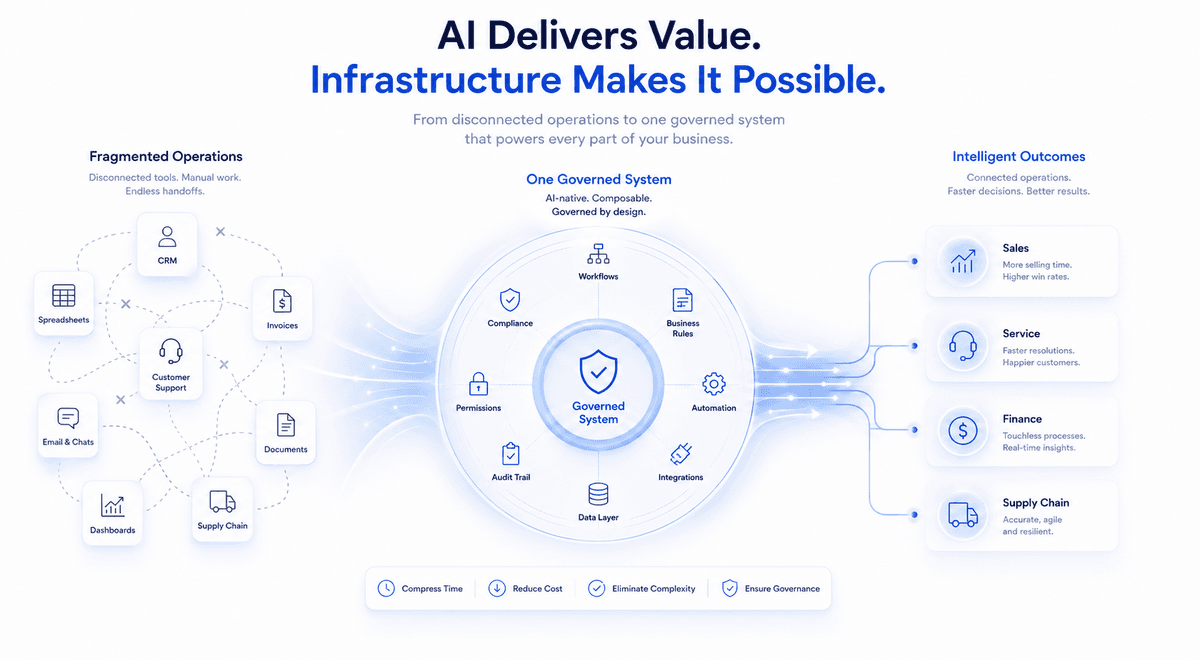
Instead of replacing the ERP core immediately, add a low-code layer that handles modern workflows, user experiences, and system orchestration. This gives you speed and flexibility while preserving stable backend systems.
Use cases include approval automation, procurement workflows, sales-to-operations handoffs, service ticket routing, and KPI dashboards.
Six-Week Rollout Pattern
Weeks 1-2: Scope One Process
Choose one high-friction process and define cycle-time and error-rate targets.
Weeks 3-4: Integrate and Build
Connect ERP data, build workflow logic, and validate role-based access and audit logging.
Weeks 5-6: Pilot and Expand
Deploy to a controlled user group, measure outcomes, and expand to adjacent workflows.
How Amoga Supports ERP Modernization
Amoga helps teams modernize operations without large-bang replacement risk. You can build process applications quickly, integrate with existing systems, and keep enterprise governance controls intact.
Learn more in Low-code ERP guide and explore the core capabilities on the Amoga platform.
Next Steps
If your ERP is slowing execution, start with one process where delay is visible and measurable.
Book your personalized demo and map a low-risk modernization path.