Applications & operations Perspective
Taming SaaS Sprawl: Gain Control & Cut Costs with Strategic Low-Code
Taming SaaS Sprawl: Gain Control & Cut Costs with Strategic Low-Code Get Started Table of Contents Digital-native businesses are supposed to move fast. Yet many...

In this article 0 sections
Digital-native businesses are supposed to move fast.
Yet many ops leaders feel the gears grinding sooner than expected.
In the first two years of life a typical young company already juggles about 16 SaaS apps
And that’s before the true scale kicks in.
Even back in 2017, BetterCloud found that organizations struggled once they crossed just 16 tools.
In the mid 2020s, when young organizations want to run faster than ever, the trouble of SaaS-sprawl is much more pronounced.
When the number of your SaaS applications tips into double digits, running fast becomes hard, because coordination, integration, and license oversight become noticeably hard.
Large enterprises with more vision and resources have reacted decisively.
97% of the Fortune 500 now use a low-code SaaS environment to keep application growth under governance.
Analysts expect that discipline to become mainstream: Gartner estimates that by the end of 2025, 70% of all new business applications will be built with low- or no-code technologies, up from < 25% in 2020.
The lesson is clear: without a strategic low-code foundation, SaaS adoption quickly tips from advantage to operational friction.
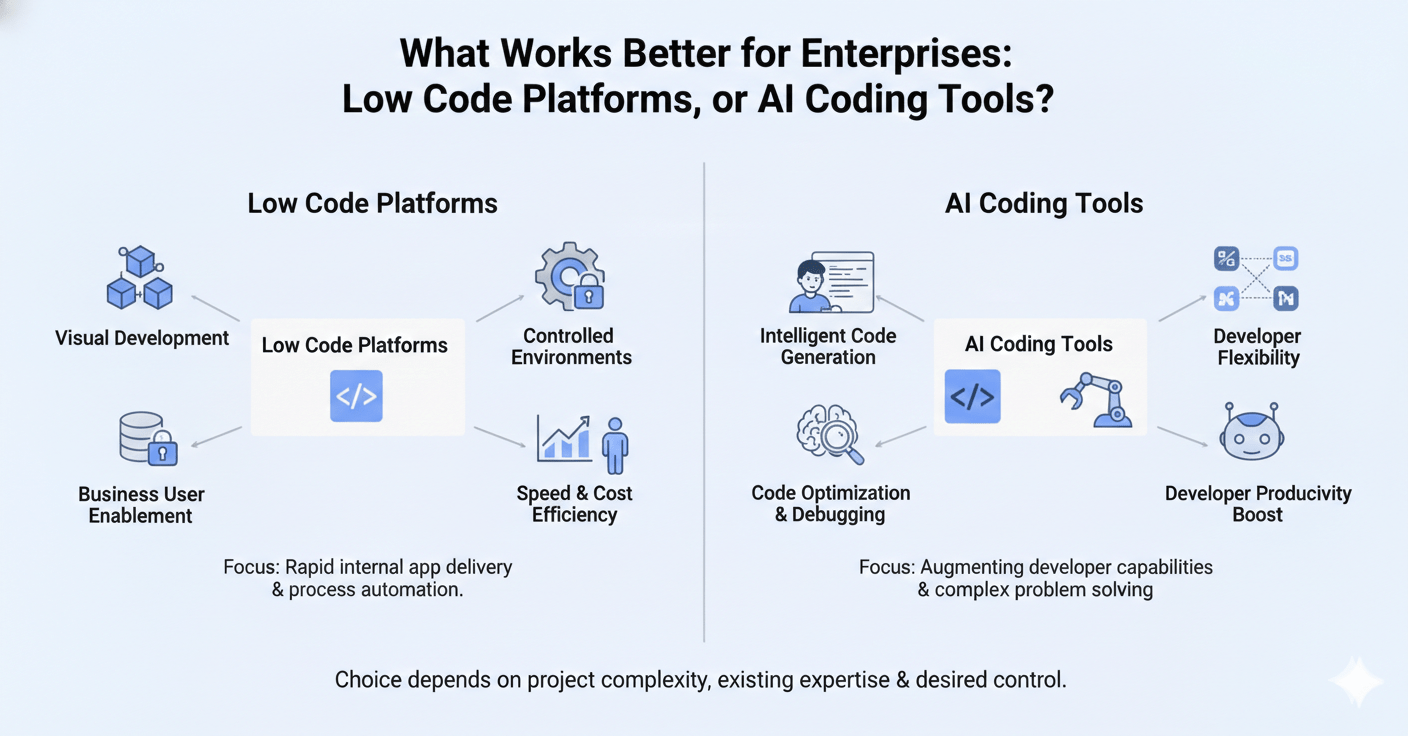
Two Strategic Paths: Tighten Controls? Or Embrace Low-Code SaaS?
Operational leaders faced with swelling licence counts and uneven data flow typically consider two responses.
Path A – Process Tightening: Centralize procurement, lock down renewals, and introduce stricter approval gates.
While such hygiene is necessary, it rarely scales. Manual oversight absorbs time, and teams bypass controls by buying niche tools on corporate cards.
Path B – Strategic Low-Code IT. Adopt a governed low-code SaaS platform that allows integrations and bespoke micro-applications to be delivered rapidly inside a secure, policy-controlled space. In fact, 72% of IT leaders now say project backlogs block them from strategic work.
Common objections of the CIO and COO-“Is it secure?” “Will it scale?”-are increasingly outdated. Enterprise LCAPs run on scalable cloud infrastructure, publish open APIs for pro-code extensions, and pass the same compliance audits as traditional SaaS.
Pick a slot for a live walkthrough with our team.
Also read: CRM Hub: Transforming Customer Service With Low-Code
Amoga – Engineered to Contain and Reverse SaaS Sprawl
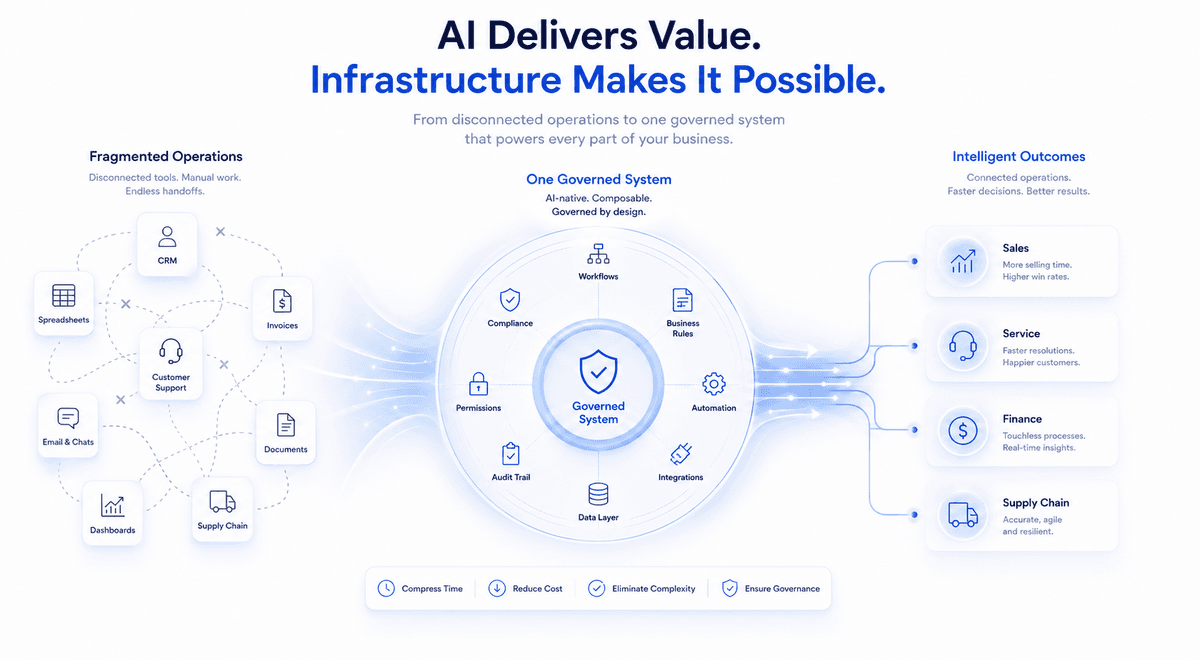
Amoga was conceived with SaaS sprawl as a first-order design problem. Its architecture rests on five technical pillars that give operational leaders a direct line of sight – and control – over application growth.
-
Unified Integration Fabric – Drag-&-drop connectors tap into CRMs, ERPs, data warehouses, and home-grown APIs. An event-driven pipeline syncs changes in real time, which gives you low-code SaaS integration without custom script debt.
-
Governed Citizen Development – A policy engine enforces RBAC, data-loss prevention and version control and still lets power users drag-and-drop their way to solutions. IT sees every asset, audit logs roll automatically, and Shadow IT evaporates.
-
Enterprise-Grade Security & Reliability – Multi-tenant isolation, SOC 2 alignment, regional data residency, and always-encrypted transit/storage mean your custom low-code SaaS platform meets the same bars as best-in-class SaaS.
-
Lifecycle Analytics – Built-in usage telemetry highlights idle licences and overlapping functionality; finance can model savings before a renewal hits, then track post-consolidation ROI on a live dashboard.
-
Composable Micro-Apps – Need survey forms, request portals or a lightweight CRM add-on? Build them as plug-in “micro-apps” that live natively on Amoga. Consolidate two or three niche subscriptions into one governed workspace-no feature bloat.
In 2025 Q1, an Amoga customer replaced a survey tool and a kanban app with a single request-tracking micro-app-integrated with Slack and their ERP-within six days of effort.
The outcome was a 45% reduction in subscription expense for that workflow and the removal of two ungoverned data silos.
This is merely the first-week impact. The power of a simplified-low-code and powerful-no-code platform like Amoga is way more.
Operational Life after Low-Code: Fewer Log-ins, Faster Decisions
Once integrations stabilize and redundant tools are retired, daily work is bound to feel markedly different.
Employees no longer juggle multiple dashboards. Instead, they access a unified console that reflects near-real-time data.
Academic and industry studies suggest that employees can lose the equivalent of five working weeks per year to context switching between applications. Reducing the number of surfaces, therefore returns a non-trivial slice of productive time.
The productivity dividend extends further.
In a 2024 market survey, 80% of enterprises reported measurable productivity gains from low-code adoption, while 79% cited direct reductions in operating costs. Those figures correlate with real-world outcomes:
EY’s global finance team rebuilt a posting workflow on a low-code platform and recorded a 95% reduction in lead time and an expected 30% cost saving.
For operations teams, the intangible benefits are equally important: onboarding shortens, data quality improves, and iterative enhancement becomes normal practice rather than a future project.
In this way, low-code (when managed responsibly) transforms the technology stack from a constraint into a flexible, continuously improving asset.
How Can You Begin Your Low-Code IT Revolution?
An effective way to begin is a structured SaaS Rationalization Workshop with Amoga (at a time that suits you, with no obligations). Typically, whenever we do such a detailed workshop, it is followed by a limited-scope pilot on Amoga:
- Inventory & Score – Catalogue your 10–20 existing applications. Note licence counts, utilisation, and overlap.
- Prioritize Integrations – Select the five highest-leverage systems for immediate connection through Amoga’s integration fabric.
- Prototype a Micro-App – Identify one workflow served today by two or more niche tools; rebuild it inside Amoga.
Measure Outcomes – Use Amoga’s lifecycle analytics to track seat reductions, usage consolidation, and cycle-time improvement.
Most organisations accumulate sufficient evidence in 30 days to make an informed decision about a broader rollout. If your goal is to regain control of your software landscape while preserving the agility that defines digital-native success, Amoga offers a pragmatic, technically robust path forward.
Start transforming ops-book a demo today.