Applications & operations Perspective
You Don't Need Perfect Requirements Anymore: How GenAI Low-Code Enables Fast, Iterative App Building
Discover how GenAI low-code no-code platforms simplify requirement gathering, speed up iterations, and make AI-powered app development practical.
In this article 0 sections
If you ask most enterprise teams why their internal apps take several months, the answers revolve around capacity, skills, or complexity.
But in my experience, there’s another blocker, which makes it hard for people to begin, and then sustain the enthusiasm and momentum necessary for a software dev project.
That blocker is: requirements that never become clear enough to start building with confidence.
Every large company we’ve worked with struggles not because they lack tools, but because they lack clarity. And this isn’t a reflection of the people involved. It’s simply the nature of how real operations work.
Processes live in people’s heads.
Interpretations differ across teams.
Priorities shift faster than documentation cycles can keep up.
Research puts a number on this: 71% of software failures trace back to poor or changing requirements.
And this is exactly where even low-code no code and citizen-development initiatives stall.
Also, this is exactly the bottleneck that GenAI removes.
Also read: Stop Adapting to AI Features, Start Adapting AI to Your Operations: The Low-Code Control Advantage
The GenAI Shift: Requirements Become Conversations, Not Documents
When I talk to CIOs and CHROs, I often say: “Spend 60 minutes talking to your business user, and you’ll understand more than reading 60 pages of a BRD.”
GenAI makes it possible to build an MVP in that 1-hour conversation.
Instead of asking for detailed requirements, a GenAI low-code no-code platform asks you a simple question:
And that changes everything.
The business user no longer has to think like an architect.
They don’t need to write user stories.
They don’t need to define every field or rule.
A genAI low-code no-code platform takes an incomplete, plain-English requirement and automatically generates:
- Objects and data model
- Pages and UI screens
- Workflows and approvals
- Roles and responsibilities
- Notifications and SLAs
- Automation scripts
This is why generative AI for software development is a shift in the development process starts.
You no longer start with documentation. You start with a draft build.
You no longer debate hypotheticals. You iterate on something real.
You no longer need perfect clarity to begin. You refine clarity through usage.
The moment teams see an early version of their workflow, everything accelerates. What was hidden becomes visible.
What was ambiguous becomes explicit.
And what was complicated becomes surprisingly manageable.
This is the shift: requirements become conversations, not documents.
And once conversations drive the build, something even more powerful becomes possible.
Build First, Clarify Later: The New MVP-First Development Loop
The biggest benefit of low-code no-code with AI is not speed alone.
It’s the sequence in which speed is applied.
Here’s how modern teams build with GenAI platforms:
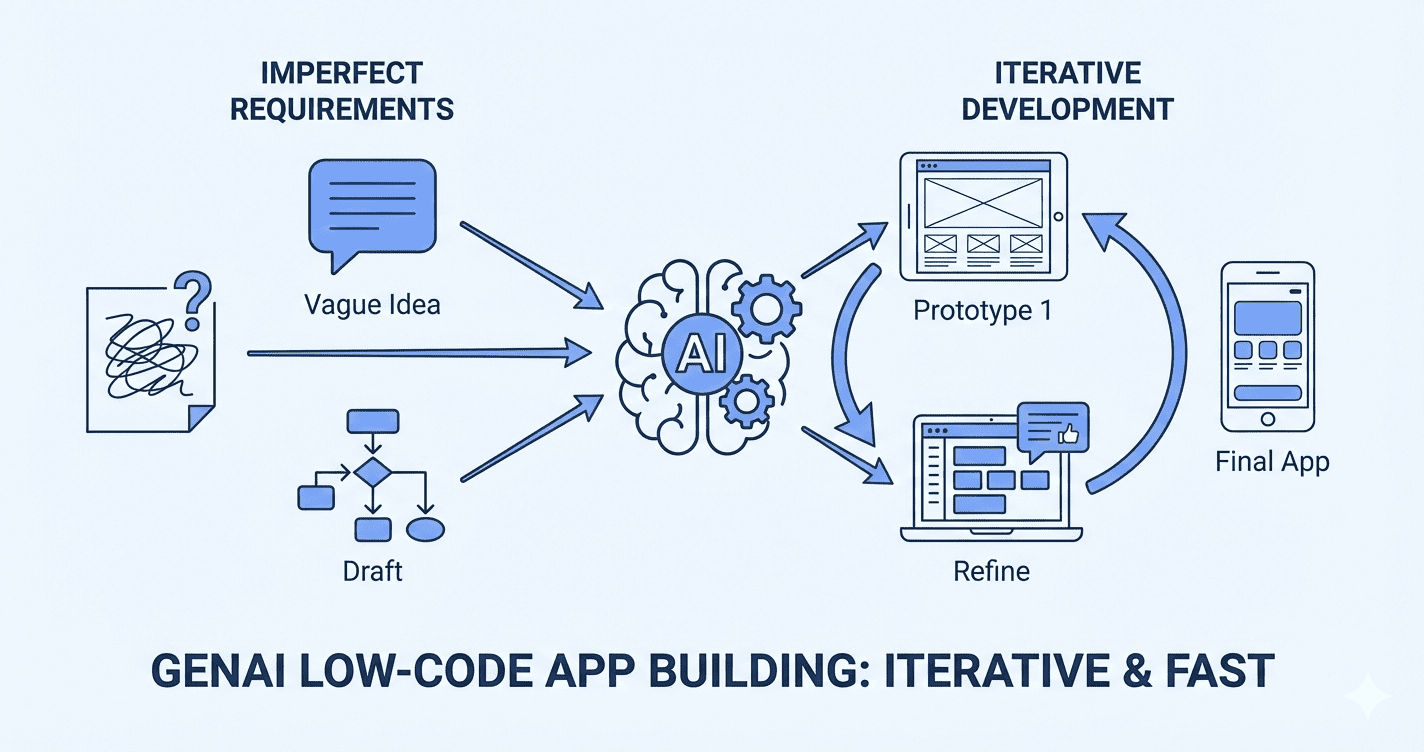
Step 1: Capture a high-level requirement (1–2 paragraphs)
No templates. No BRDs.
Just describe the process.
Step 2: Generate an MVP automatically
The system produces a functional blueprint:
- Data objects
- UI screens
- Workflows
- Basic logic
- Approval routes
All in minutes.
Step 3: Deploy instantly
Teams see and use the workflow on day one.
Step 4: Gather real feedback
Real users interacting with real screens generates far more clarity than weeks of meetings.
People finally say:
- “This step happens before that.”
- “This team shouldn’t see this field.”
- “We need a status between Draft and Approved.”
- “This SLA must be five hours, not 48.”
Step 5: Apply changes via natural language
Instead of rebuilding manually, the platform accepts plain-English edits:
- “Add a review step before approval.”
- “Make status changes trigger an email to the requester.”
- “Restrict this field to HR only.”
Step 6: Regenerate → redeploy
Fresh version in minutes.
Iteration cycles shrink dramatically.
This is the opposite of how traditional projects run.
In the old world:
Months → build → UAT → changes → rework → launch.
In the new world:
Requirement → draft build → usage → refinement → usage → refinement → go-live.
And this is the moment when citizen development actually becomes possible.
Because the barrier to building (the perfect requirement) disappears.
Now, the question becomes: how do we make this practical inside a real enterprise?
How Amoga Makes This Practical for Enterprises
Let’s get concrete.
There’s a difference between showing a vision and making it work at enterprise scale.
Here’s what we’ve built at Amoga, and why it matters for real business teams and IT leaders.
First, AI interprets even vague requirements and converts them into a working app:
- The data model (objects, fields, relationships) are auto-generated
- UI pages (forms, lists, task views, approval flows) are built out of the box
- Workflows (who does what, when, and how) gets mapped from your process description
- Automation (Python scripts or business rules) are ready for editing or extension
Instead of a wall of configuration screens, you get plain-language editing:
Want a new approval step?
Just type: “Add content head approval after the content writer.”
Need an alert? “Send an email to the requester when the task status changes.”
This is real AI-powered app development.
But the real difference for enterprise IT is control:
- Every app version is saved. If something breaks, you can roll back instantly.
- Audit trails track who changed what, and when (no “shadow IT” or mystery automations).
- Enterprise digital transformation tools only work when governance is built-in, so we made sure IT can:
- Set data access rules
- Approve publishing of critical changes
- Enforce security and compliance standards
You can use Amoga for CRM, HR processes, field ops, procurement, audit, mrp, and more.
We’ve seen business teams build a working MVP in under an hour, and keep iterating based on live user feedback.
That’s where you see the real power of citizen development in enterprises.
For IT, the pressure finally shifts from being the “requirements translator” to being the guardian of standards, security, and scale.
Over time, you see a real culture shift:
- Teams digitize faster.
- Experiments become normal.
- Improvement becomes constant-not a once-a-year thing.
- People get used to iterating with real data, not in abstract meetings.
The fear of “breaking something” is gone because rollback is instant and governance is built-in.
There’s no waiting on massive PRDs, no lost months, and no endless clarification meetings.
And at the heart of it, that’s the promise of GenAI low-code no-code platforms like Amoga:
- They make requirements a bridge, not a barrier.
- They let business and IT move together, at the speed of change.
When requirements stop being a barrier, citizen development finally works- and Amoga makes it possible.
Reserve a 30-minute demo tailored to your workflows.