Applications & operations Perspective
Delight Customers: Automate with Low-Code/No-Code Platforms
The pithiest truism in the world of business is perhaps this: Sales trump all. There’s a reason for that. Getting one sale is achievable. But low-code.

In this article 0 sections
The pithiest truism in the world of business is perhaps this: “Sales trump all.”
There’s a reason for that. Getting one sale is achievable. But businesses are built on repeat sales. The second sale (just like the second album for a rock band) is the real test. We live in a world where the customer holds the money, the knowledge, and the drive to find what’s best for them. They will stay loyal to your brand under one condition: if you delight them and surpass their expectations. Brands that fail to do this soon find their luck running out as customers flock to other businesses that understand the power of customer experience and its capacity to delight.
Customer delight is what keeps sales coming. It’s when every time your customer thinks of you, they have positive thoughts. This happens only if you take control and ensure that the customer feels like more than just a ‘category’-they feel recognized as individuals. All interactions between your business and the customer must be personalized while remaining efficient. Otherwise, operational complexity can become unmanageable.
The PEOPLE who represent your business (salespeople, customer support, account managers, etc.) need to operate in a way where ‘going the extra mile’ becomes ‘business as usual.’ But achieving this consistently is easier said than done, and maintaining it over time is even harder.
For the last 50 years, the big challenge in business has been: How do you deliver great customer experiences, delight every customer, and do it at scale? The essential question is: Can you turn slow, hard-to-scale, error-prone tasks into positive interactions that help customers? Can you automate customer experience (CX)? If you can, then you can automate customer delight as well. Let’s delve deeper and explore what Customer Experience Automation (CXA) truly is.
What is CXA?
First, let’s make one thing clear: CXA is not a technology or an application; it is the pursuit of a state of systems.
Understanding the Core of CXA
It helps to think of customer experience automation as a set of four concentric circles.
Orchestration: This is at the very core. Simply put, orchestration means that although your business has many departments, each with numerous people and varied responsibilities, to the customer, you are a single entity. Every interaction a customer has with your business must seamlessly connect with the next. This requires an overarching layer of orchestration across all your operations. When done right, this ensures that every customer engagement happens at the right time and in a relevant manner.
Personalization: Once the orchestration challenge is solved, the next step is to personalize customer interactions. This means that, in addition to feeling coherence in their interactions, customers should feel that their experiences are tailored to them. They should sense that you understand them, know what they want, and respect that. Achieving this means that every customer interaction feels unique and meaningful.
Segmentation: This is the first step towards adding scalability to customer experience automation. Segmentation involves grouping customers based on shared characteristics so that communication can be tailored at the group level while still being perceived at the individual level.
Automation: The final layer in the pursuit of scalability is automation. Think of this as using chatbots and sophisticated workflows to handle common, high-frequency tasks. This frees up the mental space and time of human agents, enabling them to focus on more complex issues.
Why Has CXA Been Difficult to Achieve Until Now?
Explaining the concept of customer experience automation is the easy part. It’s straightforward to agree with in theory, but IT leaders know this ambition is lofty. They are, rightfully, sceptical-and for good reason. Over the past 30 years, every business application has promised a different version of this capability and failed to deliver to business users. The core reason for this failure is simple: these applications are built on a high-code paradigm.
Exploring the Evolution of Customer Experience Automation
Customer Experience Automation (CXA) has evolved significantly over the years, transforming how businesses engage with their customers. Initially, the focus was primarily on software development, where traditional high-code applications dominated the landscape. These systems offered limited flexibility and were often cumbersome to adapt to changing business needs. However, as the demand for seamless customer interactions grew, the limitations of high-code applications became apparent. This led to the rise of process automation, enabling organizations to streamline operations and enhance operational efficiencies. Modern advancements in technology have now paved the way for Low-Code/No-Code (LCNC) platforms, which empower businesses to create agile, user experience-oriented, customer-centric solutions without the extensive coding requirements of the past. This evolution has made it possible for companies to achieve greater scalability and responsiveness in their customer experience strategies.
The Limitations of High-Code Applications
The high-code nature of traditional business applications means they are difficult to customize to meet evolving business needs. To modify or adapt these systems, a full-fledged team of expert software developers, well-versed in specific software libraries, is required to create custom applications that effectively meet organizational demands. Finding and maintaining such a team-whether in-house or through a vendor-is costly and cumbersome.
Even worse, making even the smallest changes can be a long, drawn-out process that takes months. As a result, within a year of adopting a new application, users get accustomed to working within the system’s constraints, rather than considering what could be possible. They know that initiating changes is so arduous that they stop envisioning improvements. Soon, businesses find themselves trapped in their IT ecosystems, tackling only the most pressing issues. The idea of truly reaping the benefits of a digital work paradigm becomes a distant dream.
Why Low-Code/No-Code (LCNC) Platforms Change the Game
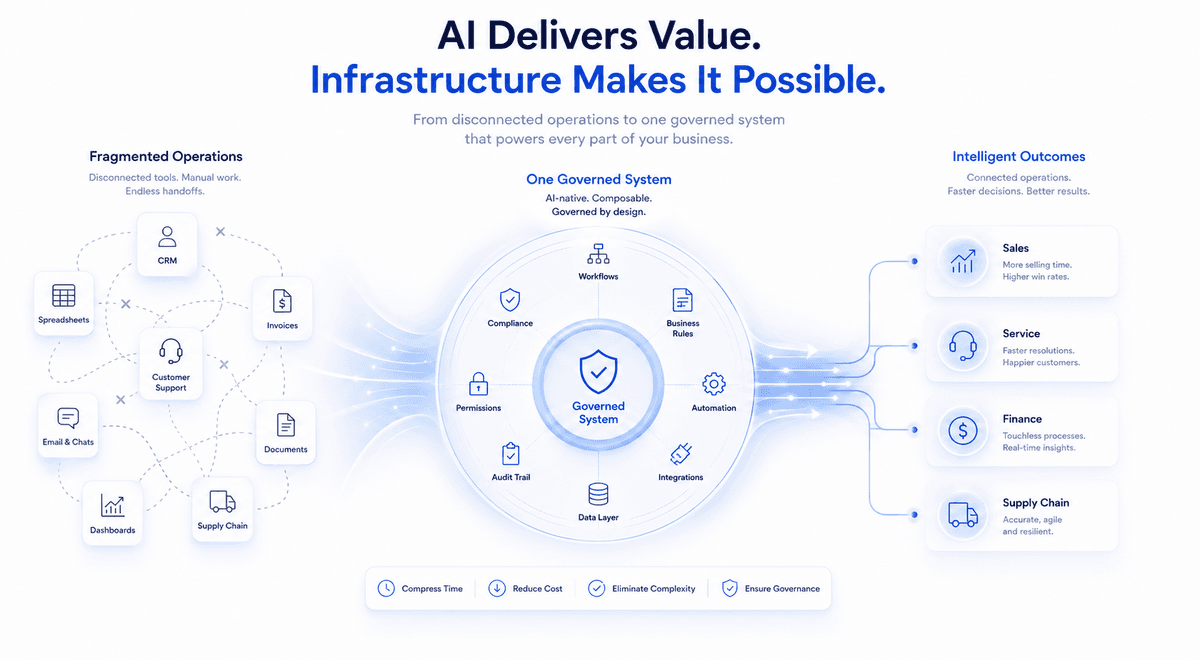
This is where Low-Code/no-code (LCNC) platforms come in. They move away from the high-code approach and simplify the process. LCNC platforms offer a path to faster, more flexible development and customization, allowing businesses to automate customer experience with modern user interfaces without the hurdles of traditional, high-code software solutions, even for users with limited technical expertise or coding experience. Instead of writing extensive lines of code, businesses can leverage these platforms. And this is why, for the first time, the vision of scalable customer experience automation is within reach.
The Power of Low-Code/No-Code (LCNC)
a man is standing next to a robot and a tablet
Low-Code/No-Code (LCNC) platforms are transformative. They break away from the high-code paradigm that has held businesses back for decades. Why is this revolutionary? Here are two critical ways LCNC reshapes how end users and IT teams work:
Empowering End Users: LCNC allows anyone familiar with WYSIWYG editors to create digital tools that streamline their work. This shift encourages teams to think proactively about ‘doing it right the first time’ and ‘automating all repeatable tasks.’ It moves the focus from reacting to immediate demands to anticipating solutions that enhance productivity.
Revolutionizing IT Teams: LCNC enables IT teams to concentrate on high-impact, innovative developments. Development takes 90% less time and costs 75% less, allowing the business to adopt a digital-first approach. IT teams can finally fulfil their core mission-driving substantial, transformative changes across the organization.
These are the foundations on which your business can build scalable customer experience automation (CXA). While this vision may seem ambitious, it’s attainable. Many operations managers still prioritize daily crises, but LCNC can shift this mindset.
At Amoga, we built our LCNC platform with this very vision. We knew another high-code platform with more customization layers wouldn’t suffice. That’s why we created a platform that’s simple, secure, and scalable. How you harness LCNC depends on your challenges. We’d love to help you explore if LCNC is the right fit. Request a no-obligation demo and discover this promising new world.
a man is standing next to a robot and a phone
Benefits and Drawbacks of LCNC Solutions
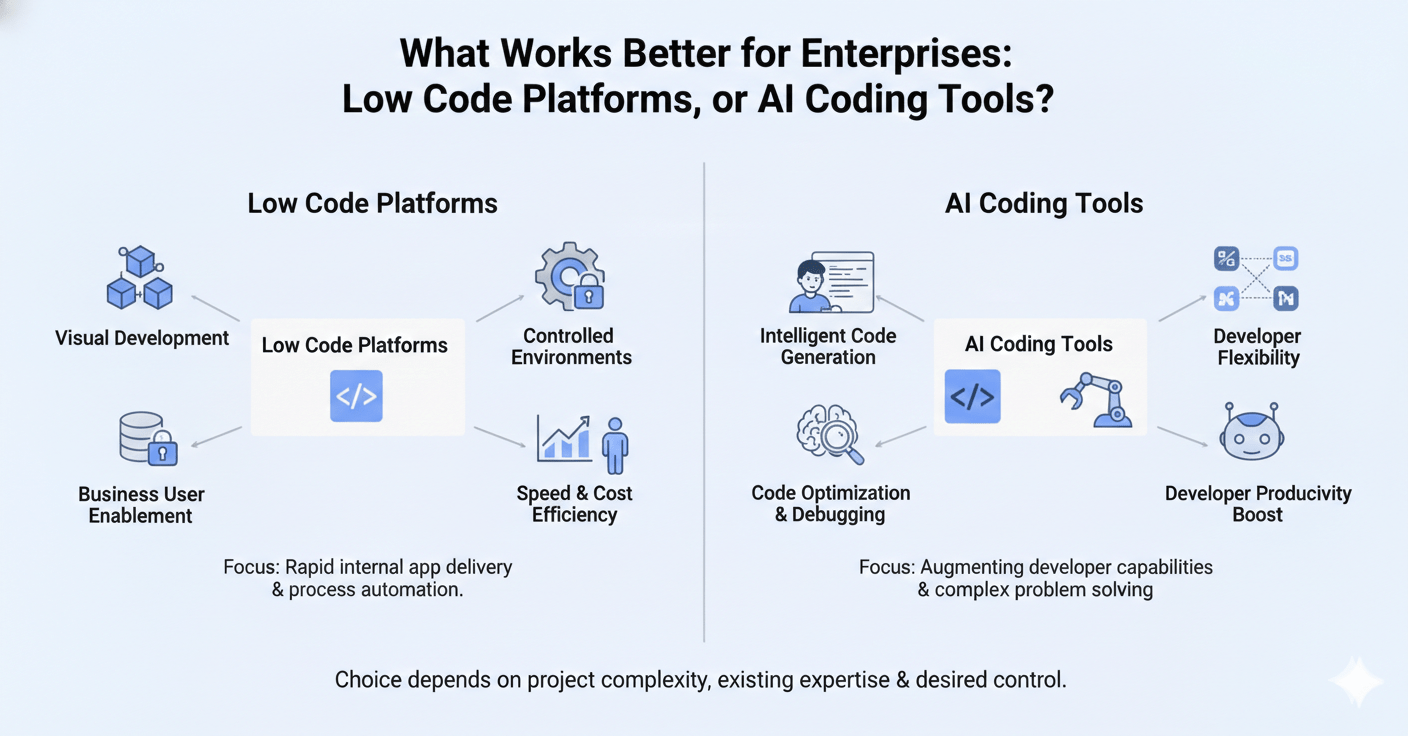
Low-Code/No-Code (LCNC) platforms offer a range of advantages that are transforming the way businesses approach application development in a manner similar to traditional software development. However, they also come with certain drawbacks that organizations must consider, especially in relation to market changes.
Development Costs: LCNC solutions significantly reduce development costs by enabling non-technical users to build applications without the need for extensive coding expertise, which ultimately leads to lower overall development costs for organizations.
Closer Collaboration: These platforms foster closer collaboration between IT and business teams, as they empower end users to take an active role in the development process.
Nontechnical Users: LCNC platforms democratize application development, allowing employees without technical backgrounds to contribute to creating solutions tailored to their needs.
Despite their benefits, LCNC platforms also present challenges. For instance, while they enable rapid development, the customization options may be limited compared to traditional coding approaches. Additionally, organizations must ensure proper governance and oversight to mitigate risks associated with shadow IT, where employees create applications outside of the established IT framework.
Integrating LCNC Platforms for Enhanced Collaboration and Reduced Costs
Integrating Low-Code/No-Code (LCNC) platforms into existing workflows can significantly enhance collaboration between business units and IT teams. By leveraging user-friendly low-code development tools that are intuitive, organizations can enable teams to quickly develop applications using code tools that address specific needs without waiting for lengthy development cycles. This agility not only accelerates project timelines but also fosters a culture of innovation, as employees are encouraged to experiment with new ideas and solutions.
Furthermore, LCNC platforms can lead to reduced operational costs. By minimizing the reliance on specialized IT resources for every application request, businesses can allocate their budget more effectively. This allows IT teams to focus on strategic initiatives rather than being bogged down by everyday development tasks, ultimately driving greater efficiency across the organization.
Navigating the Challenges of Low-Code and No-Code Platforms
While Low-Code and No-Code (LCNC) platforms provide numerous advantages, they also come with their own set of challenges. One significant concern is the rise of shadow IT, where employees create open source applications without proper oversight or alignment with organizational standards. This can lead to security vulnerabilities, including unauthorized access by malicious actors, and data management issues, as these applications may not adhere to established protocols.
Additionally, organizations may encounter challenges related to technical expertise. Although LCNC platforms are designed to be user-friendly, some degree of technical knowledge is often necessary to maximize their potential. Employees without a solid understanding of coding or application development may struggle to fully leverage the tools available, leading to suboptimal outcomes. Therefore, it is crucial for organizations to provide adequate training and support to ensure that all users can effectively utilize these platforms.
Utilizing LCNC for Rapid Application Development and Customization
Low-Code/No-Code (LCNC) platforms have revolutionized the landscape of application development, especially in terms of rapid application development using various programming languages. These platforms enable businesses to create custom solutions swiftly without the need for extensive coding knowledge. By utilizing user-friendly interfaces and drag-and-drop functionalities, organizations can design and deploy applications in a fraction of the time it would traditionally take. This agility empowers teams to respond quickly to changing business needs and market demands, ensuring that they remain competitive.
Moreover, the customization options available through LCNC platforms allow for tailored solutions that meet specific organizational requirements. Businesses can leverage pre-built templates and modules to create applications that align closely with their operational workflows. This not only enhances efficiency but also fosters a culture of innovation, as employees are encouraged to experiment and iterate on their ideas. Ultimately, LCNC platforms facilitate a seamless blend of rapid application development and customization, enabling companies to harness technology effectively to meet their unique challenges.
The Future of Low-Code/No-Code in Automating Customer Delight
As we look towards the future, the role of Low-Code/No-Code (LCNC) platforms in automating customer delight is poised to expand significantly. With advancements in technology, including artificial intelligence and machine learning (ML), new applications will emerge that further enhance the capabilities of LCNC solutions. These innovations will allow organizations to create personalized customer experiences at scale, ultimately driving customer satisfaction and loyalty.
Moreover, as businesses increasingly adopt digital-first strategies, the demand for LCNC solutions will likely continue to grow. Organizations that embrace these platforms will be better equipped to respond to changing market dynamics and customer expectations, ensuring they remain competitive in an ever-evolving landscape. By harnessing the power of LCNC, companies can unlock new levels of operational efficiency and customer engagement, paving the way for a more delightful customer experience.
Anticipating Next-Generation Technology in LCNC Solutions
As we look to the future, the integration of artificial intelligence (AI) into Low-Code/No-Code (LCNC) platforms is set to transform the development landscape further. In this digital age, businesses are increasingly seeking solutions that not only streamline processes but also enhance customer experiences. Artificial intelligence (AI)-powered features within LCNC platforms can automate routine tasks, provide intelligent insights, and offer personalized recommendations, all of which contribute to creating a more dynamic and responsive customer interaction model.
Additionally, the incorporation of advanced analytics will enable organizations to better understand customer behaviors and preferences, allowing for the development of highly tailored applications. This level of personalization is crucial in today’s competitive environment, where customer expectations are continually evolving. As LCNC platforms evolve, we can anticipate a shift toward more intuitive and adaptive technologies that empower users to create sophisticated applications with minimal effort. Embracing these advancements will be key for organizations aiming to maintain relevance and drive customer satisfaction in the coming years, ultimately leading to a more automated and delightful customer experience.
By harnessing these innovative technologies, businesses can not only accelerate their development processes but also enhance their overall customer engagement strategies. The future of LCNC is bright, and organizations that adapt to these changes will be well-positioned to thrive in the digital landscape.
FAQs on Low-Code/No-Code Development
Low-Code/No-Code (LCNC) platforms are becoming essential tools for businesses seeking to streamline their development processes. These platforms allow business analysts and other non-technical users to engage in application development and design their own applications using a low-code/no-code approach, without extensive programming knowledge, even those without technical expertise. With LCNC, organizations can reduce development work, improve collaboration, and respond more swiftly to customer needs. As these platforms continue to evolve, they will play a crucial role in shaping the future of application development and customer engagement strategies.
What are the main advantages of using low-code/no-code platforms?
Low-code/no-code platforms offer faster code development, reduced costs, and increased agility, addressing common business problems. They empower non-technical users to create applications with minimal coding knowledge, accelerating the delivery of solutions and enabling businesses to respond promptly to changing market demands.